
Cambodia Investment Review
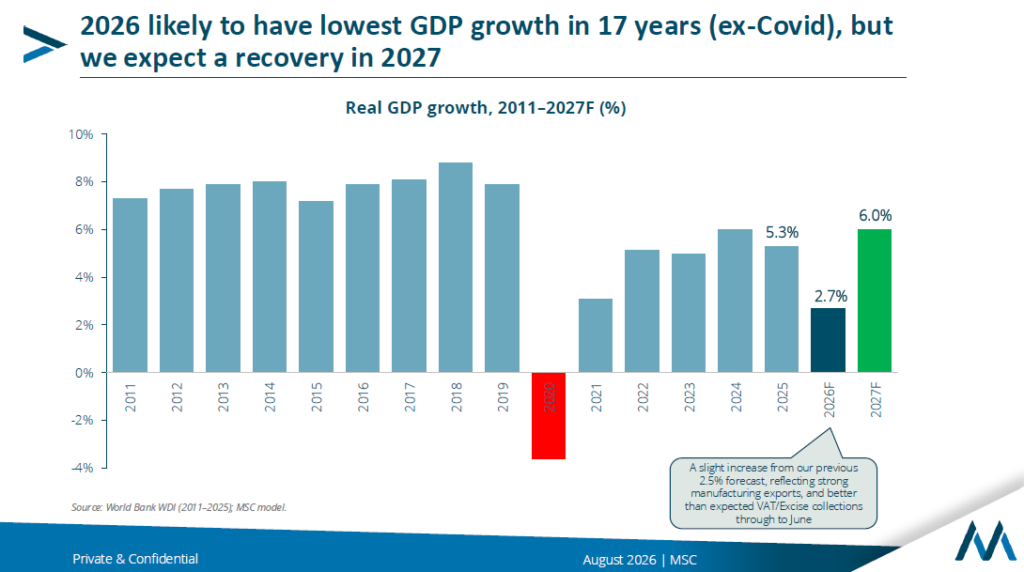
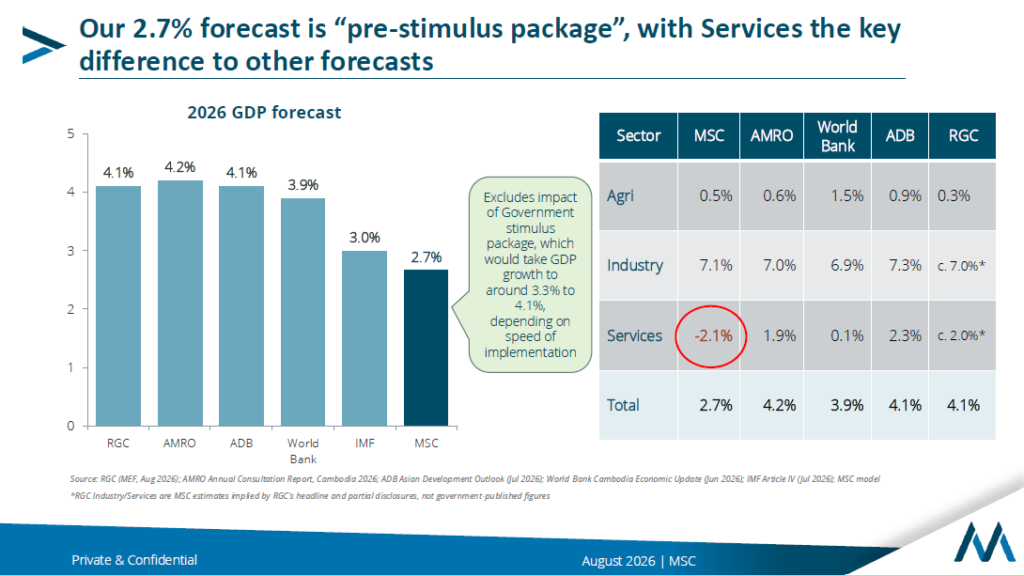
Cambodia’s economic growth could slow to 2.7 percent in 2026—its weakest performance in 17 years outside the Covid-19 period—as a sharp contraction in services offsets continued strength in manufacturing and exports, according to Mekong Strategic Capital (MSC).
The Phnom Penh-based advisory firm expects growth to recover to 6 percent in 2027, above forecasts from several international institutions, as tourism, financial services and real estate begin recovering from a weak 2026.
MSC described Cambodia as a “two-speed economy,” with industry forecast to expand by 7.1 percent this year while services contract by 2.1 percent.
Services Downturn Weighs on Headline Growth
MSC’s 2.7 percent forecast is below the Cambodian government’s 4.1 percent projection, AMRO’s 4.2 percent estimate, the Asian Development Bank’s 4.1 percent outlook, the World Bank’s 3.9 percent forecast and the International Monetary Fund’s 3 percent projection.
The difference largely reflects MSC’s more pessimistic assessment of the services sector.
Accommodation and food services are forecast to contract by 15.5 percent, with MSC assuming international tourist arrivals will fall by 27 percent and domestic tourism by 5 percent during the year.
Financial and real estate activities are projected to decline by 8 percent amid rising loan losses, property-market oversupply and increased loan restructuring.
Transportation and storage are expected to record no growth, while wholesale and retail trade are forecast to expand by just 0.6 percent.
MSC said the closure of online scam compounds was also reducing demand across property, telecommunications, transport, retail and other services. While the closures represent a law-enforcement and social gain, the report suggested they were creating a measurable short-term economic adjustment.
Manufacturing Remains Cambodia’s Main Growth Engine
Cambodia’s industrial sector is expected to remain resilient, expanding by 7.1 percent in 2026—almost matching Vietnam’s projected industrial growth of 7.5 percent.
Garments, textiles, footwear and leather production are forecast to grow by 6 percent as export orders hold up and fabric imports remain firm.
Other manufacturing could expand by 12 percent, supported by foreign direct investment and rising exports of food products, rubber, furniture, metals and non-metallic minerals.
Construction is forecast to grow by 2 percent. MSC noted that bank lending to the sector increased 13.3 percent year-on-year as of May, while lending specifically linked to real estate remained flat, suggesting that some activity was connected to productive construction rather than property transactions.
Agriculture, which accounts for approximately 13.6 percent of GDP, is expected to grow by only 0.5 percent.
Government Stimulus Could Lift Growth Toward 4 Percent
MSC said its headline forecast does not include the impact of the Cambodian government’s proposed economic stimulus package.
Depending on how quickly the measures are implemented, stimulus could lift growth to between 3.3 percent and 4.1 percent, bringing the outlook closer to the government’s projection.
The report said support directed toward services would be particularly important because industrial production is already performing strongly.
MSC estimated that Cambodia’s underlying growth potential would be close to 7.9 percent if four temporary shocks affecting the economy were removed. It did not expect all of those effects to disappear immediately, with some economic impact from scam-centre closures likely to carry into 2027.
MSC Forecasts 6 Percent Rebound in 2027
MSC expects growth to accelerate to 6 percent next year, compared with forecasts of 4.9 percent from AMRO and the World Bank and 4.7 percent from the ADB and IMF.
Industry is projected to expand by 7.9 percent in 2027, led by 13 percent growth in non-garment manufacturing. Garments, textiles and footwear are expected to maintain growth of approximately 6 percent.
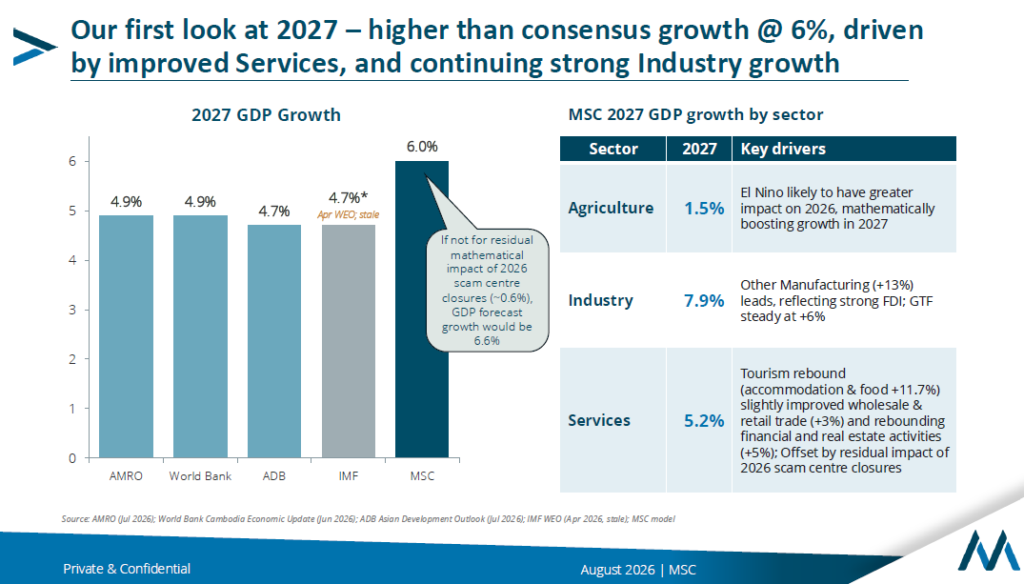
Services are forecast to rebound by 5.2 percent, driven by an 11.7 percent recovery in accommodation and food services, 3 percent growth in wholesale and retail trade, and a 5 percent expansion in financial and real estate activities.
However, MSC cautioned that even with a tourism rebound, activity may only return to 2025 levels and would remain below Cambodia’s longer-term potential.
Cambodia Becomes More Export- and Industry-Led
The slowdown comes as Cambodia undergoes a broader structural transformation.
Industry’s share of GDP has increased from 29.9 percent in 2014 to an estimated 47 percent in 2026. Agriculture’s share has fallen from 22.2 percent to 13.3 percent, while services have declined from 41.7 percent to 33.4 percent.
Industrial output per worker reached an estimated $6,744 in 2025, compared with $3,592 in services and $2,172 in agriculture.
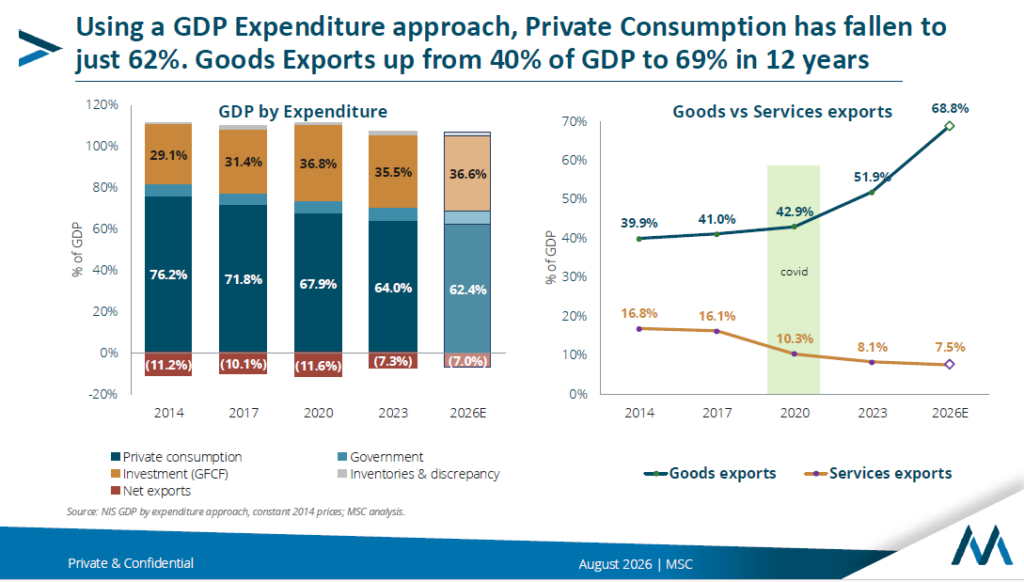
Cambodia has also become increasingly dependent on goods exports, which rose from 39.9 percent of GDP in 2014 to an estimated 68.8 percent in 2026. Services exports, meanwhile, declined from 16.8 percent to 7.5 percent over the same period.
MSC said the shift toward higher-productivity industry provides Cambodia with a stronger platform for medium-term growth, but the immediate outlook will depend on how quickly services recover and government support reaches the areas facing the greatest pressure.