

Cambodia Investment Review
Cambodia’s banking sector remains structurally attractive, but rising non-performing loans, heavy real estate exposure and high private-sector debt are creating growing risks for lenders, according to Moody’s Ratings.
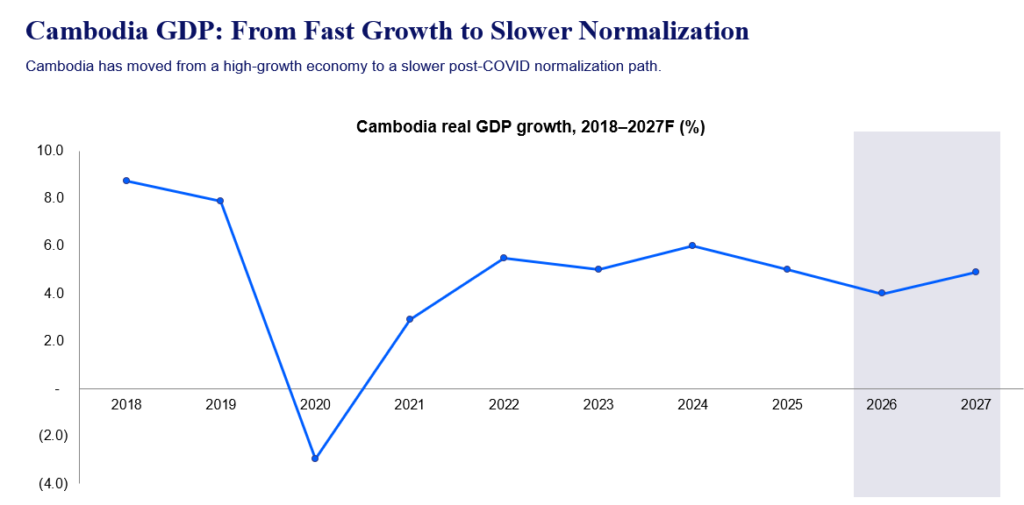
Cambodia’s banking system is entering a more difficult credit cycle as weak property conditions and slower economic growth push non-performing loans to their highest level in recent years, according to a new presentation from Moody’s Ratings.
Moody’s said the banking system’s non-performing loan (NPL) ratio reached 9.6% in June 2026, up from 8.3% at the end of 2025 and 2.4% in 2021.
The rating agency identified the clean-up of problem loans, high credit relative to gross domestic product, concentrated real estate exposure and widespread dollarisation as the sector’s principal challenges.
However, Cambodia’s banks continue to benefit from strong system-wide capital buffers, improving funding conditions and significant long-term growth opportunities from financial deepening.
The assessment was presented by Eugene Tarzimanov, Senior Vice President for Asia-Pacific Financial Institutions at Moody’s Ratings, under the theme “Cambodian Banks: Navigating Risks and Capturing Growth.”
Cambodia’s NPL Ratio Stands Out Across ASEAN
Cambodia’s 9.6% NPL ratio in June marked a sharp increase from 7.9% in 2024 and 5.4% in 2023, reflecting a prolonged deterioration in asset quality.
Based on end-2025 comparative data, Cambodia’s NPL ratio of 8.3% was already higher than most major regional banking systems assessed by Moody’s, including Mongolia at 7.3%, Thailand at 3.7%, the Philippines at 2.9%, Indonesia at 2.5%, Vietnam at 1.9% and Malaysia at 1.2%.
The rating agency also warned that headline NPL figures might not capture the full extent of credit stress because restructured loans represented approximately 9% of total lending.
This hidden layer of stressed credit could place further pressure on profitability if borrowers remain unable to return to normal repayment schedules.
Real Estate Weakness Emerges as Key Banking Risk
Property weakness remains the main channel through which Cambodia’s economic slowdown is affecting its banking system, according to the presentation.
Real estate accounted for approximately 22% of total loans at Cambodian deposit-taking institutions as of December 2025, the highest exposure among the regional markets included in Moody’s comparison.
The combination of a prolonged property downturn, slower construction activity and high lending concentration leaves banks vulnerable to falling collateral values and repayment difficulties among developers, investors and property-linked businesses.
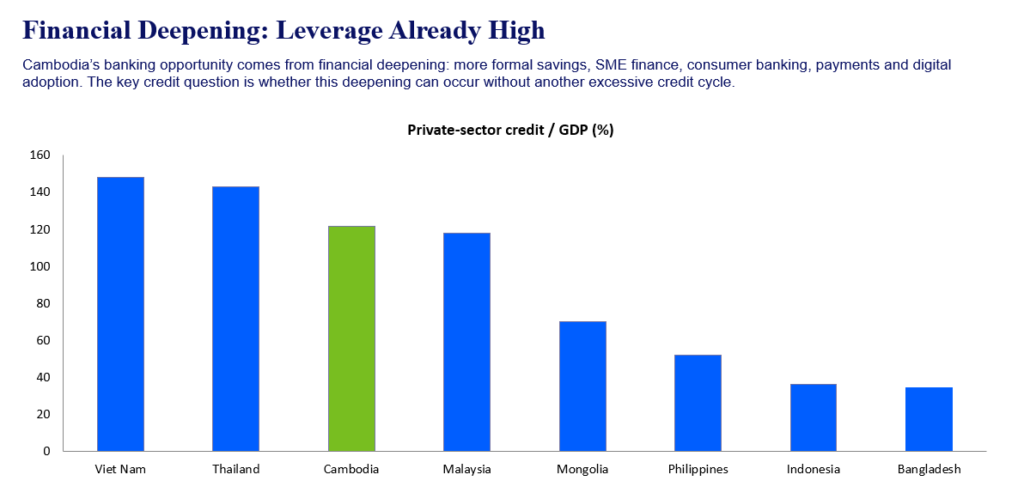
Cambodia also has one of the region’s highest levels of private-sector credit relative to GDP, at approximately 120%. Moody’s said this high level of financial leverage raised questions about whether further expansion in formal banking could occur without creating another excessive credit cycle.
Loan Growth Slows as Banks Become More Selective
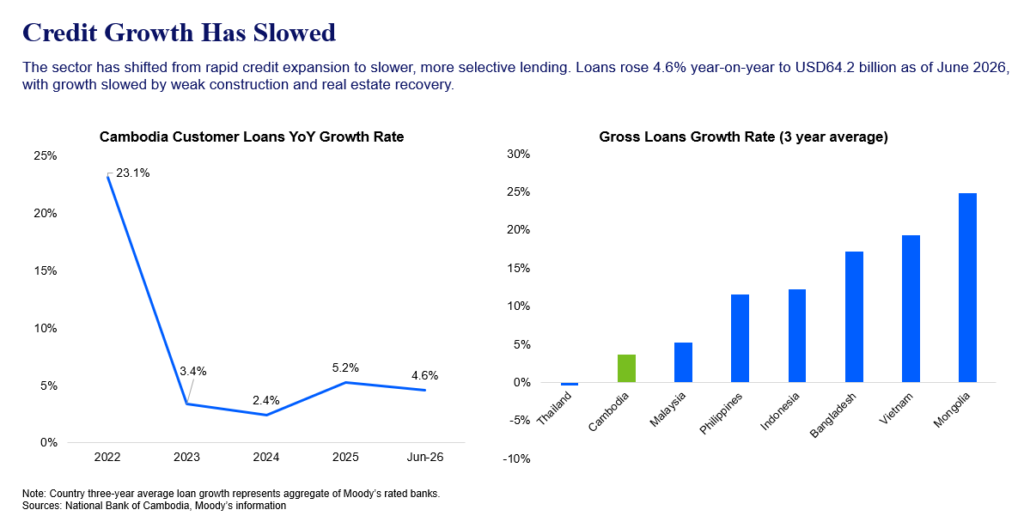
The banking sector has shifted from rapid credit expansion to slower and more selective lending.
Customer loans increased 4.6% year-on-year to US$64.2 billion in June 2026, compared with annual growth of 23.1% in 2022. Lending growth slowed to 3.4% in 2023 and 2.4% in 2024 before recovering moderately to 5.2% in 2025.
Customer deposits, meanwhile, rose 4.4% year-on-year to US$64.4 billion in June, continuing to support system liquidity.
Cambodia’s loan-to-deposit ratio stood close to 90%, broadly in line with regional peers and representing an improvement from previous years.
The funding position is particularly important because Cambodia’s highly dollarised financial system limits the National Bank of Cambodia’s ability to act as a conventional lender of last resort during periods of severe US dollar liquidity pressure.
Foreign currency deposits account for close to 90% of total deposits—far above other banking markets covered by Moody’s. Dollarisation helps reduce local-currency volatility and supports depositor confidence, but also limits monetary-policy flexibility.
Capital Buffers Provide Protection
Despite rising credit risks, Cambodia’s banking system remains supported by comparatively strong capital levels.
The country’s core capital ratio stood at approximately 20% in the first half of 2025, placing it among the strongest of the regional systems assessed by Moody’s.
However, the rating agency cautioned that system-level capital strength does not mean risks are distributed evenly across all institutions. Banks with weaker loan portfolios, high property exposure or limited pre-provision earnings could face greater pressure as credit costs increase.
Profitability is also expected to remain under pressure as slower lending growth and higher provisioning requirements offset the benefits of Cambodia’s continued financial development.
Regulatory Reforms Could Strengthen System Over Time
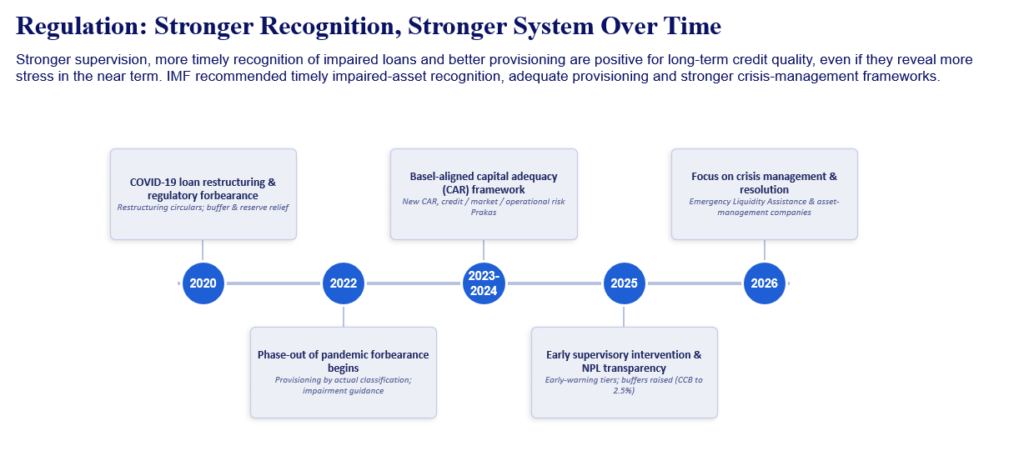
Moody’s said stronger supervision, earlier recognition of impaired loans and adequate provisioning would support the banking sector’s long-term credit quality, even if the measures reveal additional financial stress in the near term.
Cambodia has gradually phased out pandemic-era regulatory forbearance, introduced Basel-aligned capital requirements and strengthened early supervisory intervention and NPL transparency.
The authorities are also increasing their focus on crisis-management and resolution frameworks, including emergency liquidity assistance and potential asset-management mechanisms.
Moody’s concluded that Cambodia retains a structurally attractive banking market, supported by opportunities in formal savings, SME finance, consumer banking, digital payments and broader financial inclusion.
However, the sector’s ability to manage its NPL clean-up, absorb higher credit costs and reduce risks associated with real estate concentration will determine whether it can move into its next phase of growth without triggering another excessive lending cycle.