
Cambodia Leadership Review
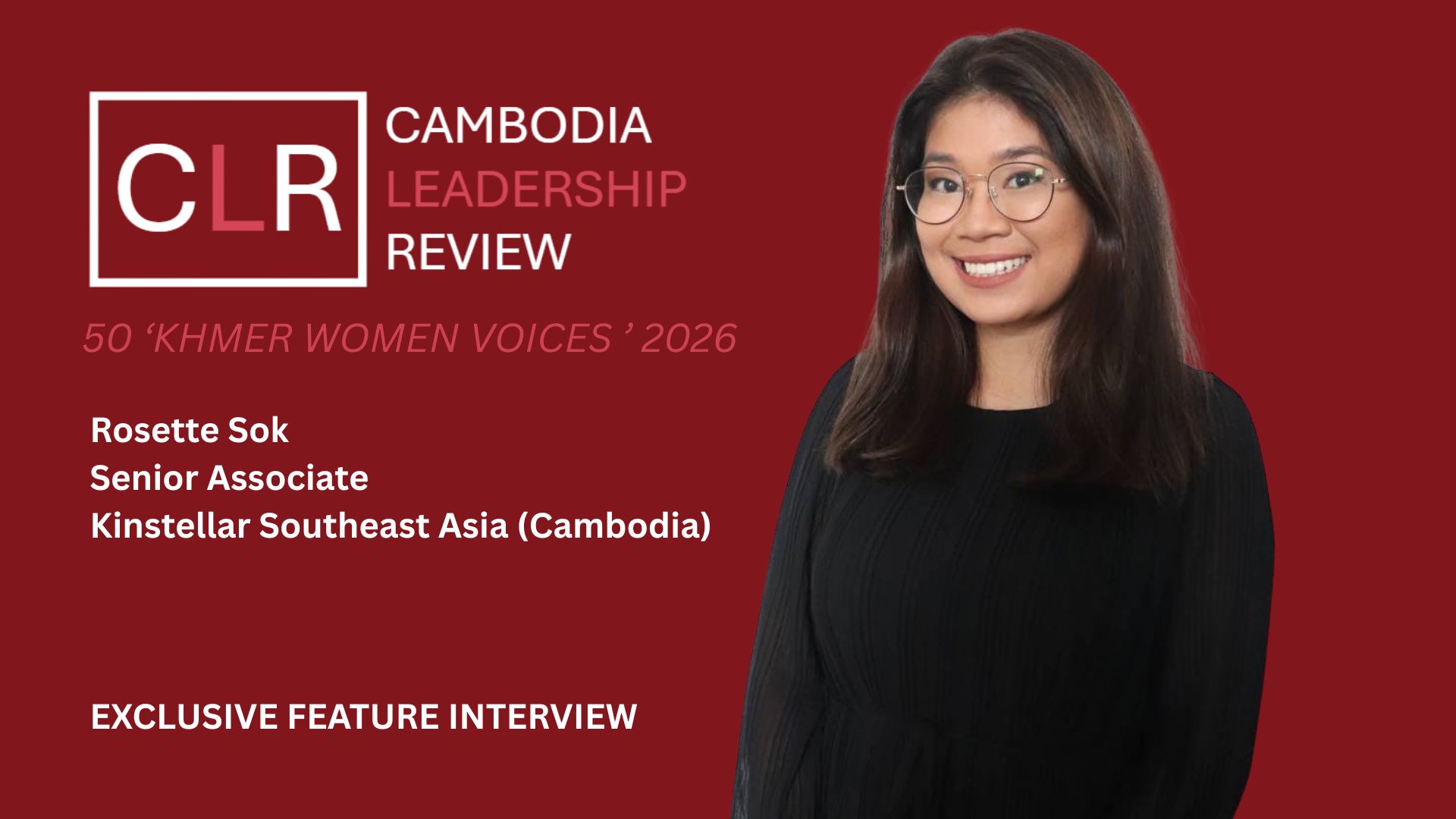
As Senior Associate at SokSiphana Sethalay in association with Kinstellar Southeast Asia (Camboda) in association with Sok Siphana Sethalay Law Office, Rosette Sok advises local and international clients on corporate law, mergers and acquisitions, and cross-border commercial transactions.
She has built her career supporting businesses and investors as Cambodia’s legal and investment environment continues to evolve. Rosette believes the future of Cambodia’s legal profession will be shaped by stronger leadership, international collaboration, and creating more opportunities for women to progress into senior roles. She is also passionate about mentoring young professionals and supporting the next generation of legal talent.
In this edition of 50 Khmer Women Voices 2026, Rosette reflects on the changing role of women in Cambodia’s legal profession, the evolution of the country’s legal environment, authentic leadership, and her advice for future women leaders in law.
Women in Cambodia’s Legal Profession
CLR: How have you seen the role of women evolve within Cambodia’s legal and professional services sector over the years, and what progress still needs to be made?
Rosette: Beyond numbers, there has been a noticeable evolution in the nature of women’s participation in the legal and professional services sectors. Women today are increasingly taking on client-facing responsibilities, leading complex transactions, managing teams and key client relationships, and playing active roles in cross-border matters. This is in line with a growing societal acceptance and celebration of women pursuing demanding careers and having leadership ambition.
International exposure in these sectors has certainly played an important role in this progression in Cambodia – working with global clients and cross-border transactions exposes us to more diverse and inclusive leadership and deal teams. Opportunities like secondments and regional collaborations also help shape these broader perspectives on leadership.
The challenge today is less about entry but more about sustained progression into senior leadership roles. Unfortunately, there are still systemic barriers and biases in place that result in fewer women progressing into partnership or executive leadership position.
Women continue to face disproportionate expectations around caregiving responsibilities, both outside and at work. In the office, for instance, female leaders may be expected to shoulder a greater share of the emotional labour within teams, such as giving more consideration to managing team wellbeing and interpersonal dynamics – responsibilities which are valuable but not always recognised or rewarded in the same way as more objective or traditional measures of performance.
Challenges also remain in overcoming entrenched perceptions of authority and leadership.
Assumptions may occasionally be made that younger female lawyers in deal teams only play a small supporting role, rather than serving as one of the key advisers on the deal. This type of unconscious bias can create an additional hurdle in female leaders being afforded the same level of credibility and trust. I have been very privileged in my life to have been surrounded by strong women, personally and professionally. Now, as I lead a team of mostly young females, I feel a sense of responsibility towards helping to build a strong pipeline of capable women in the legal profession.
Mentorship and creating opportunities for meaningful professional development is important not just for their individual careers, but for the long-term strength and sustainability of the profession as a whole. Going forward, the focus should be on genuine inclusion and influence. This requires active advocacy from strong leaders in promotion and client-facing opportunities, and firm cultures that intentionally support and retain female talent throughout their careers. Ultimately, meaningful progression should be measured not by how many women there are in the profession, but by how many are empowered to lead.
Cambodia’s Evolving Legal Environment
CLR: As Cambodia’s economy continues to develop and attract investment, how is the legal profession evolving to meet the changing needs of businesses and investors?
Rosette: As Cambodia’s economy continues to mature and integrate more deeply into regional and global markets, the legal profession has had to evolve significantly alongside it.
One of the more notable developments has been the growing complexity of transactions and regulatory frameworks. Cambodia continues to attract sophisticated clients who place greater emphasis on regulatory compliance, corporate governance, risk management and ESG considerations, which has broadened the scope of legal advisory services.
This requires lawyers to navigate both domestic legal requirements – which are constantly evolving – and international standards.
An equally important trend is the increasing sophistication of Cambodian businesses themselves. While much attention is often placed on foreign investment into Cambodia, we are also seeing a growing number of local businesses and conglomerates with financial strength, operational capability and strategic ambition to expand within and beyond Cambodia.
As these companies look to enter new markets, pursue cross-border acquisition, establish regional operations or seek international financing, they face many of the same legal, regulatory and governance considerations as multi-national investors. As advisers, the firm is increasingly supporting Cambodian businesses, not only in their domestic growth, but also in navigating the complexities of regional and international expansion, which reflects the continued maturation of Cambodia’s private sector and the broader economy. Being part of an international platform, we are placed in a particularly strong position to support the evolving needs of our domestic and foreign clients.
Through our regional and global network, with Kinstellar and Kinstellar Southeast Asia, we are able to draw on international best practices, sector-specific expertise and experience from other emerging markets that may be facing similar legal and commercial challenges. We work alongside and learn from colleagues across multiple jurisdictions on cross-border transactions, enabling us to provide advice that is both locally grounded and aligned with international expectations. This is particularly valuable for our clients who seek advisers capable of bridging local requirements with global standards of governance, compliance and transaction management and execution.
Leadership in Law and Business
CLR: The legal profession often requires balancing technical expertise, leadership, and client relationships. How do you personally approach leadership within a fast-moving and demanding industry?
Rosette: For me, leadership is fundamentally an exercise in self-awareness and continual self-development. Early in life, I have always held a fairly conventional view of leadership. I associated it with a particular archetype – someone decisive, dominant, unwaveringly confident and often the loudest voice in the room – all qualities which I never felt I had or could be. I also believed leadership was something one had to fully possess and know how to do before stepping into a leadership role. As a young female, I have always felt that I needed more experience, more certainty or simply more time before I, and by extension, others, could legitimately consider myself as someone ready to lead.
In the past year, I have learnt that the most effective leaders are perhaps those who possess the self-awareness to understand who they are, the confidence to trust in that understanding and the discipline to lead in alignment with it. One of the most enduring lessons I have learnt from my dad is that, when faced with a difficult decision, you should choose the course of action that allows you to sleep peacefully at night. Over time, I have come to view that as a simple but powerful test of integrity in leaders. It is a reminder that leadership is not merely about achieving outcomes, but about the manner in which you treat and lead others, which will always be a reflection of who you are, internally.
What I have learned is that leadership does not begin once you have all the answers. More often, it begins when you are willing to step forward despite not having them. I was lucky to have been given a leadership role at my firm quite early on in my career. I quickly learned that the challenge was not simply learning how to lead others but learning to trust myself to do it well. I had to develop, very quickly, an understanding of who I was, my values, what principles guide my decision-making and the type of leader I wanted to be. Rather than trying to conform to society’s model of leadership, I had to find a style that was authentic to me, while still earning the trust, confidence and respect of my colleagues and my clients.
We have often been conditioned to view leadership as something external – as a set of behaviours, actions or qualities exercised over others. My experience has been the opposite. Leadership is built through developing internal clarity. One of the greatest benefits of maturing, professionally and personally, is the gradual process of becoming more comfortable in your own skin and more secure in your identity.
Leadership begins when you develop a clear understanding of who you are and what you stand for, and when you learn to trust in that foundation.
That internal clarity then translates outwards. It influences how you respond under pressure, how you navigate your team under uncertainty, how you build credibility with clients and how you create an environment in which others can develop and succeed. In a fast-moving and demanding industry, my approach has always been to stay anchored internally, in a set of values and principles that remains constant, even when my external circumstances are not.
Advice for Future Women Leaders in Law
CLR: What advice would you give to young Cambodian women hoping to build long-term careers in law, corporate advisory, or professional services?
Rosette: One of the most valuable things that you can do is to learn to be secure in who you are. Take the time to understand your strengths, your values, your motivation and the way you work best – not just as a professional, but as an individual.
The more grounded you are in your sense of self, the less likely you are to be unsettled by self-doubt, comparison or external perceptions of success.
That sense of stability will become an important source of resilience throughout your career.
Learn to recognise and trust in your own value, as well. Every person brings something unique to the table, whether it’s their perspective, work ethic, judgment, empathy, creativity or ability to connect with others. Early in your career, it can be tempting to believe that having confidence comes from having all the answers. In reality, confidence comes from trusting that you will be capable of learning, adapting and growing when the time comes.
I have not had a particularly long-career yet, but I have come to appreciate that any long-career will be built through consistency, integrity, perseverance and the ability to pivot and bounce back when things don’t go as planned.
Supporting the Next Generation of Legal Talent
CLR: What can law firms, universities, and the wider private sector do to better support young Cambodian women entering the legal profession today?
Rosette: Law firms, universities and the wider private sector have already made significant progress in creating opportunities for young women to enter the profession. The next step is to focus on how we support them once they are there.
A great deal of emphasis is rightfully placed on developing technical excellence, but there can be less discussion occurring around the interpersonal and emotional skills that are equally critical to long-term success. Skills such as emotional intelligence, confidence, communication, resilience and self-awareness are essentially for effective leadership, yet they are rarely taught in a structured way.
This can be particularly important for young women, who face unique pressures around confidence, credibility and leadership expectations as they progress through their careers. Rather than characterising these as “soft skills” – a term which can at times suggests peripherality – we should recognise these as being fundamental leadership competencies that are essential to building high-performing teams.
Mentorship is also critical. Young women benefit enormously from seeing other women from different socioeconomic backgrounds who have successfully navigated similar challenges and from having access to mentors who can provide guidance and honest conversations about career progression.
Law firms, universities and the private sector can create more structured opportunities for these connections through mentoring programs, networking initiatives and leadership development programs.
Equally important is fostering a culture that views female success as collaborative rather than competitive. As a society, we need to move away from the idea that one woman’s success needs to come at the expense of another.
The goal should be to build a strong pipeline and community of talented and capable women who support and create opportunities for one another.
When one of us shines, we all shine.
When I look back on my career several decades from now, I hope I will consider it to be successful not simply because of the positions I held or the transactions I worked on, but because I positively impacted the people around me.
I am very lucky to have had strong women pave the path for me – especially, my mom – and I will believe that my career has been successful if any women I work with, mentored or lead go on to become exceptional professionals and leaders themselves. More than any measurable key performance indicator, leadership is about creating opportunities for others and to help them realise potential that is even greater than your own.
Explore the complete Cambodia Leadership Review – 50 Khmer Women Voices 2026 featuring exclusive interviews with Cambodia’s Top 50 Khmer Women leaders. Discover their journeys, leadership lessons, and vision for the Kingdom’s future.