

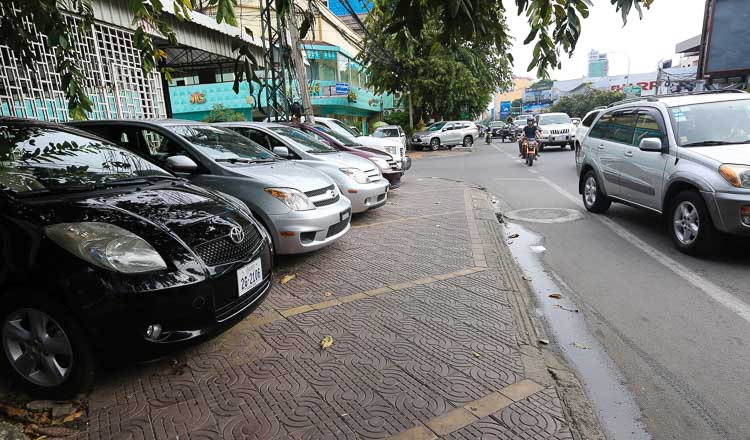
Anyone who has tried to walk in Phnom Penh knows how impossible it is to stay on the sidewalks. Be it a residential street, a busy commercial thoroughfare, or even a prominent boulevard, parked cars choke sidewalks, forcing pedestrians to make detours.
Private developers and City Hall have tried to alleviate the issue by constructing more parking spaces. Yet, no matter how much parking space is constructed, there never seems to be enough. Currently the city has less than 0.98 square kilometers of registered parking space. According to my estimation, the parking area required for all private vehicles in Phnom Penh is 22.8 square kilometers, or roughly the size of Russey Keo district.
Parking spaces are in short supply, and with private vehicle ownership continuing to rise, the issue will become more acute. Yet adding more parking to a city, although obvious, is not the orrect solution. In fact, too much parking can lead to a number of problems, as I have written previously.
With Phnom Penh on average having about one car and four motorcycles for every household, it would make more sense to carefully control the number of private vehicles, thus reducing congestion, pollution, and danger posed by vehicles.
Measures to curb the growing ownership of private vehicles, especially in dense urban centres like Phnom Penh, can take many forms. The government could revise its annual vehicle tax to be based on weight in order to curb the growth of large and heavy vehicles, apply congestion pricing in central areas of the city, improve public transit, redesign street layouts to better suit active commuters, and revise land-use planning. However, these approaches alone are not sufficient and must be complemented by more direct measures.
Regulating Vehicle Ownership
Directly regulating the number of private vehicles is another policy option for Cambodian planners. This concept has been implemented effectively in many cities, although some systems are stricter than others.
The largest Chinese cities, where congestion and pollution are critical issues, impose a requirement on potential buyers to receive an ownership license or permit. For example, in Beijing, buyers apply for a quota that is distributed through a lottery, whereby no monetary transaction is required but waiting times are often very long. Meanwhile, Shanghai uses a plate auction system, whereby participants bid for a limited number of vehicle plates available, resulting in costly bids for buyers but generating revenue for the city.
Singapore utilizes a certificate of entitlement (COE) to carefully manage the growth of its private vehicles and generate revenue for its public services. In this system, prospective car owners must bid for a COE that grants them a 10-year permit to own a car. The COEs are not transferable to another car, and when the time period is up, they can either bid for an extension permit or deregister their vehicle for scrapping or export.
Although effective in limiting car growth in urban areas and, in some cases, generating revenue for their respective governments, such restrictive policies have raised concerns about the impact on welfare, increasing financial costs to obtain the license or entitlements, and unfairness in the bidding process, which favors wealthy citizens.
Choosing a Methodology that Works for Cambodia
Cambodia’s circumstances do not warrant stringent vehicle quantity regulation policies. Indeed, Japan utilizes a less restrictive proof of parking methodology, which is a non-tax/fee approach whereby obtaining a garage certificate, or “shako shomeisho,” is based on the parking space available to the household.
The primary barrier that may hinder vehicle ownership is not paying a large monetary cost, which may lead to corruption, mismanagement, or loopholes exploited by affluent individuals; instead, ownership is based on the physical space in which a household has to store a private vehicle.
This policy targets car ownership in dense urban areas, where private parking is limited and leased parking prices are high. Consequently, it deters car ownership precisely where car ownership is least necessary and most negatively impacts the city.
The impact of such a policy is evident in Japan, with urban dwellers primarily depending on public transportation, while car ownership is easily obtained by farmers and rural residents who have plenty of space for parking. Likewise, businesses and services that rely on vehicles are less disrupted, because they typically have ample garage space.
Although the three case studies share the same goal at the macro level, namely restricting vehicle numbers in cities, each method offers distinct advantages and disadvantages. Singapore’s and Shanghai’s approaches drastically cap vehicle ownership, are more predictable to obtain than Beijing’s lottery system, and generate significant revenue, but their approach also requires strong enforcement and governance while giving wealthy residents an unfair advantage.
Thus, Japan’s lenient and flexible approach is more suitable for Cambodian policy-makers to consider. Cambodia should adopt an approach based on the physical availability of parking spaces. This is a non-monetary method that is fairer for residents and businesses, especially those in rural areas who rely on vehicles for transport and work. Moreover, it would mean that the number of private vehicles should reflect the actual parking space available in the city while avoiding the hard quotas set by central authorities using other methodologies.
Implementation of a Garage Certificate
In practice, this approach will require the close cooperation of several ministries and the utilization of existing bureaucratic structures to avoid exacerbating pressures on local administrations.
Firstly, availability of parking space should be verified at a local Ministry of Land Management, Urban Planning, and Construction department, where prospective vehicle buyers will submit a floor plan of their household or acquire a parking space contract.
The department has the technical capacity to examine floor plans of houses and apartment complexes to assess how much parking is available. They can cross-check with parking that is already used up to issue the correct amount, while also verifying that vehicle owners rent garage spaces that are within 400 meters of their residences.
Assuming that all criteria are met, applicants will be issued a parking certificate that can then be used to purchase a car and register it normally through local departments of the Ministry of Public Works and Transportation.
Secondly, the parking certificate is not tied to the car (to avoid hefty registration fees when changing vehicles) but is tied to the car owner’s residential address, so changing residences or parking lease location will require a new certificate. Similarly, in order to avoid having two cars registered under the same certificate, the owner must update the certificate when they buy a new car.
Thirdly, the rollout should start in Phnom Penh first as a pilot to gauge and gain valuable lessons. Then the implementation can gradually expand to provincial capitals and other areas that will benefit the most from the policy.
Moreover, Cambodia’s version of the garage certificate could adopt a digital framework from its inception by utilizing the Ministry of Post and Telecommunications’s blockchain-based verify.gov.kh platform for verification. Eventually, the certificate and the application process should aim to become entirely digital to save cost and speed up the process.
An argument could be made that the certificate system can easily be exploited. An obvious loophole is to register a car in an outlying suburb where parking is easier to find but use the vehicle for daily commutes inside the city. Indeed, this is the same vulnerability faced by the “shako shomeisho” system.
However, urbanists are quick to point out that even if vehicle owners attempt to bypass the system, they are still inevitably fulfilling the policy objective, which is to limit the number of private vehicles on the road, rather than necessarily limiting where they are used.
Conclusion
It is no secret that Cambodian cities are growing too dependent on cars and are suffering from the burdens imposed by car dependency.
Policies that directly regulate car numbers have proven effective elsewhere, but their implementation must be carefully considered. Therefore, to better control the increase of private vehicles, policy-makers should enact a certificate system based on parking availability that grants owners the right to purchase a vehicle.
Only by carefully managing private vehicle dependency can Cambodian towns and cities be more livable and human-centered.
Aronsakda Ses is a Research Fellow at Future Forum. This article was written as part of the Future Forum’s Inclusive Policy Fellowship, an endeavor supported by the Australian Government through The Asia Foundation’s Ponlok Chomnes II: Data and Dialogue for Development in Cambodia.