
Cambodia Investment Review
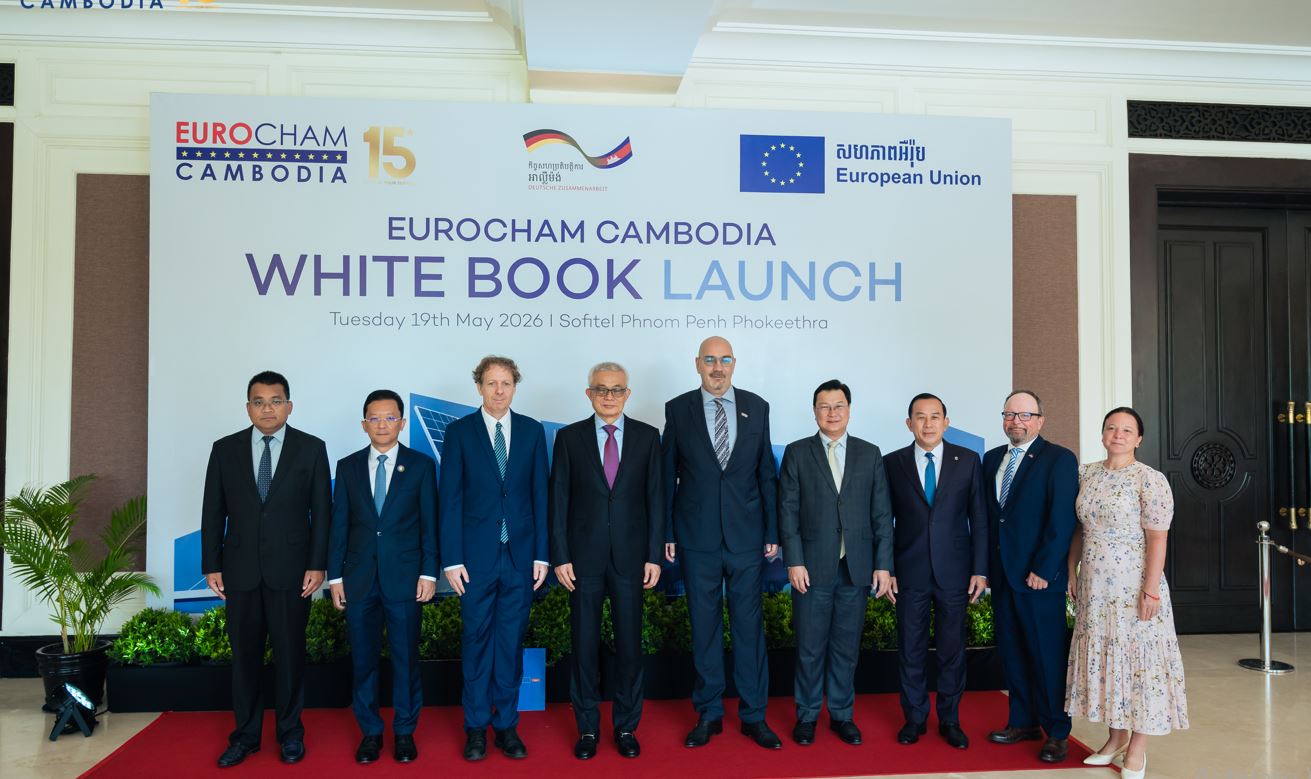
The European Chamber of Commerce in Cambodia officially launched its White Book 2027 on May 19 at Sofitel Phnom Penh Phokeethra, with business leaders and senior government officials calling for accelerated regulatory reform to strengthen Cambodia’s long-term investment competitiveness ahead of the country’s expected graduation from Least Developed Country (LDC) status in 2029.
The launch ceremony brought together representatives from the Royal Government of Cambodia, the Delegation of the European Union to Cambodia, diplomatic missions, development partners, and the private sector. During the event, EuroCham Chairperson Tassilo Brinzer formally handed over the White Book 2027 to Aun Pornmoniroth, Deputy Prime Minister and Minister of Economy and Finance.

Speaking at the launch, Brinzer said Cambodia faces a critical period as global geopolitical tensions, energy price pressures, and rising operational costs continue to reshape international business conditions. He said Cambodia’s transition away from LDC status would require stronger competitiveness, improved logistics, greener energy systems, and deeper economic diversification.
Brinzer described the White Book, alongside EuroCham’s upgraded Advocacy Compass and newly launched Red Tape Tracker, as practical tools aimed at turning operational business challenges into evidence-based policy recommendations.
“EuroCham will continue to work with the Royal Government and other partners on a range of regulatory topics – not to complain, but to solve,” he said.
Tax, Healthcare and Green Finance Reforms Highlighted
EuroCham Executive Director Martin Brisson presented a review of the chamber’s advocacy progress since the White Book 2024, noting that 10 out of 78 recommendations had been fully resolved while another six were partially addressed through almost 30 government consultations conducted in 2025.
Among the reforms highlighted were the establishment of the General Department of Taxation’s Special Tax Audit Unit, the introduction of a compliance certification system aimed at improving predictability for compliant businesses, and the resumption of Ministry of Health committee sessions for medical product registrations and renewals.

The chamber also pointed to the launch of Cambodia’s Sustainable Green Financing Facility as a positive step toward expanding access to green finance for businesses operating in the Kingdom.
The White Book 2027 introduces 18 new recommendations covering sectors including digital assets, pharmaceutical regulation, advertising guidelines, renewable energy, automotive policy, and green economy frameworks.
EU Calls for Transparent and Predictable Regulation
Igor Driesmans, Ambassador of the Delegation of the European Union to Cambodia, described the White Book as a “timely, practical, and solution-oriented roadmap” aligned with Cambodia’s Pentagonal Strategy.
Driesmans highlighted several recent outcomes from EU-EuroCham-government engagement, including regulatory clarification surrounding the definition of new vehicles, progress toward an internationally recognised renewable energy certificate framework, and the phase-out of “open-lid beer promotions” that had raised fair competition concerns.

“For high-quality European investments in Cambodia to reach their full potential, they need to be anchored in a regulatory framework that is transparent and predictable, and aligned with international best practices,” Driesmans said.
Government Highlights Shared Reform Priorities
In his remarks, Aun Pornmoniroth said Cambodia’s economy expanded by 5.3 percent in 2025 and outlined six reform priorities shared between the Royal Government and the White Book 2027.
These include accelerating the digital economy and adopting a Personal Data Protection Law aligned with international standards, improving competition frameworks, modernising trade facilitation through full integration into the National Single Window, implementing renewable energy certificate systems, investing in human capital, and improving regulatory transparency to strengthen investor confidence.

“Over the years, the White Book has been instrumental in driving many key reforms in Cambodia,” Aun Pornmoniroth said, describing the publication as an important “investor’s perspective” for policymakers.
Stronger infrastructure, regulatory quality, and workforce skills development
A high-level panel discussion moderated by Julie Kéo, Vice-Chairperson of EuroCham Cambodia, also featured H.E. Phan Phalla, Secretary of State at the Ministry of Economy and Finance, Koen Everaert, Deputy Head of Cooperation at the EU Delegation, and World Bank Senior Economist Faya Hayati.

Panelists called for faster business registration processes for first-year investors, increased use of digital systems to reduce multi-ministry certification requirements, and stronger inter-ministerial coordination as Cambodia prepares for post-LDC economic realities.
Hayati cautioned that Cambodia would no longer be able to rely on preferential trade access after 2029 and said future competitiveness would need to be driven by stronger infrastructure, regulatory quality, and workforce skills development.