


Cambodia Investment Review
Cambodia’s industrial ambitions and economic diversification strategy were in focus during a recent televised episode of the Economic Growth Policy Dialogue, hosted by H.E. Prof. Bundit Sapheacha Dr. Sok Siphana, Senior Minister in charge of Special Missions and Chairman of the Trade Policy Advisory Board (TPAB).
The discussion brought together senior representatives from the private sector and policy community to examine the evolving role of the automotive industry in supporting Cambodia’s long-term economic growth. Participants included Seng Veng, General Manager of Ford Cambodia, and David Van, Senior Director at Platform Impact Co Ltd., with the session framed as part of Cambodia’s broader push to move beyond an import-dependent model toward higher-value industrial production.
Automotive sector emerging as industrial foundation
The dialogue positioned the automotive sector as a key entry point for Cambodia’s industrial development, reflecting the country’s steady transition over the past three decades. From a market once dominated by imported vehicles, Cambodia is now beginning to establish local assembly and early-stage manufacturing capabilities.
Ford Cambodia’s evolution illustrates this shift, having moved from distribution into local production supported by favorable government policies and growing domestic demand. The company’s current production capacity of up to 10,000 units annually signals a notable step forward in the Kingdom’s ability to support industrial-scale operations.
Local assembly is also contributing to improved pricing competitiveness and strengthening after-sales service networks nationwide. At the same time, the presence of other global automotive brands entering or expanding assembly operations in Cambodia points to increasing investor confidence in the sector.
Skills gap remains a critical constraint
While the sector’s growth trajectory is gaining momentum, the discussion highlighted workforce development as a central challenge. Cambodia continues to face a shortage of skilled technical labor, particularly in areas requiring hands-on, industry-ready capabilities.
The gap between academic education and practical training remains a structural issue, limiting the pace at which the automotive sector can scale. Addressing this constraint has become a priority for both the government and private sector stakeholders.
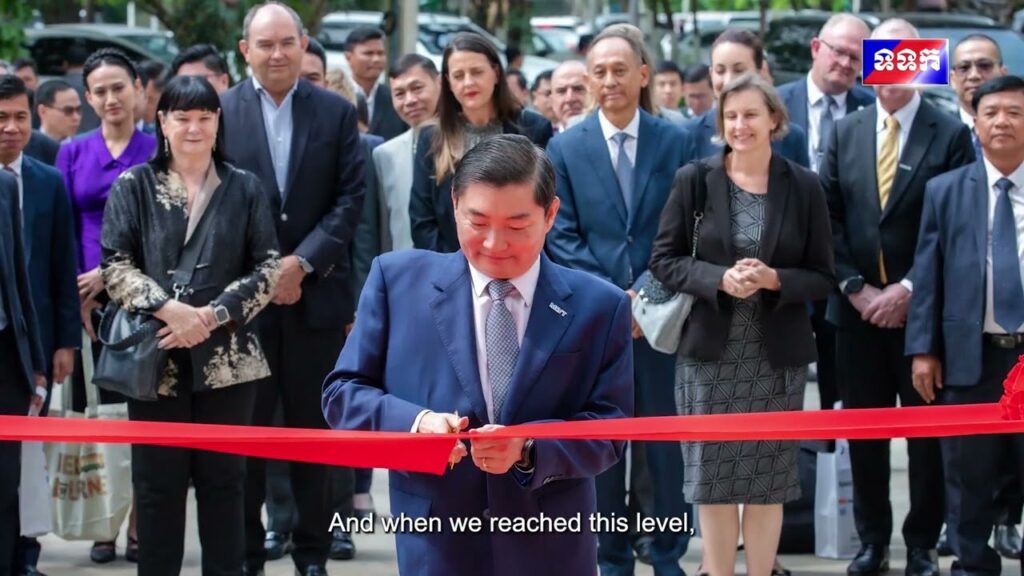
A newly established Automotive Center of Excellence was presented as a key initiative aimed at bridging this gap. Developed through a partnership between government institutions, private industry, and an Australian training provider, the center focuses on delivering internationally aligned technical training. Its objective is to create a pipeline of skilled technicians capable of supporting not only existing manufacturers but also attracting new investment into Cambodia.
Ford Cambodia’s own investment in workforce development, including international training programs and local capacity building, reflects a broader industry trend toward long-term human capital development.
Industry structure and policy dynamics
The discussion also outlined the structure and incentives shaping Cambodia’s automotive sector, particularly the role of government policies in encouraging local production. Tax incentives linked to different assembly models, such as complete knockdown (CKD) and incomplete knockdown (IKD), are designed to promote higher levels of local content and job creation.
Key industry considerations discussed included:
- Local assembly operations benefit from tax incentives that improve pricing competitiveness compared to fully imported vehicles
- Higher levels of local production are linked to increased employment and skill development requirements
- The development of supporting industries, including component manufacturing, remains at an early stage
- After-sales service and nationwide support networks are becoming key differentiators for manufacturers
- Workforce training and certification standards are critical to maintaining production quality and attracting further investment
These structural factors are expected to play a significant role in shaping the sector’s long-term competitiveness.
Outlook shaped by regional integration and global trends
Looking ahead, Cambodia’s ability to integrate into regional and global supply chains will be a defining factor in the sector’s development. Potential participation in high-standard trade agreements could open new export opportunities for locally manufactured vehicles and components.
However, the discussion also pointed to emerging challenges, particularly from global market dynamics. The rise of electric vehicles, combined with competitive pressures from large-scale producers, may impact investment decisions in local manufacturing. Current policy frameworks and tax structures could influence the pace at which Cambodia adopts and produces EVs domestically.
Despite these challenges, the overall outlook remains positive. The combination of policy support, private sector investment, and growing domestic demand is gradually positioning Cambodia as a developing player in the regional automotive industry.
As highlighted throughout the televised discussion, the sector represents more than just vehicle production. It is increasingly viewed as a pathway for Cambodia to build technical capabilities, create skilled employment, and strengthen its industrial base as part of a broader economic transformation agenda.