

Cambodia Investment Review
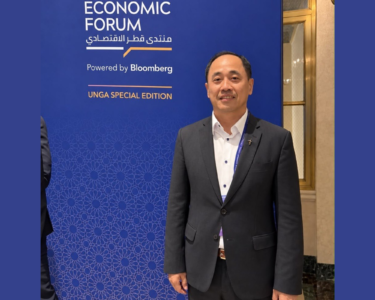
As global trade tensions intensify and governments increasingly turn to defensive measures, Cambodian businesses are being urged to sharpen their understanding of trade remedies. Speaking at a EuroCham Cambodia session held at TRIBE Hotel Phnom Penh on February 12, Edwin Vanderbruggen, Senior Partner at Andersen in Cambodia, laid out how anti-dumping, countervailing duties and safeguard actions are reshaping market access worldwide — and why Cambodian exporters must be prepared.
“Free trade works,” Edwin told the audience. “But the global trading system is in trouble. We are seeing more restrictions, more investigations and more disputes than before.”
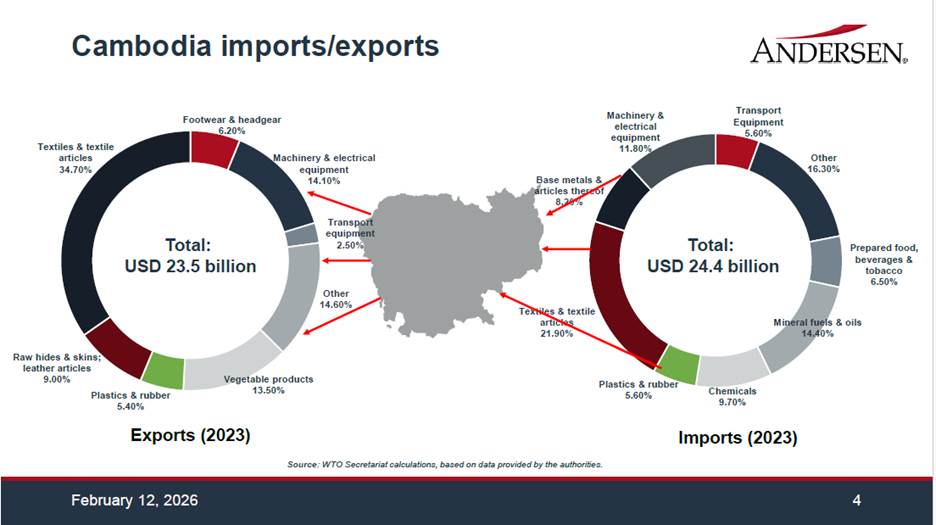
Cambodia’s total trade now exceeds $45 billion annually, with textiles and garments continuing to anchor exports, alongside machinery, footwear and agricultural products. Through ASEAN frameworks, RCEP and bilateral agreements with China, South Korea and the UAE, the Kingdom has secured significant tariff advantages. However, Edwin stressed that tariff preferences do not insulate exporters from trade remedy actions.
“Even if you benefit from zero tariffs under an FTA, you can still face anti-dumping or countervailing measures,” he said. “Trade remedies operate independently from tariff concessions.”
How Anti-Dumping Investigations Work
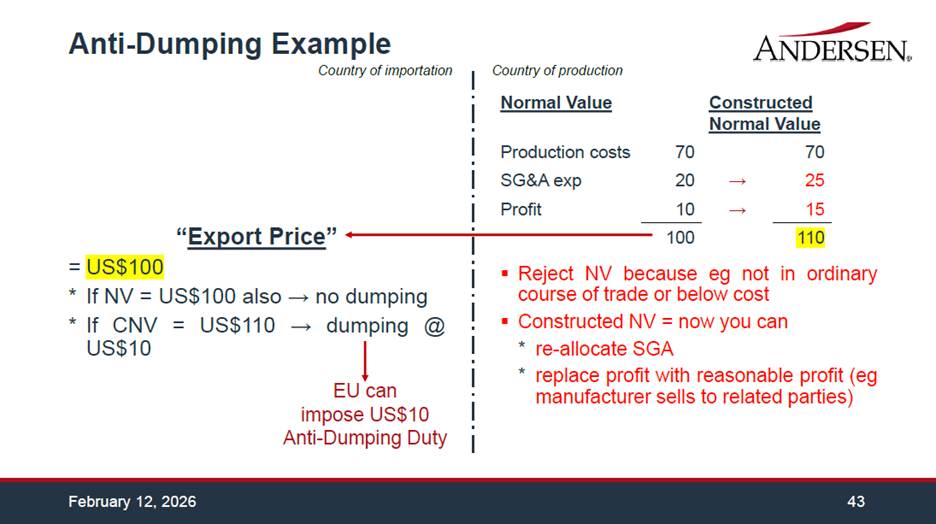
A central focus of the session was anti-dumping investigations, which can lead to additional duties when an export price is lower than the “normal value” of the product in the exporter’s domestic market. Authorities compare the two prices at a comparable ex-factory level, adjusting for freight, commissions and other costs.
“The lower the export price, the higher the dumping margin,” Edwin explained. “And the higher the normal value, the higher the margin.”
Where domestic sales are considered unreliable — for example, if they are below cost or insufficient in volume — authorities may construct a normal value based on production costs, selling and administrative expenses, and profit. According to Edwin, this constructed approach allows discretion in how overhead and profit are treated.
“There is room for interpretation in cost allocation and profit assumptions,” he said. “These technical decisions can significantly change the outcome.”
He also addressed the practice of “zeroing,” in which negative dumping margins are not used to offset positive ones in certain calculations. “With zeroing, you can find dumping even when, on average, there was none,” he noted, emphasizing that methodology matters as much as price data.
Beyond pricing calculations, the procedural demands are substantial. Exporters must respond to detailed questionnaires, provide financial documentation and often allow on-site verification. Failure to cooperate can result in authorities applying “best information available,” often producing higher duties.
“If you do not cooperate,” he warned, “the authority will assume the worst-case scenario.”
Subsidies and Safeguards
The session also examined countervailing duties, which address government subsidies that confer a benefit to producers. Edwin referenced a recent solar panel case involving Cambodian producers, where both cross-border financial arrangements and domestic investment incentives were scrutinized.
“The definition of a subsidy under WTO rules is broad,” he said. “It can include tax exemptions, preferential loans or other financial contributions that provide a benefit.”
While investment incentives remain central to Cambodia’s development strategy, he emphasized the need for careful structuring and documentation to withstand potential investigations in export markets.
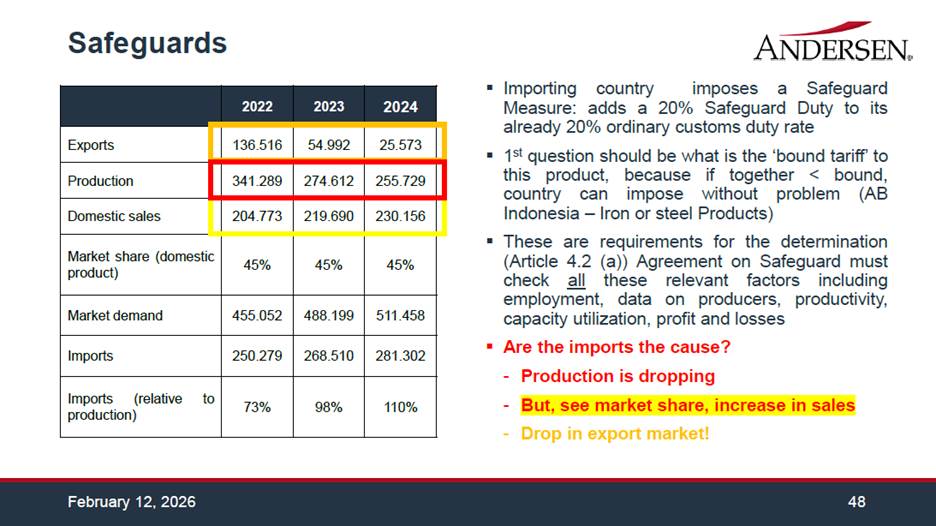
Safeguards, meanwhile, are emergency measures imposed in response to sudden increases in imports causing serious injury to domestic industries. Authorities must assess factors such as production, market share, profits and employment.
“There must be a recent, sudden, sharp and significant increase,” Edwin said. “And imports must be shown to be the cause of the injury.”
What Businesses Should Watch
- Pricing comparisons: Small adjustments between export price and normal value can drive large duty outcomes
- Cost allocation: Treatment of overhead and profit assumptions can materially affect constructed margins
- Documentation and cooperation: Incomplete responses can trigger harsher findings under “best information available.”
- Investment incentives: Tax and financing benefits may be examined as potential subsidies in countervailing cases
- Import trends: Rapid increases in shipments can expose products to safeguard investigations
Cambodia’s Trade Remedy Framework
Cambodia adopted its Law on Trade Remedies in 2017, establishing the legal basis for anti-dumping, countervailing and safeguard investigations. Edwin noted that additional sub-decrees are required to fully operationalize the system and clarify procedures.
“The law is in place,” he said. “But implementation and due process protections will determine how credible and effective it becomes.”
He concluded that trade disputes are increasingly a normal feature of global commerce. For Cambodian exporters, success will depend not only on competitive pricing but on preparedness when scrutiny arises.
“Winning in trade,” he said, “is about being ready when questions are asked — and having the data to answer them.”