
Stew Post
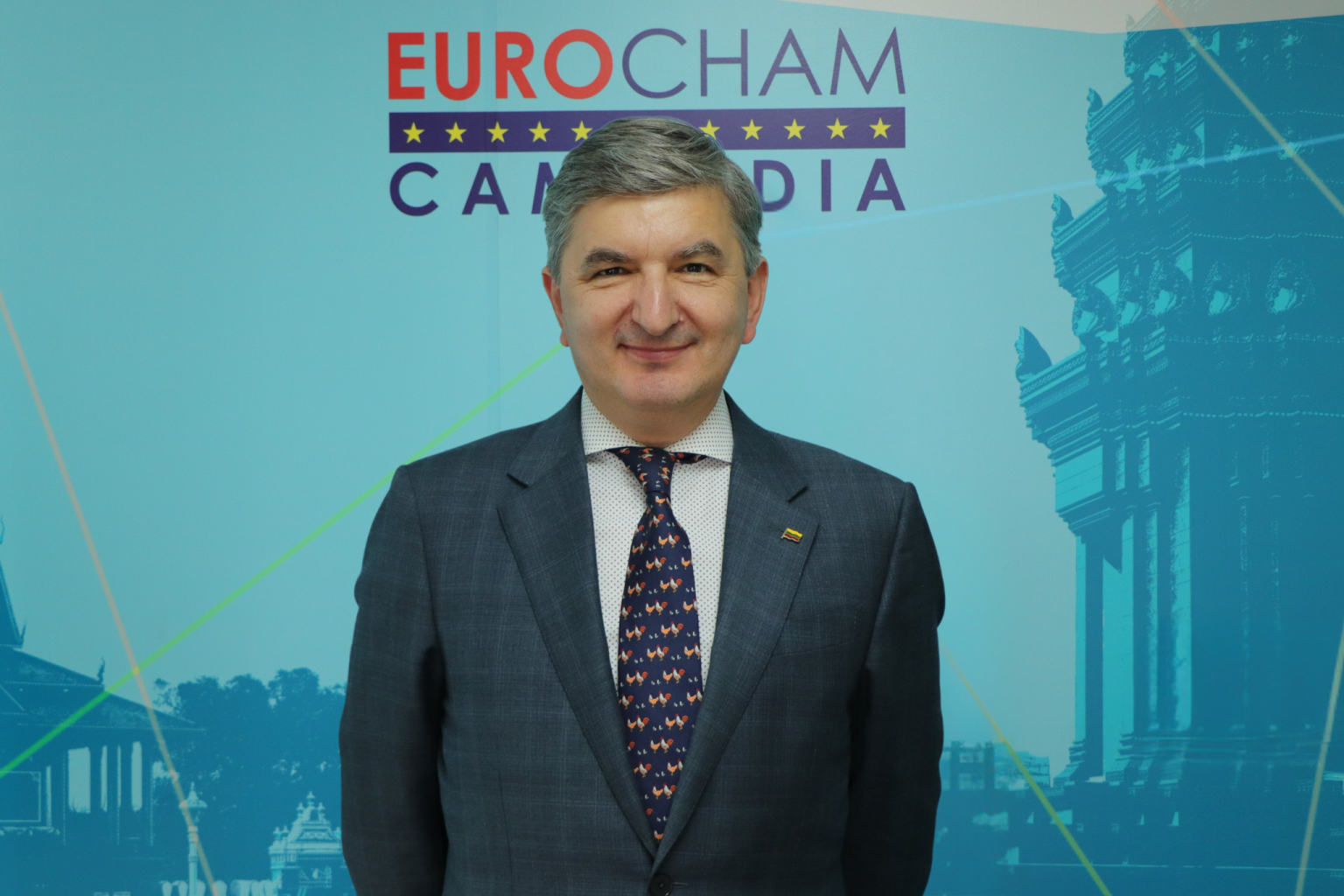
For this week’s interview, Senior Communications Officer Stew Post sat down with Lithuanian Ambassador to Cambodia, Darius Gaidys during his recent visit to EuroCham offices.
Over the course of a wide-ranging conversation, the pair discussed parallels between Lithuanian and Cambodian history, how his 20+ years in the Foreign Service has shaped his approach to diplomacy, and what he sees as the most promising paths for deepening business cooperation between the two countries.
First Impressions Of The Kingdom
Stew: You’ve been in the region for a while now, serving as the Ambassador of Lithuania in Singapore, but you are now in a new position as Ambassador to Cambodia. Is this your first trip to the country? What are your first impressions of the Kingdom so far?
Ambassador Gaidys: In my official capacity, this is my first trip to Cambodia, but unofficially, three and a half years ago, I spent Christmas time in Angkor Wat, Koh Rong, Phnom Penh and Sihanoukville.
Ahead of my trip, I read extensively about the history of Cambodia, so I knew that at some point, it was probably the biggest country by territory in the region, like Lithuania was the largest country in Europe at one point in the 15th century. Then we shrank, both Cambodia and Lithuania.
We each also a had colonisation period: France here, Russia in Lithuania. We had some painful situations with communist terror. They experienced genocide here in the 1970s while we had mass deportation, mass killings by the communist party of the Soviet Union in the 1940s, ending in the 1950s. So, in a way, we have our histories in common.
When I arrived, I was amazed by the deep historical roots here. There is fantastic nature, and of course, friendly and smiling people. I haven’t been engaged in business here yet, this is something new, so I will see how it goes for businesses in Cambodia. But overall, my first impressions are very positive.
Stew: You have extensive experience in Foreign Service with more than 20 years in stations across the globe. How do you feel that your background and your knowledge base have prepared you for this new position in Cambodia?
Ambassador Gaidys: Well, as diplomats, we are masters of all trades because we do politics, we do economics, we do cultural affairs, we do sports diplomacy, and we work with diasporas. We handle a full range of topics and we are positioned in many countries.
For me, having previously been posted in America and in Europe, it was a kind of novelty coming to Asia, but from your experience, you find ways to operate in a new environment. Basically, diplomats need to understand local people and local customs. This is the most important, to learn local customs and immerse yourself in the local culture.
Speaking the language always helps. I don’t speak Khmer yet, but I’m learning Chinese actually, which is useful in Singapore, where 75% of population are of Chinese origin.
Potential For Private-Sector Partnerships
Stew: You have highlighted economy, energy, digitalisation, science, and education as priority areas of cooperation.
From a business perspective, which of these sectors do you believe offers the strongest potential for private-sector partnerships and investment, and why?
Ambassador Gaidys: There are several levels. One of the levels is government to government cooperation. Then, of course there is business to business, as well as business to government cooperation.
I think cooperation on the energy sector is very important. We have excellent experience in this area, as we have disconnected from the Russian-based power grid and connected with the Western, Central, and North European grid. So we can share the experience with our Southeast Asian partners, because we know how to build cables, how to synchronise transmission, how to disconnect, and how to connect. We know how to do all of this and we are ready to offer our expertise.
Another area is digital technologies. We are a small country like Cambodia. We don’t have natural resources, so we rely on, not on natural resources and manufacturing, but on digital technology and industries. We have very strong FinTech capabilities. We have quite a lot of unicorns (enterprises) in many areas.
Another thing that is very important is government technology capacity, GovTech. In Lithuania, through a single government portal, you can access 600 plus government services in one space. You can, for example, enrol children in school online while sitting on your couch, or change your driver’s license, or sign a power of attorney, or get a construction permit online.
This is very convenient, but it is also very good because it significantly reduces the space for corruption because everything is done online. We are ready to share our experience with Cambodian partners.
Digitalisation Of Business Processes
Stew: In the past few years, there’s been a significant push throughout the Cambodian government for a single type of single portal window and digitalisation of business processes.
Have you had a chance to explore any of these initiatives underway in Cambodia?
Ambassador Gaidys: Yes, we have been talking about these developments. As a member of the European Union, we are participating in a number of Twinning Projects. We have one project led by Italians. We are working with the statistics office for data processing. But this is just the beginning. The European Union has other mechanisms, like TAIEX (Technical Assistance and Information Exchange), where experts in certain areas can come to Cambodia and organise a series of seminars. Or, through TAIEX, we can invite mechanism experts from Cambodia to Lithuania to learn new skills and systems. This is on offer as well and something we are working on.
Stew: Cambodia has been a leading player in the regional fintech space, with massive adoption of digital payment systems. Do you think that there is potential for commercial collaboration from Lithuanian businesses entering the market here?
Ambassador Gaidys: Yes, we have looked into fintech in particular because financial technologies are very hot and very well developed in Southeast Asia. But I’m not talking about money transfers and digital wallets, because these technologies are already very well developed within the region. I’m talking more about the services that are around these technologies, for example, KYC, facial recognition, customer recognition, and processing of data and documents.
Because money transfer is heavily regulated and licensed, so you need to wait a lot, you know, it’s a lengthy process and not every company from Lithuania or other European countries would be willing to establish in Cambodia. But these other periphery services do not have the same licensing requirements so it’s easier to access markets, so I see good potential there.
Then we have cyber security experience. We have a couple of unicorns in Lithuania in cyber defence, NordVPN is very well known; Surfshark is known around the area. These are Lithuanian companies that provide cyber security solutions, and I believe they are interested in working in Cambodia.
Strategic Gateway For Cambodian Companies
Stew: With your accreditation across ASEAN and Lithuania’s position within the EU, how can Lithuania serve as a strategic gateway for Cambodian companies looking to enter European markets and, conversely, for Lithuanian firms looking to expand into Cambodia and the wider ASEAN region?
Ambassador Gaidys: I think every country in the European Union positions itself as an entryway into the EU market, of course. And more or less, the same is true with the ASEAN and nations in Southeast Asia. In Singapore, they say, “Oh, we are the entrance point into Southeast Asia.” Indonesia says the same now also.
But I see the benefits of Cambodia and Lithuania being that we are both small in terms of population size compared to our neighbours. We see this as an advantage because growth is often faster in small countries: there are less layers to go from the very bottom to the very top. So, everything can go slightly faster. This is an opportunity for Cambodian businesses to go to Europe through Lithuania, and of course, Lithuanian businesses to go to Southeast Asia through Cambodi
Stew: What’s the kind of general understanding of and knowledge about Cambodia as a business destination in Lithuania?
Ambassador Gaidys: Business-wise, it’s not very well known yet. It’s well known as a tourist destination because everybody knows Angkor Wat, everybody in Lithuania knows about the Khmer Rouge regime and people are generally interested in the history of Cambodia. We have seen an increase of Lithuania tourists, but not yet as a business destination.
So, this is the task of my embassy: to improve knowledge of Lithuania as a business destination for Cambodians and to improve knowledge of Cambodia as a commercial destination for Lithuanian businesses.
The first step is called inventorisation. Basically you need to find out what could happen, how it would be facilitated, and what is the interest from both sides. Then you need to find good partners: the embassy cannot make business decisions for companies, but we can open the door, we can give advice, we can connect businesspeople. We can also connect businesses with government institutions. These are the very first steps.
Support Economic Diplomacy Objectives
Stew: What message would you like to send to European, Lithuanian, and Cambodian business communities about engaging with Lithuania–Cambodia relations, and how can institutions like EuroCham Cambodia support your economic diplomacy objectives?
Ambassador Gaidys: First, we need to learn more about each other. This is the most important starting point because we are separated by 14 or 15 hours of flight. It’s a really significant distance. Also, we are not big players in world politics, so we need to learn about each other and find the opportunities for collaboration, both at the government level and in the commercial space. I believe we will find these opportunities and we will see more businesses from both sides thriving.
In terms of these goals, EuroCham is very important for us. Being members of the European Union, it is the go-to destination for our businesses to learn about Cambodia and explore market opportunities. I’m very happy that Martin [Brisson, Executive Director] said that EuroCham can provide assistance in finding reliable business partners, providing sound advice, opening doors, and talking with different government institutions here in Cambodia.
I’m certain that many Lithuanian businesses will go through EuroCham to enter into Cambodia. Hopefully, maybe one day we will have a Lithuanian chamber of commerce here in Cambodia.