

Cambodia Investment Review
Cambodia’s economy is forecast to grow 2.7% in 2026 before rebounding to 6% next year, according to Mekong Strategic Capital (MSC), as strong manufacturing exports offset pressure on tourism, household spending and the financial sector.
Stephen Higgins, Managing Partner of MSC, presented the outlook at an Australian Chamber of Commerce (AusCham) briefing on October 21, 2026.
“The Cambodian economy hasn’t had a ‘normal’ year since 2019,” the presentation stated, highlighting the cumulative effects of the pandemic, scam-centre activity, the Thai border conflict and property-related financial pressures.
MSC raised its 2026 forecast from 2.5%, reflecting stronger manufacturing exports. Nevertheless, it expects the weakest growth in 17 years outside the pandemic period.
Exports drive industrial growth
Goods exports rose 18% in the first nine months of 2026, according to customs figures presented in the briefing. Manufactured exports outside garments, footwear and travel goods increased 49%, highlighting Cambodia’s expanding industrial base.
Rubber exports climbed 66%, adding approximately $931 million compared with the same period last year. Electrical machinery exports rose 40%, while furniture and bedding shipments increased 28%.
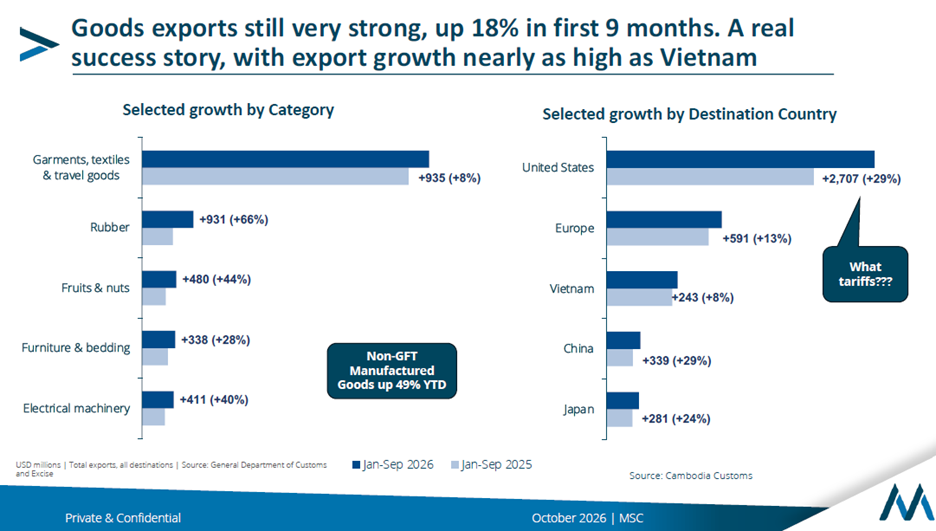
Garments, textiles and travel goods remained important, with exports increasing 8%, equivalent to approximately $935 million.
The United States delivered the largest increase among the destinations highlighted, with shipments rising 29%, or approximately $2.7 billion. Exports to Europe increased 13%, while China and Japan recorded gains of 29% and 24%, respectively.
MSC forecasts industrial growth of 7.1% this year, supported by foreign investment and manufacturing diversification.
Tourism and spending weaken
Services face a tougher outlook. MSC forecasts the sector will contract 2.1% in 2026, including declines of 15.5% in accommodation and food services and 8% in financial and real estate activities.
Its model assumes international tourism falls 27% this year, alongside a 5% decline in domestic tourism, and ignores claims that domestic tourism is up 50%, which it sees as implausible.
“Major change is needed, particularly investment in tourism promotion,” the presentation stated, describing tourism as a “code-red” situation requiring urgent action.
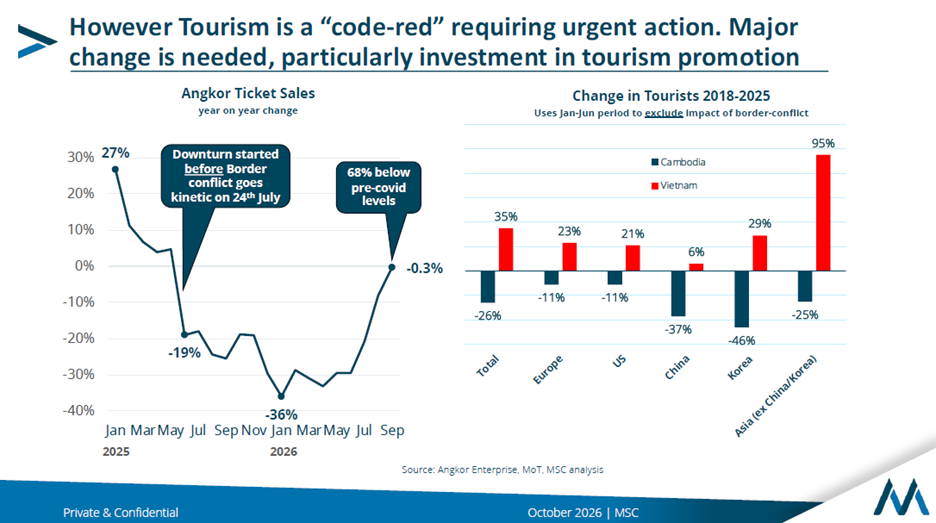
The briefing noted that falling Angkor ticket sales predated the July 2025 escalation of the Thai border conflict, indicating broader challenges.
VAT revenue declined 1.5% in January–August, partly reflecting fuel-tax relief. Total government revenue nevertheless rose 2.9% to approximately $4.99 billion, supported by higher corporate and personal income tax collections.
Loan stress weighs on property
Citing Credit Bureau Cambodia data, MSC reported that approximately $14.6 billion in loans, equivalent to 23% of lending, were more than 30 days overdue and/or had been restructured.
This covers a broader category of stressed lending than non-performing loans alone.
MSC warned that much of the affected lending is secured against property. Potential collateral sales could add to the existing supply overhang and complicate the real estate recovery.
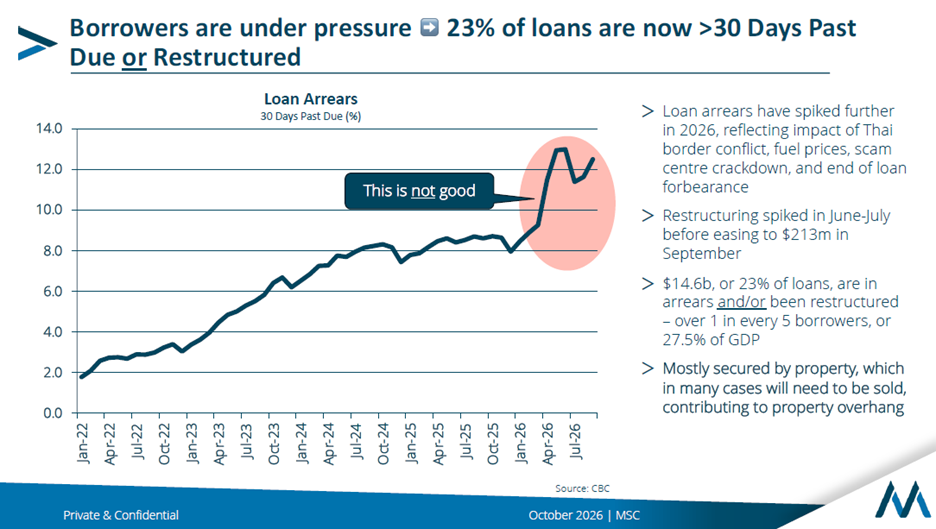
The presentation linked rising arrears to the border conflict, fuel prices, scam-centre closures and the end of loan forbearance.
National Bank of Cambodia figures cited in the briefing showed deposits had fallen approximately $2.15 billion since the start of 2026, based on August data. MSC suggested slowing deposit growth could end the period of falling interest rates.
Recovery rests on services and manufacturing
MSC’s 6% growth forecast for 2027 assumes industrial expansion of 7.9%, a 5.2% recovery in services and agricultural growth of 1.5%.
Accommodation and food services are projected to rebound 11.7%, while financial and real estate activities return to 5% growth.
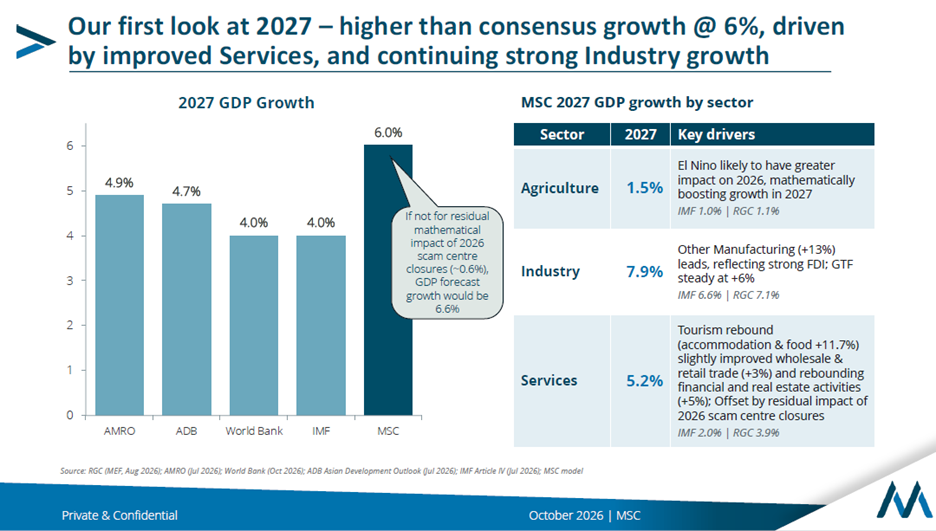
The model assumes scam-centre shutdowns are largely completed by end-2026, with some effects continuing into next year.
Longer term, MSC sees manufacturing, urbanisation and demographics supporting expansion. Industry’s share of real GDP is estimated to rise from 29.9% in 2014 to 47% in 2026, while Cambodia’s working-age population is projected to increase 24% between 2021 and 2050.
Its illustrative scenario points to annual growth of around 6% over 2025–2050, while cautioning: “Tailwinds create a stronger starting mix; realised upside depends on execution.”