


Cambodia Investment Review
Cambodia’s healthcare sector needs closer coordination between government, hospitals, insurers and technology providers to improve patient care while managing costs, industry representatives said at EuroCham Cambodia’s Health Innovation Forum 2026.
Held on October 22 at Sun and Moon Riverside Phnom Penh, the forum examined hospital accreditation, insurance coverage, access to specialised medicines and the growing role of artificial intelligence in healthcare operations.
The discussions highlighted challenges for healthcare businesses and policymakers as they seek to raise service standards, improve financial protection and prepare workers for changing patient needs.
“Patients and healthcare providers in Cambodia are both under economic pressure,” said Dr. Elias Engelking, Co-Chairperson of EuroCham’s Healthcare Committee and Head of Digital Health at InterCare Hospital.
He said proposed changes should be assessed against their ability to improve access, outcomes and patient experience at a sustainable cost.
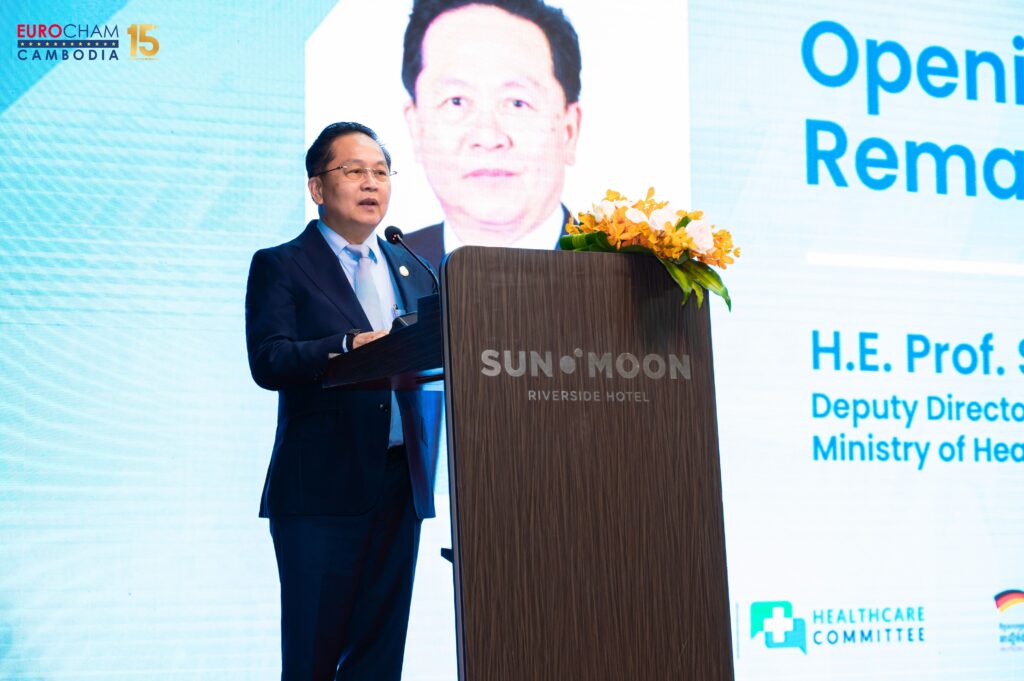
Opening speakers included EuroCham Cambodia Chairperson Tassilo Brinzer, German Ambassador to Cambodia Silke Röfer and Prof. Sok Chour, Deputy Director General for Health at the Ministry of Health.
Accreditation and Insurance Coordination in Focus
Hospital accreditation emerged as a central issue, with participants examining how Cambodia’s national framework could strengthen patient safety and improve confidence among patients and organisations paying for care.
Healthcare quality and accreditation consultant Edward Chappy presented on the topic before a panel involving Ministry of Health representatives, accreditation specialists and hospital managers.
Discussions covered implementation requirements and costs, independent assessment and the potential for accreditation to support risk management and operational improvements.
Health financing was another priority, particularly the relationship between National Social Security Fund coverage and private health insurance.

International health financing economist Holger Thies outlined European approaches to public-private coverage, including complementary benefits, co-payments and coordinated reimbursement.
Representatives from the NSSF, private insurance and healthcare providers subsequently examined how Cambodia could better align benefits, claims procedures and reimbursement arrangements.
The discussions explored potential approaches rather than announcing a new coverage agreement or implementation timetable.
Brinzer emphasised the importance of cooperation between public institutions and businesses.
“When the public sector establishes clear, efficient, and supportive governance, and the private sector provides innovation, investment, and speed, Cambodia benefits the most,” he said.
Medicine Access Highlights Supply Chain Challenges
Access to quality-assured medicines brought regulatory processes and pharmaceutical supply chains into focus.
Jan Oesterreich, Regional Director APAC at Komtur Pharmaceuticals, presented regional approaches to obtaining specialised medicines, including treatments for rare diseases and products facing shortages.

A subsequent panel examined product registration, authorised supply chains and regulatory pathways, alongside opportunities to make treatments available more quickly and affordably.
The discussion highlighted how medicine access depends on coordination across regulators, suppliers and healthcare providers, particularly for treatments requiring specialised sourcing.
AI Adoption Raises Workforce Questions
Digital health discussions focused on how connected systems and AI tools could change hospital administration, clinical documentation, insurance claims processing and patient coordination.
Engelking examined the potential role of interoperable systems and AI agents, while representatives from academia and health technology discussed the skills needed to develop, implement and supervise them.
Human oversight remained a central consideration as participants explored wider use of AI in healthcare operations.
Röfer said dialogue between regulators, public institutions and private innovators would be essential to responsible adoption. She also highlighted Cambodia’s potential to develop digital services for regional markets.

“Ultimately, progress should be measured not by the technology itself, but by better care, better patient outcomes, and more effective use of resources,” she said.
A final workforce discussion considered how education and professional development could respond to demand for specialised clinical services, child wellbeing support and home-based care.
The forum also featured business networking and a parallel session on Cambodia’s healthcare outlook for 2027. Across the programme, participants stressed the need to connect investment and innovation with practical improvements in healthcare quality, affordability and delivery.


