
EuroCham Cambodia
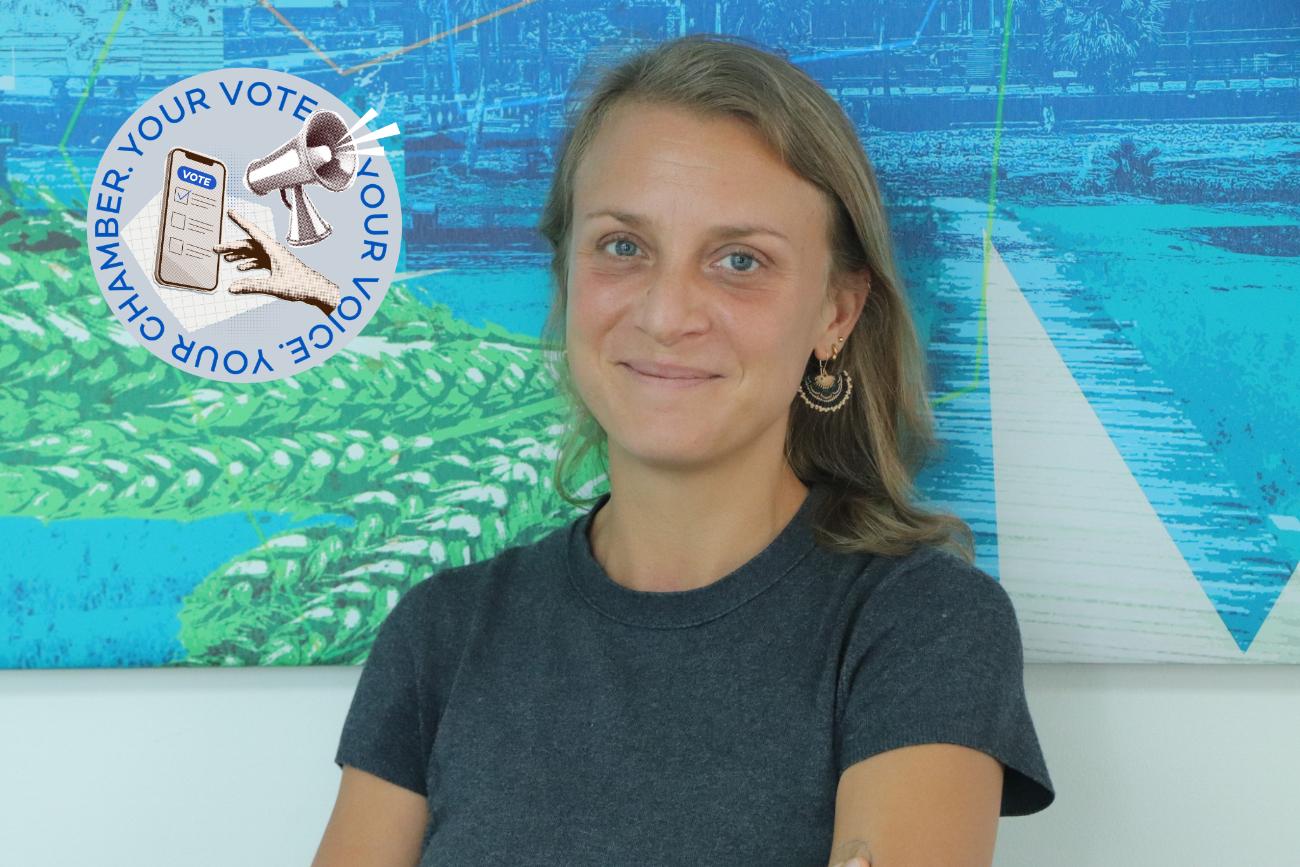
With Committee elections just a few weeks away, EuroCham Cambodia spoke with Sarah Kolbenstetter, Vice-Chairperson of EuroCham’s Green Business Committee and Founder & Zero-Waste Consultant at Little Green Spark.
We discussed the evolving shape of sustainability in Cambodia, EuroCham’s Sectoral Committees as platforms for sharing best practices, and how they can bridge the gap between small businesses and high-level dialogue.
Sarah shared what drew her to committee leadership, the advocacy outcomes she is most proud of, and why she is putting herself forward for a second term.
Your firm Little Green Spark is a natural fit for EuroCham’s Green Business Committee: you work with stakeholders across industries to create eco-friendly solutions with a focus on workshops, trainer training, and implementing zero-waste initiatives for businesses. What inspired you to get involved as a committee leader and why have you decided to return as a candidate this time?
Sarah: What inspired me to get involved was the sense that Little Green Spark’s work — grassroots, on-the-ground with companies, communities, and youth across Cambodia — needed a complement at a higher level. Through that work, I kept seeing the same pattern: businesses genuinely want to do the right thing on sustainability, but they don’t have anywhere to turn for practical, locally-relevant guidance. The Green Business Committee filled that gap; I saw it as a place where companies could compare notes, get real answers, and move from good intentions to action. As vice-chair, I could help shape what the committee actually offers, not just take part in it. It also meant staying genuinely “in” what’s happening across Cambodia on waste and sustainability more broadly. I think both sides, the grassroots work and the committee work, are equally important and make each other stronger: one keeps the committee’s priorities grounded in reality, the other keeps me connected to the bigger picture shaping the sector.
As for why I’m putting myself forward again: two years in, I feel like I’ve only really gotten started. The first stretch was as much about building trust and understanding how the committee could be genuinely useful to members as it was about running programs, and that groundwork takes time. I’d rather see through what I’ve built than hand it off half-finished; there’s still work I want to push further, from growing the training side to getting more businesses actively engaged rather than passively signed up.
Over the past two years as a leader of the committee, what changes have you seen in the business landscape in terms of sustainability, circularity, and eco-conscious operations? Are there any advocacy achievements of the Green Business Committee that you are particularly proud to have been a part of?
Sarah: Over the past two years, I’ve seen a real shift in how businesses here talk about sustainability : it’s moved from a compliance afterthought to something companies bring up on their own, whether that’s asking about circular packaging options, waste segregation, or how to prepare for stricter EU-linked requirements on their exports. Within the committee, our own agenda has understandably leaned toward clean energy, which has been a dominant focus for members, but I’ve worked to keep sustainable waste management on the table as well, because it’s an area where I see businesses needing just as much practical guidance and where Cambodia still has real gaps to close.
In terms of advocacy, I’m proud of the committee’s contribution to the White Book, which remains one of the most concrete ways our work translates into actual policy dialogue with the government. The recommendation I’m most proud of, in the recently published White Book 2027, is the one on sustainable waste management: calling for the development of fiscal and non-fiscal instruments to recognise, encourage, and incentivise private sector initiatives to reduce, separate, and recycle their waste. It’s the recommendation closest to my own area of work and seeing it retained in the White Book is exactly the kind of outcome that makes this role worthwhile: turning what I see on the ground into something that can genuinely shift how the government approaches the issue.
Looking ahead, what do you feel are the most pressing issues facing sustainability in Cambodia and what are the most promising areas for progress? What role do you feel that targeted advocacy and public-private sector dialogue can play in steering the direction of these developments?
Sarah: The most pressing issue, from where I sit, is still the gap between the volume of waste Cambodia generates and the systems in place to manage it properly. We have a strong and resourceful informal recycling sector, but very little formal infrastructure or fiscal incentive for businesses to reduce waste at the source or invest in separation and recycling themselves. On top of that, export-oriented sectors like garment, footwear, and travel goods are facing growing pressure from EU-linked requirements (e.g. on packaging, traceability, end-of-life obligations, etc.) and many businesses simply don’t have the guidance or the systems yet to respond. That’s the issue I know best and care about most, but it’s far from the only one shaping Cambodia’s sustainability path.
The most promising areas for progress span well beyond waste. There’s real momentum building around circular economy approaches, such as sustainable packaging, textile waste recycling, formalising links with the informal recycling sector, etc., and I find that genuinely energising. But I’m just as encouraged by what’s happening elsewhere in the space our committee covers, particularly the progress on clean energy and Renewable Energy Certificates, which has rightly been a major focus for our members and one I’m glad to keep supporting even though it’s not my own area of technical depth. Cambodia’s sustainability agenda will move forward on several fronts at once, and I think that breadth is a strength, not something to choose between.
This is exactly where targeted advocacy and public-private dialogue matter most. Businesses on the ground know what’s workable and what isn’t, but that knowledge rarely reaches policymakers directly. The committee’s role is to close that distance — to turn scattered, sector-specific experience, whether on waste, energy, or anything else members bring forward, into recommendations concrete enough for government to act on, like the fiscal incentives we proposed on waste management in the White Book. Advocacy only works if it’s grounded in that kind of real input, and dialogue only moves things forward if it’s sustained rather than a one-off exchange. I see the next stretch of my involvement as continuing to build that bridge, whatever the topic, bringing what members are seeing on the ground into a form the committee and its government counterparts can actually use.