


By Raymond Sia
While the affected banks / financial institutions mentioned above constitute a small percentage (less than 3%) of the entire banking system asset base and the banking system continues to be well capitalized and in compliance with prudential ratios, such events are still not good optics and creates the wrong perception to the customers and public. Perception shapes customer confidence.
In recent times, there have been more scrutiny on the banking industry in Cambodia. Four banks have been sanctioned by the U.S. Treasury / Office of Foreign Assets Control (OFAC) and they comprise the five bank that are liquidated. We currently have another bank that is under external administrator and another bank that is being closely monitored on their liquidity situation.
The Regulators have done a good job in being forefront on the rationale behind these closures; and reassuring the public on the health of the banking industry.
With all the good works done and (also) good intentions, we have to still be mindful that it is often the weakest link that breaks the chain.
In any business; including banking, there is no “special playbook or recipe” that guarantees us success. However, as a banker for over three decades I have observed that there are certain essential / core values and key success factors which when applied collectively; there is a higher probability of success and of us thriving (rather than striving).
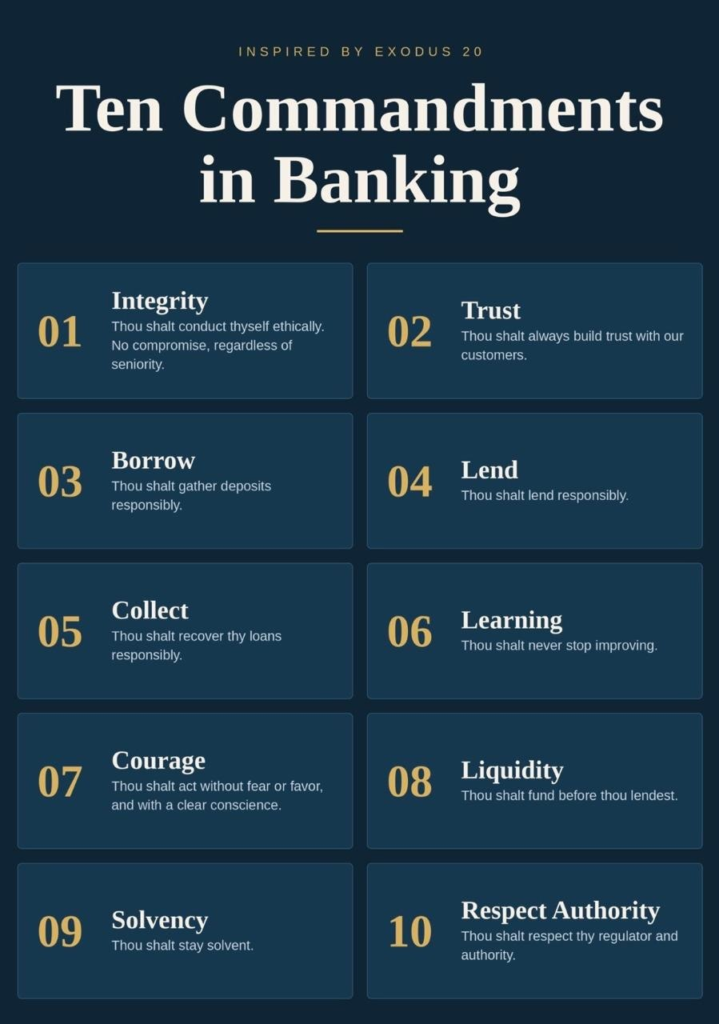
“Ten Commandments in Banking”
The below are my “Ten Commandments in Banking”, inspired by Exodus 20 from the Bible. Like any commandments or policy or Prakas, they only work when people abide by them.
1. Trust – Thou shall always build trust with our customers.
Our integrity is priceless and there should never be a compromise on this important value; irrespective of how senior or what position a person holds in a financial institution. It is extremely disappointing to hear news about bankers compromising on this value.
In looking for people to hire, you look for three qualities: integrity, intelligence and energy. And if they don’t have the first quality, the other two will kill you. – Warren Buffet.
2. Trust – Thou shall always build trust with our customers.
Banking business is built on the bedrock & foundation of trust.
Once trust is broken, it is almost impossible for any financial institution to recover.
Trust comes in different forms including the ability of a financial institution to promote (the right) financial access and financial literacy and also provide the surety to customers to withdraw their deposits. It’s unfortunate and rather bizarre in current times; to see customers not able to withdraw their hard-earned savings from bank(s) in a timely manner.
Banks are meant to be the safest refuge for our money and hard-earned savings.
3. Borrow – Thou shalt gather deposits responsibly.
Without funding, a bank cannot function as its business is in gathering deposits and effectively mobilizing the deposits as loans; ensuring prudent credit risk management.
Experienced bankers will subscribe to the principle of “fund before we lend”. This principle would also mean bankers need to gather deposits ethically and professionally.
Caveat emptor when financial institutions offer overly high deposit interest rates.
4. Lend – Thou shalt lend responsibly.
Banks are not charitable organization although many banks do give-back to the community and country via corporate social responsibility activities.
Bank’s profitability is driven by both interest income (from lending activities) and non-interest / fee income (from transactions and other services). The proportion of interest and non-interest income varies in different banks and different regions.
We often see a higher proportion of non-interest income in more developed and matured markets. In developing and emerging markets, heavier reliance is placed on lending activities for income.
When lending activity is muted, total income and profitability will be under pressure and any increase in delinquency accounts will have an amplified effect on both delinquency ratio and profitability.
Avoid over-gearing customers.
5. Collect – Thou shalt recover thy loans responsibly.
Banks are in the business of “prudent risk taking & management”; but there will be situations where wrong decisions could be taken in lending activities and could result in these loans turning delinquent & non-performing (“NPL”).
When such a situation occurs, bankers would need to work harder to restructure and / or seek swifter resolutions; while ensuring the same level of professional conduct and behavior.
It is always better to avoid an accident from occurring than dealing with an accident after it occurs.
6. Learning – Thou shalt never stop improving.
Banking (like many other industries) has evolved over the years and continues to evolve. How banking activities are conducted today is vastly different compared to a decade ago and we are certain; over the next decade, there will be further changes and evolution.
The usage of Artificial Intelligence (“AI”) will create more redundancy in banking industry and we have already seen this phenomenon in recent times with massive layoffs by global banking group.
AI has simplified (some) work but has to be applied smartly, carefully and responsibly to ensure we have a society that can still function effectively without AI.
We have seen many people being over-reliant on AI that they do not articulate over subject matters but rely solely on AI, to the extend; it is obvious that the final output is not their original work.
Any fool can know. The point is to understand. — Albert Einstein
7. Courage – Thou shall act without fear or favor; and with a clear conscious.
In any leadership or management seminar or training, we will be told (and it is absolutely spot-on) that a good strategy is only effective when it is executed. Without (right) action(s), a strategy is useless and worthless.
There will be certain hard & tough decisions that are needed for the good of the individual institution or industry and we must have the courage to confront the issue and take the appropriate action. Being a wussy in decision making and pussyfooting in times of urgency is often a recipe for disaster.
Hope is not and never a strategy.
8. Liquidity – Thou shalt fund before thou lendest.
Every prudent banker will tell us that liquidity is the lifeline of a financial institution (or any business).
One simple measurement of liquidity is loans-to-deposit (“LDR”). A financial institution faces liquidity risk if they operate with a high LDR; especially should there be unexpected large withdrawals or if there are concentration risks in the deposit base i.e. reliance on a small group of customers for the deposits.
More banks have failed for lack of liquidity than lack of capital.
9. Solvency – Thou shalt stay solvent.
Solvency of a financial institution measures the ability to meet long-term obligations and absorb losses without failing.
There are different measurements of Solvency which includes Capital Adequacy Ratio and NPL Ratio. Any loan losses and higher NPL will have a impact on Solvency.
Solvency is the art of ensuring that today’s promises do not outpace tomorrow’s scarce resources.
10. Respect Regulator & Authority – Thou shalt respect thy authority.
As I had penned in May 2026 article – “Crisis or (Mere) Challenge? The State of Cambodia’s Banking Industry”; it is always easy to engage in hindsight analysis after the fact. The industry is never short of “hindsight specialists.” But what we truly need are foresight practitioners; who ask the hard questions before such incidences occur, not after a bank collapse.
The Best Interest Of The Industry
All relevant stakeholders – regulators, board of directors, shareholders and employees need to play their part and we must be respectful and believe that all relevant parties have the best interest of the industry.
Best way to respect the Regulator & Authority is to make their standards our minimum requirement; and not our maximum goal.
Raymond Sia is the author of the “Right Angle – The Collection Volume One”. He has been with Canadia Group since 2018 and currently serves as the Managing Director of Canadia Investment Holding Plc. He is also a Board Director for Canadia Bank and Credit Bureau Cambodia. The above article was inspired by the Book of Exodus 20: 1-17 and like in any policy (or commandments), it is only effective when people abide and follow them. The views expressed above are strictly the author’s personal opinion and do not represent the organizations & institutions he is attached with or represents.