
Cambodia Investment Review
International business chambers operating in Cambodia have called for a series of reforms to strengthen the country’s primary government-investor dialogue mechanism, with unanimous support emerging for measures aimed at improving coordination, regulatory consultation, and issue tracking within the Government–Private Sector Forum (G-PSF).
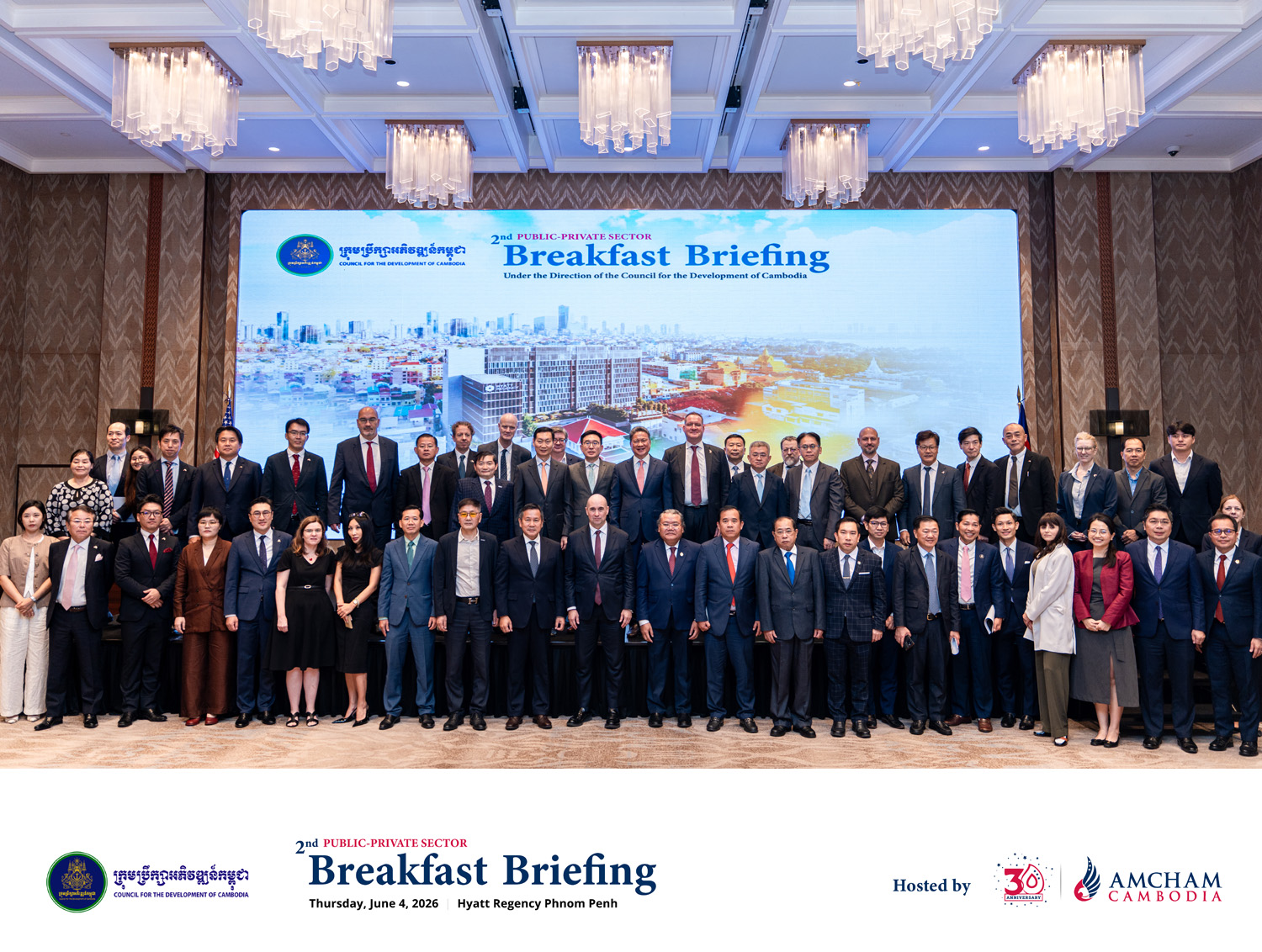
The discussion took place during the second Public–Private Sector Breakfast Briefing hosted by the American Chamber of Commerce in Cambodia (AmCham Cambodia) under the direction of the Council for the Development of Cambodia (CDC), bringing together chamber leaders and senior government officials led by H.E. Sun Chanthol, Deputy Prime Minister and First Vice Chairman of the CDC.
The meeting focused on the future development of the G-PSF, Cambodia’s principal platform for structured engagement between the government and private sector on investment, regulatory, and business issues.
Survey Finds Broad Support For Reform
Ahead of the meeting, AmCham Cambodia conducted a survey among seven international chambers to gather views on potential reforms to the G-PSF system.
Read More: Opinion: Government-Private Sector Forum 2026 – Cambodia at the Threshold
According to the findings, none of the 24 proposed reforms received opposition from participating chambers, highlighting broad support for strengthening the existing framework rather than replacing it. The survey found strong consensus around improving coordination between business chambers, the Cambodia Chamber of Commerce, government agencies, and G-PSF working groups.
Participants also identified issue tracking and earlier consultation on regulations affecting investment as key priorities for improving the investment environment. Proposals receiving the strongest support included the introduction of an evaluation framework, a quick-reference guide, centralized issue registration, formalized technical working groups, and a private-sector validation process.
Several chambers also expressed support for consolidating existing working groups rather than creating additional structures.

Debate Continues Over Governance Changes
While overall support for reform was strong, two proposals generated differing views among chambers and were earmarked for further discussion during the briefing.
These included potential co-chair term limits and the establishment of a formal conflict resolution mechanism within the G-PSF framework. Discussions also focused on the pace of implementation, with some chambers advocating for faster reforms while others recommended alignment with parallel review work currently being undertaken with support from the Cambodia Australia Partnership for Resilient Economic Development (CAPRED).
The meeting agenda included presentations from Mr. Devin Barta, President of AmCham Cambodia; Mr. Arnaud Darc, Co-Chair of G-PSF Working Group D; and Mr. Tassilo Brinzer, Chairperson of EuroCham Cambodia, before concluding remarks from H.E. Sun Chanthol.
Investor Dialogue Remains Central To Cambodia’s Business Environment
The G-PSF serves as Cambodia’s primary platform for dialogue between the government and private sector, providing a structured mechanism for raising regulatory concerns, discussing investment barriers, and advancing policy reforms through sector-specific working groups overseen by the CDC.
Representatives from several leading international business organizations participated in the meeting, including EuroCham Cambodia, the Japanese Business Association in Cambodia (JBAC), the Australian Business Association of Cambodia (AusCham), and the British Chamber of Commerce in Cambodia (BritCham).


