
As someone who remembers Cambodian football before its first real light, I believe the game in this country is now in a period of rehabilitation. I do not mean that results have simply been poor in recent months. I mean something more serious than that.
Cambodian football has already gone through a period of expansion in ambition, investment and expectation.
Read More: The business model of a Cambodian Football club – Next Step FC
It has brought in outside expertise, improved parts of its development environment and asked its supporters to believe that it was moving toward a higher level.
Yet those gains have still not been fully consolidated into stable, repeatable competitiveness. That is why I describe the present not merely as decline, but as rehabilitation.
Cambodian football has already had its dawn. In March 2015, Cambodia defeated Macau and advanced for the first time to the second round of qualification for the 2018 FIFA World Cup and the 2019 AFC Asian Cup.
That was more than a qualifying result. It was the moment Cambodian football began to speak about itself in different terms. For the first time, there was a real sense that the national team might no longer exist only on the margins of Asian football but might begin to measure itself against a more demanding future.
Cambodian football changed in tangible ways
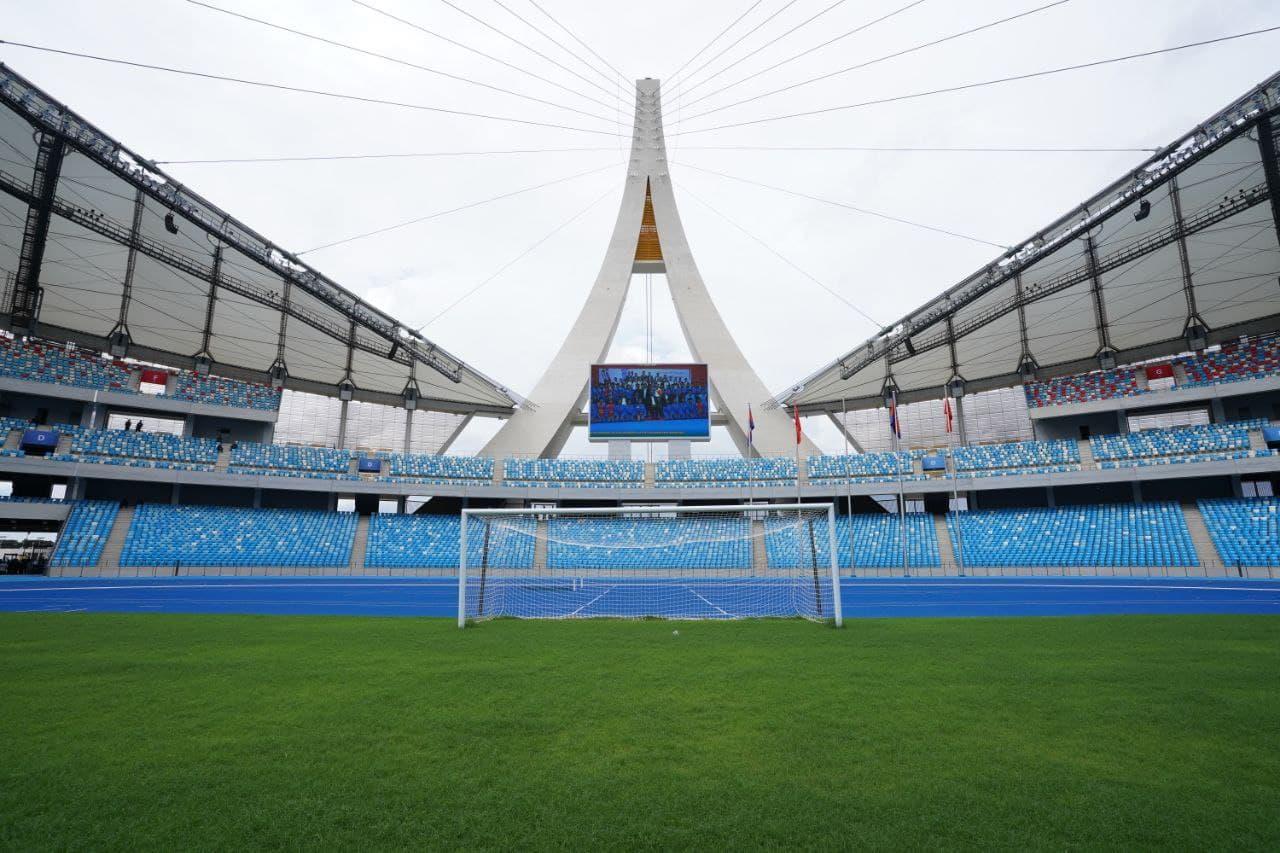
Over the decade that followed, the environment around Cambodian football changed in tangible ways. Cooperation between the Japan Football Association and the Football Federation of Cambodia gave structure to youth development and technical support around the National Football Center in Bati.
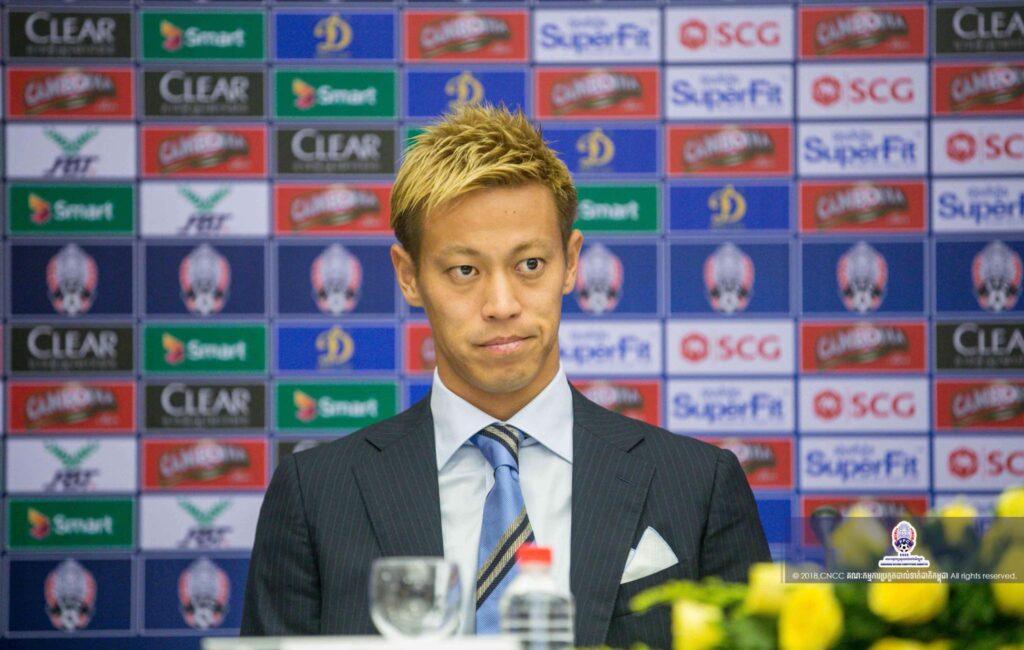
The creation of that center in 2013 signaled an attempt to treat development not as a temporary project but as a system. Later, Keisuke Honda’s appointment as general manager of the national team brought unprecedented international visibility.
His presence alone did not transform Cambodian football but it changed the scale of attention around it. At roughly the same time, the Cambodian Premier League entered a new phase under outside management, with reforms aimed at commercial growth, club standards and the broader competitive environment.
What matters is not the symbolism of individual names, but the larger pattern. For a meaningful period, there was a clear attempt to raise Cambodian football across three levels at once: the national team, youth development and the professional league.
Read More: Explainer – How to start a professional football team in Cambodia?
That is why what happened in 2023 cannot be dismissed as just another disappointing year.
At the men’s football tournament of the 32nd Southeast Asian Games, Cambodia, as host nation, failed to reach the semi-finals.
That alone was serious enough. But what followed made the moment heavier still. In the Asian qualifiers for the 2026 FIFA World Cup, Cambodia then failed to get past Pakistan, drawing 0-0 at home and losing 1-0 away to go out 1-0 on aggregate.
That result was not merely a missed opportunity. It was widely seen as a setback. Pakistan’s victory was reported internationally as its first ever win in FIFA World Cup qualifying.
From Cambodia’s side, that means the loss was not only painful in domestic terms. It also created the impression internationally that the competitive gains Cambodia believed it had been building since 2015 had not only stalled but may have gone backward.
That is the point at which the word rehabilitation becomes necessary. Cambodian football is not in this position because nothing was built. Quite the opposite. A considerable amount was built.
The problem is that too much of it has not yet taken durable form
The improvements in infrastructure, the injection of outside expertise, the heightened attention around the national team, and the ambitions attached to the league and youth system have not yet produced a level of strength that feels coherent, transferable and self-sustaining.
The issue now is not how to create the next moment of excitement. It is how to turn what has already been gained into something institutional, lasting and domestically reproducible.
That is why the role of outside experts must be discussed with more seriousness than either blind praise or reflex rejection allows.
Their value was real. Keisuke Honda brought Cambodia visibility it had rarely known. He made the national team legible to a wider football audience.
He helped create the sense that Cambodia could be spoken about beyond its usual place in regional hierarchy. External management in the league also brought new standards, or at least new awareness of standards, in areas such as club operation, facilities and the commercial presentation of the game.
But the harder question is not what outside experts brought. It is what Cambodian football was able to keep. Outside expertise can trigger change but it cannot substitute for internal capacity forever.
If knowledge, method and standards are not absorbed into domestic coaching structures, technical development, league governance and long-term planning, then reform remains tied to the tenure of individuals.
Converting outside knowledge into permanent domestic capability
Once they leave, uncertainty returns. That is the real issue. The question is not whether bringing in outside experts was right or wrong. The question is whether Cambodian football succeeded in converting outside knowledge into permanent domestic capability.
The debate over naturalized players belongs in the same framework. Naturalization can make sense as a short-term measure. A national team that lacks depth, physical profile, international experience or competitive intensity in certain positions may gain immediate benefits from adding such players.
But excessive hope should not be placed on that policy. Naturalization should not become the central idea through which a national team imagines its future. At most, it should be understood as a limited instrument for maintaining a minimum competitive level while deeper domestic work continues.
The broader Asian picture makes this clear. Japan went through periods in which naturalized players played an important role in the national team’s development.
But today Japan reaches the FIFA World Cup with a squad built overwhelmingly through its own player development system and the competition produced by its own football culture.
China, too, has experimented with naturalized players in recent years, yet the overwhelming majority of its national team remains Chinese.
The lesson is straightforward. In the long run, national teams are not lifted by naturalization itself. They are lifted by grassroots football, youth development, domestic leagues, coaching education and the ability to produce competition from within.
There is no need to reject naturalization outright. But it should not sit at the center of hope. Before asking how many players can be added through naturalization, Cambodian football should be asking how much competition it is creating at grassroots level, how many players it is genuinely developing, and whether its own structures are producing enough internal pressure to raise standards over time.
The future of the national team will ultimately depend not on how many holes can be patched from outside, but on how much strength can be produced from within.
The breakthrough of 2015 and the growth period that followed
This brings us to what may be the most undervalued asset in Cambodian football today: the generation of players who lived through the breakthrough of 2015 and the growth period that followed.
They are not merely former internationals. They are the generation that knew the game before the environment improved, lived through the years when the environment began to change, experienced the arrival of deeper cooperation with Japan, saw the national team move into a larger public spotlight under Honda, and then had to absorb the disappointments of 2023.
In other words, they are the generation that knows from direct experience what Cambodian football tried to become, where it succeeded, where it stalled and what remained missing.
If many of those players are now moving into second careers, Cambodian football cannot leave their place in the game to chance.
Their experience must be positioned deliberately. Youth development, national-team staffing, scouting, opposition analysis, club technical departments, player education, grassroots promotion, administrative liaison and media communication all require people who understand not only football in the abstract, but Cambodian football in particular.
It is not enough to honour such figures as former national-team players. Their experience has to be connected to institutions. If it is not, then Cambodian football risks repeating one of its deepest problems: trying to solve new setbacks without carrying forward the hard lessons of the previous era.
Supporters must also be part of this conversation. A national team is not shaped only by its federation, coaches and players. It is also shaped by what its supporters demand, what they tolerate, what disappoints them and what standards they insist upon.
Broader sense of possibility to Cambodian football
After the failures of 2023, many supporters responded to Honda’s departure first with gratitude. In one sense, that was understandable. He did bring attention, visibility and a broader sense of possibility to Cambodian football.
But gratitude and rigorous judgment must coexist. Appreciation for symbolic value is one thing. Serious evaluation of competitive failure is another. If those two are blurred together, then the standards around the national team begin to blur as well.
Support does not mean unconditional protection. To support a national team is not merely to applaud it. It is also to recognize defeat as defeat, to say clearly when expectations have not been met, and to keep asking what conditions are necessary for genuine progress.
The higher the expectations become, the stricter the evaluation of failure must be. That is not disloyalty. It is maturity.
More than that, supporters should not think of themselves as passive spectators. They are one of the most important forms of external pressure in the game.
Federations, coaches and players cannot always maintain standards by themselves. Someone must insist, from outside the internal structure of the game, that results still matter, that defeat is not to be blurred, and that standards are not to be quietly lowered.
That pressure must come, in part, from supporters. If supporters reduce their demands, the standards of the national team will fall with them.
Cambodian supporters must therefore understand that they are not just an audience. They are a force that helps determine whether the game remains serious with itself.
In the end, Cambodian football does not need another high-profile name or another short-term fix. What it needs is a more exact reckoning with everything gained since 2015, and a serious effort to turn those gains into durable domestic strength.
What, precisely, did cooperation with the Japan Football Association leave behind? Where has the work done in Bati produced results, and where has it stalled?
What did the Honda era and the wider period of outside expertise give Cambodia, and what did they fail to leave as institutional legacy? At what point does naturalization cease to be a reasonable supplement and become a way of disguising structural weakness?
Where should the post-2015 generation now be placed in the architecture of the game? And what standard are supporters prepared to continue demanding of the national team?
These are not secondary questions. They are the real content of rehabilitation. Cambodian football has already had its dawn.
It is no longer a football nation waiting for first light. If that is true, then the task now is not to look as though it is changing, but to decide clearly what should be inherited, what should be corrected and what should be retained as Cambodia’s own strength.
If there has been a growth period, then a reckoning with that period cannot be avoided. The failures at the 32nd Southeast Asian Games and in the 2026 FIFA World Cup qualifiers made that impossible to postpone.
Whether the next decade becomes more meaningful than the last will depend on whether Cambodian football now has the discipline to turn its experience into institutions of its own.
Masayori Ishikawa is an AIPS member based in Cambodia, who has been reporting on the intersection of sports, culture and international relations in Southeast Asia. This article was first published in Cambodianess.