
In the landscape of emerging markets, the transition from ad-hoc public and private sector engagement to institutionalized reform is often the missing link in economic maturity. For Cambodia, this link is forged through the Government-Private Sector Forum (G-PSF). Once a nascent platform for dialogue, the G-PSF is evolving into a sophisticated, high-performance Public Private Dialogue for Results (PPDR) system[1]. By treating the G-PSF not merely as a meeting format, but as a tangible development product, Cambodia has created a reliable engine for policy manufacturing, regulatory reform, risk mitigation and economic diplomacy.
The PPDR Approach: From Dialogue to Product
The traditional view of Public-Private Dialogue (PPD) often centers on the point of engagement between a government and the private sector. However, the PPDR Approach[2]—the second-generation PPD methodology currently driving the G-PSF—redefines dialogue as a results-oriented process that is underpinned by institutional alignment, defined inputs and measurable outputs.
Read More: Opinion – Government-Private Sector Forum 2026 – Cambodia at the Threshold
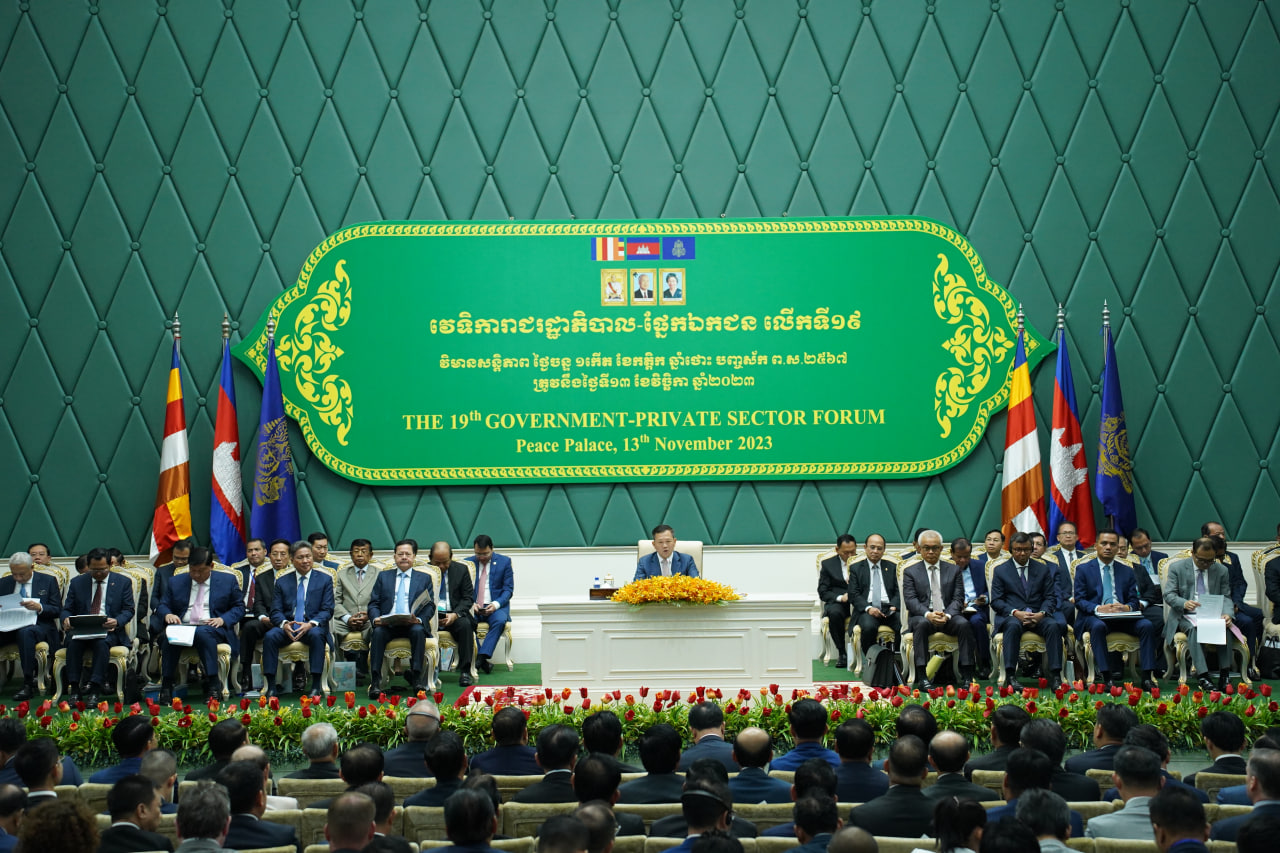
Under this model, the Cambodian G-PSF is recognized as a discrete product comprising written procedures, a digital monitoring backbone, and robust institutional support. It operates on a dual-result logic: first, building the institutional framework necessary for engagement, and second, delivering the specific policy outcomes that drive national progress. Since the 19th G-PSF Plenary in November 2023, this shift toward productization is moving Cambodia from an emerging to a mature PPDR model, where efficiency and accountability are built into the system’s DNA.
A Triple-Tiered Engine of Reform
To understand the G-PSF as a product, one must look at its structural integrity. It functions through a three-tier architecture that ensures every issue raised by the private sector has a clear pathway to resolution:
- The Plenary Session: Chaired by the Prime Minister, the decisions made during the G-PSF plenary carry the weight of Cabinet decisions, providing the G-PSF product with a demonstrable illustration of political will.
- 16 Technical Working Groups (TWGs): These are the engine rooms of the G-PSF System. Co-chaired by Government Ministers and private sector leaders, these groups cover essential sectors—from Agriculture and Tourism to Taxation and Customs—creating a continuous production line of recommendations.
- The Secretariats: Housed within the Council for the Development of Cambodia (CDC) and the Cambodia Chamber of Commerce (CCC), these units act as facilitators, convenors and quality control. They implement the process that has guided the G-PSF from the early 2000s. This process has now been drafted into Standard Operating Procedures (SOPs) that will ensure that this complex, multi stakeholder engagement, is transparent and data-driven.
Manufacturing Solutions: Measurable Impact
The results produced by the G-PSF are verifiable policy reforms. The data following the 19th G-PSF is telling: the implementation rate for the 179 reforms announced by the Prime Minister have reached 93%. Furthermore, 82% of the 196 new requests raised post-plenary have already been resolved.
This level of efficiency positions Cambodia at the high end of the PPD Spectrum. Rather than a passive recipient of mandates, the private sector acts as a co-designer of the regulatory landscape. The G-PSF is a partnership between the public and private sector. It signals to the global market that Cambodia’s business environment is increasingly defined by mutual accountability rather than top-down decree. The G-PSF remains a work in progress. As long as the elements of the G-PSF are driven by the PPDR methodology then the potential for the G-PSF to drive reform and policy implementation are considerable.
A Magnet for Investment and Technical Assistance
For foreign investors, the G-PSF serves as a critical risk-mitigation tool. In a region where regulatory shifts can be unpredictable, the CDC’s digital tracking system—featuring a live dashboard and dataset—provides the transparency required for long-term capital commitment. Investors gain a clear pathway to resolve bottlenecks, ensuring that the regulatory framework evolves in alignment with global standards.
Furthermore, framing the G-PSF as a ‘product’ can change the manner in which Development Partners (DPs) are engaged in the policy reform framework. By defining the G-PSF system’s modular components (such as IT infrastructure, SOPs, Secretariat support, research, sector support or capacity building for Business Membership Organizations), the CDC provides clear entry points for technical assistance via the G-PSF. The Cambodian Chamber of Commerce and sector focused BMOs also provide entry points to supporting the G-PSF.
By focusing on the accountability mechanism rather than just the individual grievances, the G-PSF serves as a risk-mitigation tool for foreign investors. This structure signals that Cambodia’s business environment has a G-PSF mechanism that is predictable and verifiable.
In the G-PSF as a product, Development Partners should also no longer consider their investments in private sector development as short term projects. Rather, in the G-PSF they are contributing to a sustainable delivery vehicle with twenty-five years of institutional memory. In this context, Development Partner support is contributing to improving the status of a PPDR from nascent to emerging, from emerging to mature and from mature to institutionalized. Whether it is the Australian Government’s support for the IT framework or GIZ’s work on provincial dialogue, these contributions are institutionalized within the G-PSF, ensuring impact long after a specific donor cycle ends.
Building Civil Society and Professional Advocacy
Beyond economics, the G-PSF has been foundational to the development of Cambodia’s post-war civil society. In 1999, private sector advocacy was nascent; today, the G-PSF is a primary catalyst for building the capacity of Business Membership Organizations (BMOs). By providing a structured environment for advocacy, the forum forces the private sector to evolve, professionalize its research, and sharpen its service orientation.
This constructive tension between a reform-minded government and an evolving private sector is exactly what a mature economy requires. It ensures that the demand side of reform (the private sector) is as sophisticated as the supply side (the government).
Conclusion: The Road to 2050
As Cambodia looks toward its goal of becoming a high-income by 2050, the G-PSF stands as its most sophisticated instrument of economic diplomacy. It has moved beyond the ‘issue of the day’ to become a strategic pillar of national development.
By applying the PPDR methodology to the G-PSF, Cambodia hasn’t just improved dialogue—it has manufactured a system of structural reliability. This G-PSF product ensures that for every challenge the private sector faces, there is a technical working group to analyze it, a secretariat to track it, a Minister to resolve it and the Prime Minister to champion it as a critical national function. In the global race for capital and expertise, as the G-PSF continues to evolve it will be an increasingly important product that will have a profound impact on Cambodia’s economic development.
James Brew is a global expert on Public Private Dialogue (PPD). He has previously worked with the World Bank’s PPD Global Products team. He developed the Public Private Dialogue for Results (PPDR) concept to better focus on impact. His involvement with the G-PSF Cambodia started in 2002.
[1] Brew, J.P; The Public Private Dialogue (PPD) System, www.publicprivatedialogue.org, Sept. 2022
[2] Brew, J.P; The Public Private Dialogue for Results (PPDR) Approach, www.publicprivatedialogue.org, Feb. 2023