
Cambodia Investment Review
Cambodian commercial banks are holding their lowest level of readily available U.S. dollar liquidity at the National Bank of Cambodia (NBC) in more than a decade, according to a new assessment by the ASEAN+3 Macroeconomic Research Office (AMRO), highlighting a potential vulnerability in one of the world’s most highly dollarized financial systems.
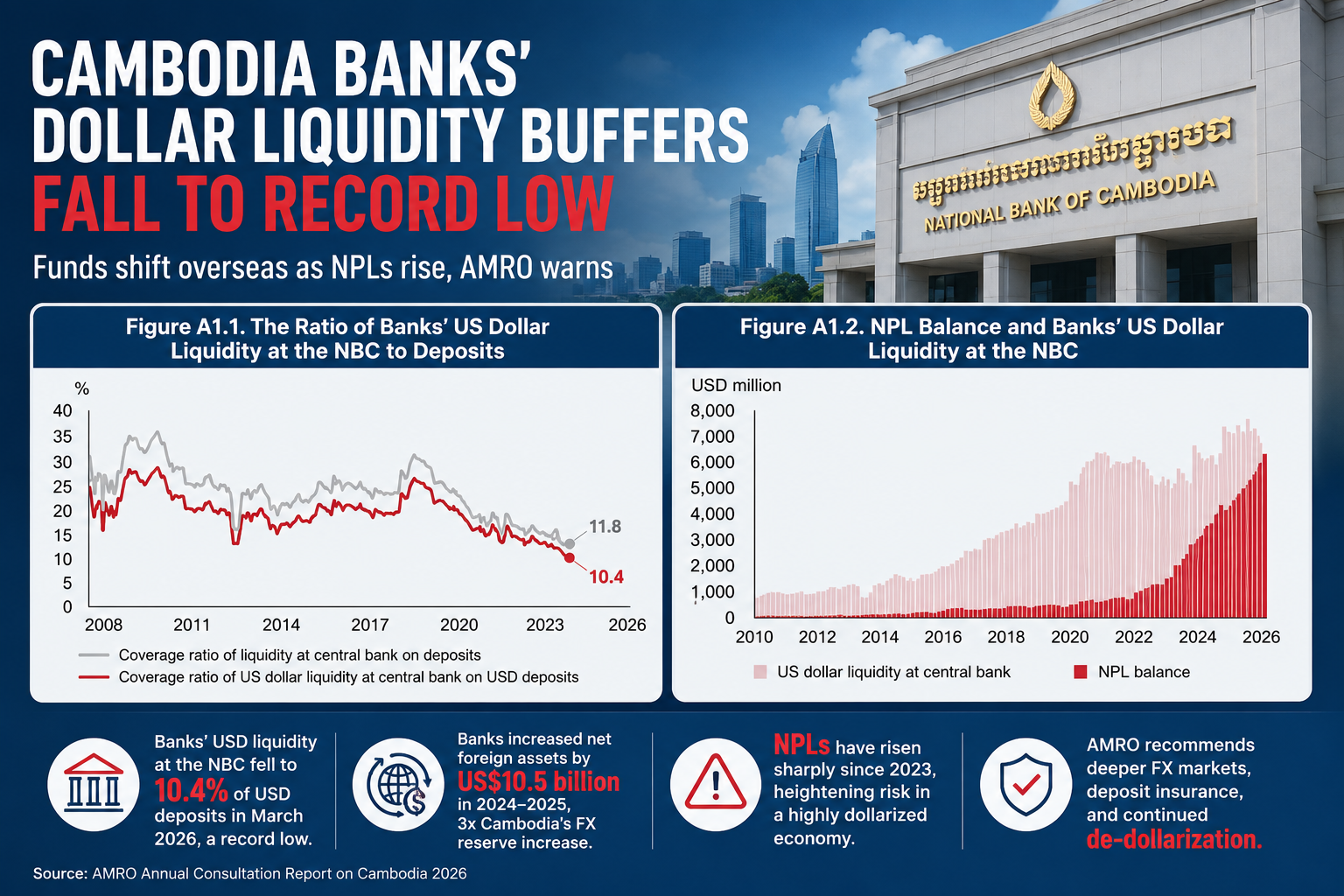
The report found that banks’ immediately accessible U.S. dollar liquidity held at the central bank declined to an estimated 10.4% of total U.S. dollar deposits as of March 2026, down from 12% at the end of 2025, representing the lowest level on record under AMRO’s analytical measure.
Rather than indicating a shortage of capital, AMRO said the decline reflects a shift in how banks are deploying their funds. Financial institutions have increasingly redirected capital into overseas assets, seeking higher returns amid weaker domestic lending opportunities and rising credit risks.
Banks Shift Capital Abroad
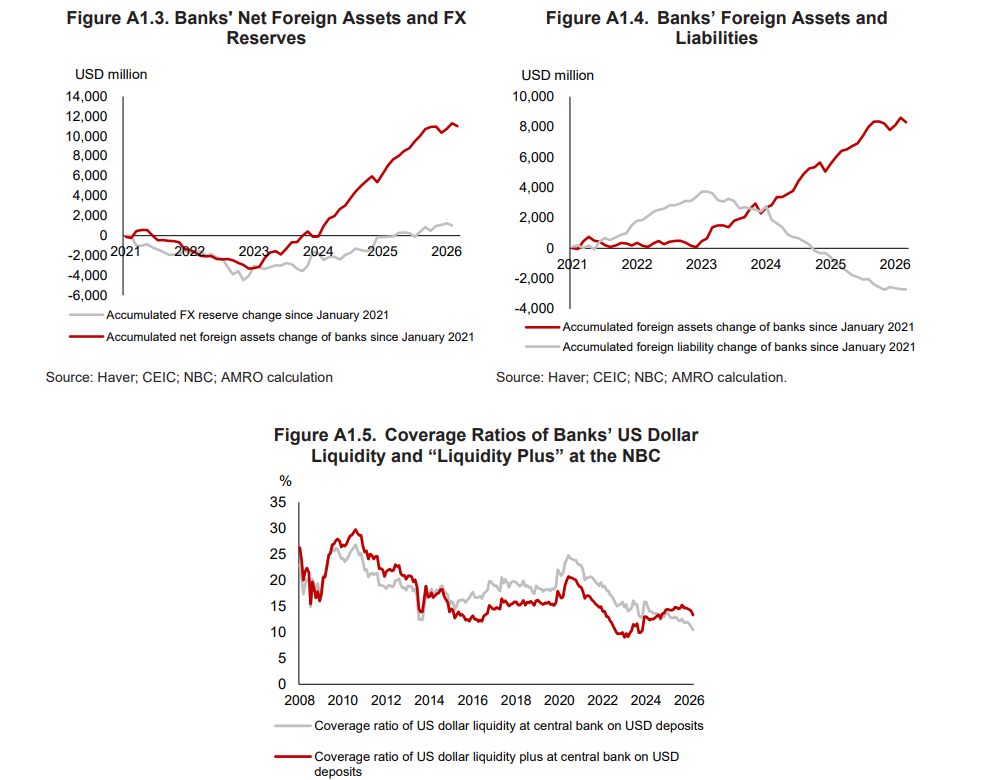
According to the report, Cambodian banks increased their net foreign assets by approximately US$10.5 billion during 2024 and 2025, around three times the increase in Cambodia’s official foreign exchange reserves over the same period.
The report said banks have simultaneously expanded foreign asset holdings while reducing foreign liabilities, resulting in a significant net outflow of U.S. dollar liquidity from the domestic banking system.
AMRO noted this strategy is commercially rational for individual banks facing slowing credit demand and elevated risks in the domestic market. However, if a period of financial stress were to emerge, a larger share of banking sector liquidity would be held offshore rather than immediately available within Cambodia.
Market participants cited in the report believe many of these overseas assets consist of trade settlement funds and short-term deposits that remain relatively liquid and could potentially be repatriated if required.
Dollarization Remains a Structural Risk
Cambodia remains one of the world’s most dollarized economies, with 83.4% of broad money (M2) denominated in U.S. dollars at the end of 2025, according to the report.
This limits the NBC’s ability to act as a traditional lender of last resort during periods of market stress because it cannot create U.S. dollars in the same way that many central banks can create their domestic currency. While the NBC has introduced liquidity facilities to support the Cambodian riel and aligned reserve requirements between U.S. dollar and riel deposits, AMRO said the structural dependence on the U.S. dollar continues to expose the financial system to liquidity risks.
Rising Non-Performing Loans Increase Pressure
The report also highlighted that rising non-performing loans (NPLs) could amplify liquidity pressures during periods of financial instability.
Although AMRO stressed there is no direct relationship between higher NPLs and U.S. dollar liquidity, deteriorating asset quality could reduce banks’ cash inflows and potentially weaken depositor confidence if financial conditions worsen.
In Cambodia’s highly dollarized banking system, where no formal deposit insurance scheme currently exists and U.S. dollar lender-of-last-resort capacity is limited, maintaining sufficient liquidity buffers becomes particularly important.
Overseas Assets Could Strengthen Liquidity
AMRO said the outlook would improve considerably if banks redirected even part of their overseas investments back into Cambodia.
Its analysis suggests that reallocating just one-quarter of banks’ net foreign assets into domestic liquidity buffers would significantly improve the banking system’s coverage ratio and strengthen depositor confidence without requiring banks to unwind all of their international investments.
Policy Recommendations
To strengthen resilience, AMRO recommended several policy measures, including:
- Developing a deeper domestic interbank lending and foreign exchange swap market.
- Expanding the supply of U.S. dollar-denominated domestic assets, such as government securities.
- Introducing a deposit insurance scheme to strengthen confidence in the banking system.
- Exploring international currency swap arrangements to support short-term U.S. dollar liquidity if required.
- Continuing the NBC’s long-term de-dollarization strategy by expanding the use of the Cambodian riel and strengthening the domestic payment ecosystem.
AMRO concluded that while banks continue to hold substantial foreign assets that may remain liquid, policymakers should continue closely monitoring U.S. dollar liquidity conditions to ensure the financial system remains resilient during periods of market stress.