

Cambodia Investment Review
The World Bank has urged Cambodia to introduce targeted, time-bound cash transfers for vulnerable households as rising fuel prices, slowing economic growth and broader economic pressures increasingly threaten livelihoods across the Kingdom.
In its latest Cambodia Economic Update, Navigating Shocks, released on June 9, the World Bank warned that a global oil price shock triggered by conflict in the Middle East is raising transport and production costs throughout the economy, putting pressure on businesses while reducing the purchasing power of Cambodian households.
The recommendation comes as Cambodia faces a combination of economic challenges, including a prolonged property sector downturn, weaker remittance inflows following the return of nearly one million migrant workers, and broader uncertainty stemming from the ongoing Thai border crisis. Businesses and communities are also adjusting to the economic effects of recent scam center closures and enforcement operations, which have reduced activity in some local economies despite being viewed as positive for Cambodia’s long-term investment reputation.
Inflation Hits Low-Income Households Hardest
According to the report, headline inflation rose to 5.8 percent in April 2026, driven largely by higher fuel and transportation costs.
The World Bank estimates that a 10 percent increase in fuel prices could increase Cambodia’s poverty rate by 1.4 percentage points, highlighting the disproportionate impact of rising living costs on low-income households.
While Cambodia’s economy continues to show resilience, supported by foreign investment and export growth, the World Bank warned that many vulnerable families remain exposed to economic shocks.
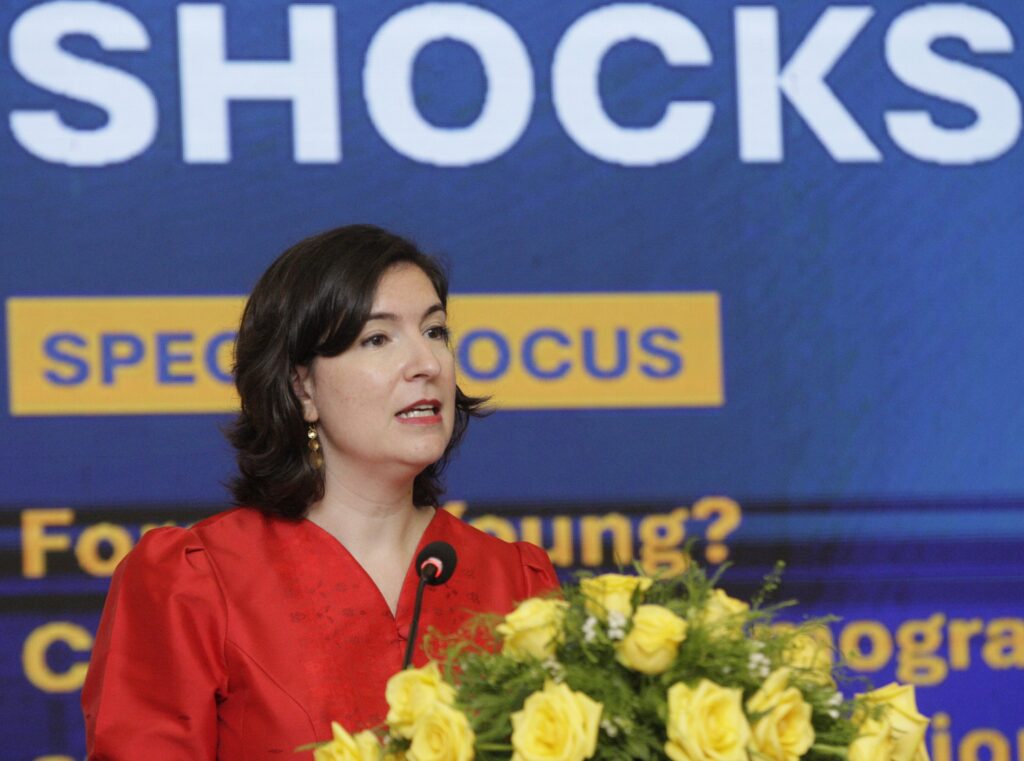
“Cambodia’s economy is holding in the face of simultaneous shocks, demonstrating a resilience that can be sustained through targeted policy action to protect jobs and livelihoods,” said Tania Meyer, World Bank Country Manager for Cambodia.
Cash Transfers Recommended Over Broad Fuel Subsidies
Rather than implementing broad fuel-tax reductions or universal subsidies, the World Bank recommends targeted and temporary cash transfer programmes aimed specifically at households most affected by rising costs.
The report argues that targeted support would provide more effective relief while limiting pressure on public finances and ensuring government resources are directed towards those most in need.

The World Bank also called on policymakers to strengthen domestic revenue collection in order to sustain critical investments in healthcare, education and social protection programmes.
In rural areas, the report recommends accelerating fertilizer imports and promoting fuel-efficient farming practices to help farmers maintain productivity and incomes despite rising input costs.
Jobs and Livelihoods Remain a Priority
Although Cambodia attracted $5.1 billion in foreign direct investment during 2025 and goods exports expanded by 17.7 percent during the first quarter of 2026, the World Bank expects overall economic growth to moderate to 3.9 percent this year before recovering to 4.9 percent in 2027.
The institution said protecting jobs and household incomes should remain a key policy priority as the country navigates multiple economic headwinds.
A special chapter of the report also highlights Cambodia’s demographic transition, noting that the country’s working-age population is expected to peak around 2043.

The World Bank argues that creating quality employment opportunities, investing in human capital and strengthening social protection systems will be critical if Cambodia is to maximise its demographic dividend and achieve its Vision 2050 development goals.
“With the working-age population share projected to peak around 2043, the next 15 to 20 years are decisive for Cambodia’s future,” Meyer said. “Investing in people — in education, in jobs, in new engines of growth — is what will turn Cambodia’s demographic window into its greatest competitive advantage.”
The Cambodia Economic Update is published twice annually by the World Bank and assesses the country’s economic outlook, risks and policy priorities.