
By David Van
Cambodia today stands at an important crossroad in defining what it truly means to support “local products” and “national industries.” For years, terms such as “Local Brand,” “Cambodian Brand,” and “Cambodian Products” have been used loosely in the marketplace, often interchangeably. Yet behind these labels lies a far more complicated reality—one that increasingly raises questions about authenticity, consumer transparency, and the actual state of Cambodia’s industrial development.
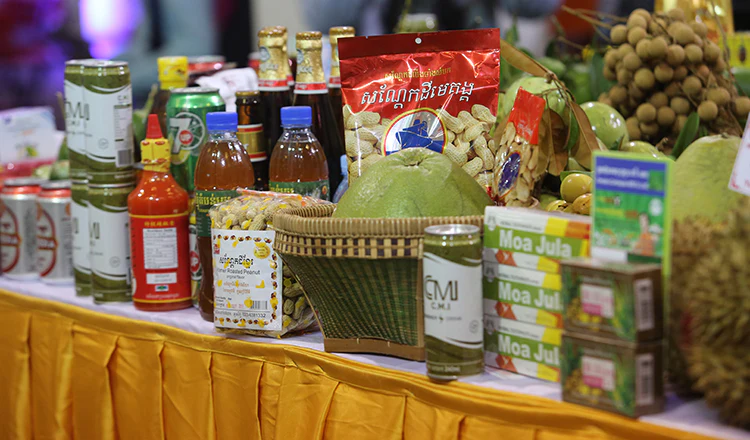
In recent years, due to Thai products boycott, there has been a visible rise in Cambodian-branded products across supermarkets, retail stores, cafés, and digital platforms. On the surface, this appears to reflect the emergence of a stronger local economy and a growing sense of national pride. Consumers are encouraged to “support Cambodian brands,” while businesses proudly market themselves as local success stories. However, a deeper examination reveals that many of these so-called Cambodian brands are, in reality, heavily dependent on imported goods, imported raw materials, imported packaging, imported expertise, and in some cases, fully manufactured overseas products simply relabeled under a Cambodian identity.
Read More: Khmer Can Do Exhibition Highlights Cambodia’s Rising Entrepreneurial Spirit
This distinction matters greatly.
A product carrying a Cambodian logo or Khmer-inspired packaging does not necessarily mean that it is genuinely produced in Cambodia. In many cases, the value creation taking place domestically is minimal. Some products are entirely manufactured abroad and merely distributed locally under a Cambodian-owned trademark. Others undergo only simple packaging or assembly in Cambodia while the overwhelming majority of production inputs originate elsewhere. The result is a marketing landscape where “Cambodian brand” often becomes more of a commercial identity than an indicator of true domestic production capability.
Recognizing this growing ambiguity, the Royal Government of Cambodia is now finalizing clearer inter-ministerial definitions surrounding terms such as “Products of Cambodia,” “Made in Cambodia,” “Sourced from Cambodia,” “Packaged in Cambodia,” and related classifications. This effort is not merely administrative or technical. It represents an important attempt to establish domestic rules of origin and create greater honesty, accountability, and transparency in the marketplace.
Such definitions are essential because they determine what Cambodia genuinely produces versus what Cambodia merely trades, imports, repackages, or markets.
At the heart of the issue lies a deeper structural concern about the Cambodian economy itself.
Cambodia’s economy remains overwhelmingly trade-driven and consumption-based. Despite years of impressive GDP growth figures and optimistic economic narratives, the country still struggles to establish strong industrial foundations. Much of the economy revolves around import distribution, real estate, retail trade, tourism, construction, and low-value assembly operations. Genuine manufacturing capacity with significant local value addition remains extremely limited.
Even sectors commonly described as “manufacturing” often contain very low domestic content. Raw materials are imported. Machinery is imported. Technology is imported. Skilled expertise is imported. In many industries, Cambodia contributes mainly low-cost labor, simple assembly, or packaging functions rather than high-value industrial production. The local supply chain ecosystem remains shallow, fragmented, and underdeveloped.
This creates a difficult but necessary question:
Can a country realistically aspire to middle-income or high-income status without building real industrial depth, domestic technological capability, and meaningful capital formation?
Economic statistics alone can create an illusion of progress. GDP per capita may rise. Consumption may increase. Urban skylines may expand. Yet beneath these numbers, the structural reality may remain fragile. A country cannot sustainably advance if its economy lacks strong productive roots, diversified industrial clusters, technological sophistication, and a highly skilled workforce capable of generating innovation and competitiveness.
In Cambodia’s case, one of the greatest long-term challenges has been the inability to develop a strong and self-sustaining industrial cluster. For decades, policymakers and private sector actors have discussed industrialization, diversification, and value-added production. Yet Cambodia still struggles to establish even a single globally competitive industrial ecosystem with deep local supplier networks, strong supporting industries, domestic research capacity, and advanced human capital.
Without these foundations, economic growth risks becoming hollow rather than transformative.
This is precisely why the debate surrounding “Cambodian Products” versus “Cambodian Brands” is so important. It is not simply about marketing terminology. It reflects a larger national conversation about economic identity, industrial sovereignty, and the future direction of Cambodia’s development model.
Consumers today are becoming more conscious and more discerning. Many genuinely wish to support products that are authentically Cambodian—not merely in branding, but in production, sourcing, craftsmanship, innovation, and economic contribution. They want to know whether their purchases are actually helping local farmers, local manufacturers, local workers, local engineers, and local entrepreneurs build sustainable productive capacity within the country.
If transparency is absent, consumer trust can gradually erode. When products marketed as “local” are discovered to be largely imported or minimally processed domestically, it risks creating skepticism toward the broader “buy local” movement itself. Over time, this could weaken the very sense of national pride and economic patriotism that policymakers are trying to encourage.
At the same time, it is important to acknowledge that Cambodia remains in the early stages of industrial development. Building real manufacturing ecosystems takes decades of coordinated investment in infrastructure, education, technology transfer, logistics, finance, institutions, and industrial policy. No country industrializes overnight. The challenge therefore is not to criticize local businesses unfairly, but rather to encourage a more honest and mature national discussion about where Cambodia truly stands economically—and where it realistically wants to go.
Moving forward, clearer definitions and stricter domestic rules of origin can play a critical role in creating a healthier economic ecosystem. Businesses that genuinely manufacture locally and create meaningful domestic value should be distinguished from firms that primarily engage in trading, repackaging, or import distribution. This differentiation is important not only for consumers, but also for policymaking, incentives, taxation, trade promotion, and industrial strategy.
Ultimately, Cambodia’s long-term success cannot rely solely on commerce, branding, or statistical growth narratives. Real economic resilience comes from building productive capacity, nurturing skilled human capital, developing strong industrial clusters, and creating industries capable of competing regionally and globally.
Until Cambodia succeeds in building these deeper foundations, the country risks remaining economically vulnerable—an economy active in trade and consumption, but still lacking the industrial depth necessary for truly sustainable national advancement.
David VAN
9-5-2026
David Van is a veteran Cambodian business strategist and public policy advisor with over 45 years of multinational corporate, trade, and investment experience across Southeast Asia. A pioneer in Public–Private Partnerships (PPP) and blended finance, he has helped shape Cambodia’s trade, transport, skills, and industrial development policies while advising governments, multilateral agencies, and global corporations.