
By Chunyu Yang, Xiaotian (Tina) Liu
Cambodia’s robust economic growth has long been supported by garment assembly and other labor-intensive manufacturing. Yet its exports remain concentrated in low-value-added segments, particularly garments, footwear, and travel goods, while higher-value-added manufacturing remains limited.
As Cambodia prepares to graduate from the least developed country (LDC) status by 2029, moving up the value chain is becoming increasingly important. A recent AMRO analysis highlights an often-overlooked obstacle: electricity costs and supply reliability.
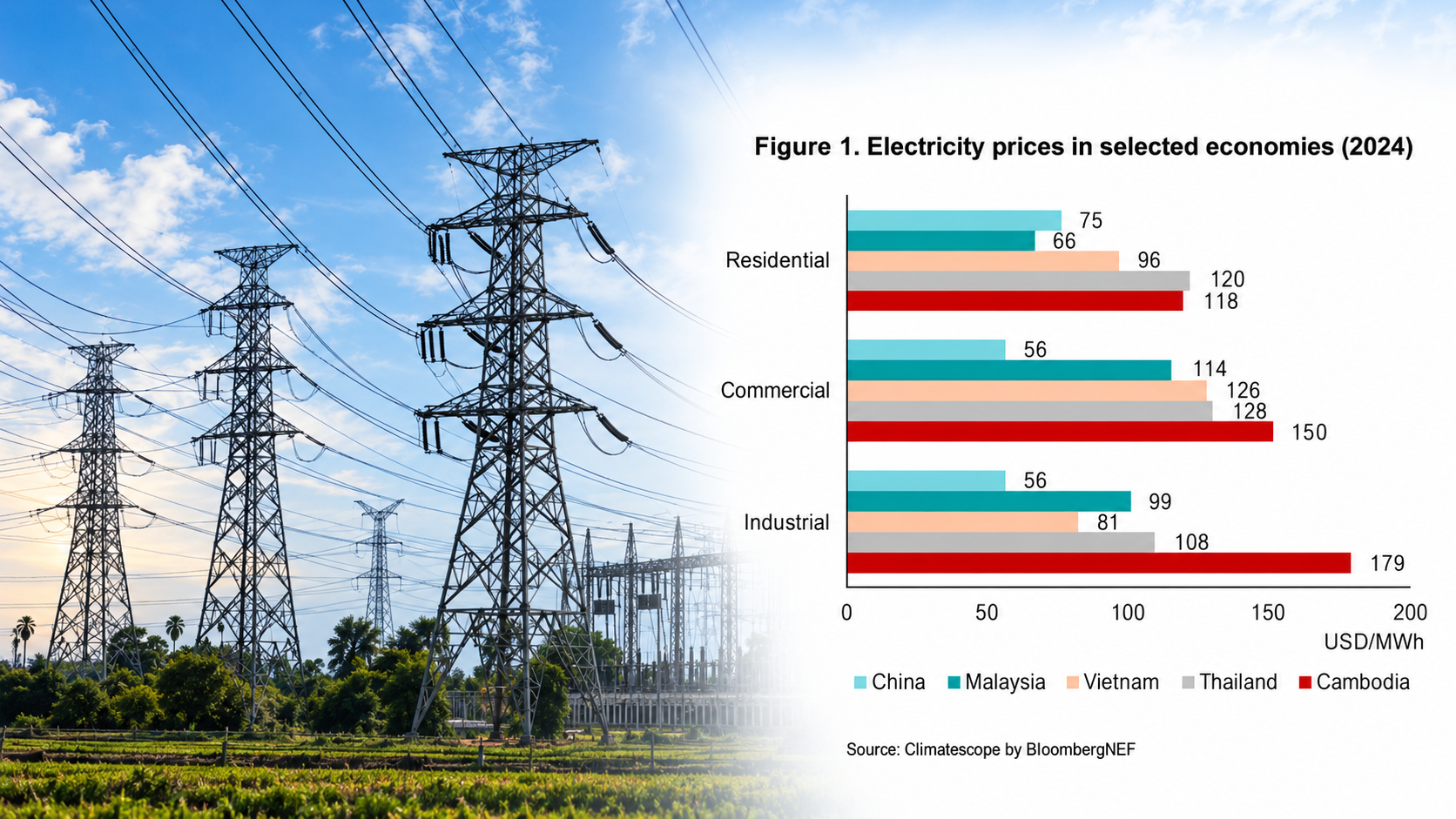
Cambodia’s electricity tariffs remain among the highest in ASEAN. In 2024, its industrial tariff was more than twice that of Vietnam, putting Cambodia at a disadvantage in competing for manufacturing investment (Figure 1).
Reliability is another concern. According to the 2023 World Bank Enterprise Survey, 55.7 percent of manufacturing firms experienced electricity outages. Cross-country evidence also suggests that outages weigh on firm productivity.

Substantial progress, but important gaps remain
Cambodia has made substantial progress in developing its electricity system over the past two decades. Access is now nearly universal: licensed electricity coverage extends to almost all villages, while about 95.9 percent of households had access to electricity in 2025.
Available power capacity reached around 5,900 megawatts (MW) in 2025, including domestic generation and imported electricity. Total electricity supplied rose by 12 percent during the year, while solar power continued to expand. Nevertheless, coal and hydropower remained the main sources of domestic electricity generation.
Important gaps remain. Imported electricity accounted for 7.9 percent of total supply in 2025, while coal accounted for 47.7 percent of domestically generated electricity. Cross-border transmission constraints, conditions in neighboring power systems, and external price shocks can affect supply and costs.
Hydropower accounted for a further 39.7 percent of domestically generated electricity. With limited energy storage capacity, the electricity system remains vulnerable to seasonal fluctuations in hydropower generation caused by drought and erratic rainfall.
Transmission bottlenecks, overloaded substations, and high technical losses also constrain electricity delivery and Cambodia’s ability to make full use of its growing solar resources.
Moving up requires more reliable electricity
Producing fabric is far more electricity-intensive than assembling garments. Illustrative US manufacturing data show that, for every USD 1 million of value created, garment assembly consumes around 147 megawatt-hours (MWh) of electricity. Producing yarn and fabric consumes around 932 MWh—more than six times as much (Figure 2).
The same broad pattern can be seen in electronics and automotive manufacturing. Basic assembly generally requires less electricity, while semiconductor production, automotive component manufacturing, metal stamping, and vehicle coating require larger and more reliable electricity supplies.
These figures do not measure electricity use in Cambodia directly but illustrate how electricity requirements differ across manufacturing activities and production stages.

These differences matter for Cambodia’s efforts to move up the value chain. Under the “smile curve” framework, assembly typically generates relatively little value added, while activities toward either end of the chain—from research and design to marketing and after-sales services—add more value (Figure 3).
Cambodia is unlikely to shift immediately into the highly skill-intensive activities at the far ends of the curve. A more realistic near-term path is to move from basic assembly into deeper processing and component manufacturing. Many of these stages require more—and more reliable—electricity. Electricity costs and reliability will become increasingly important as Cambodia seeks to move beyond assembly.

Cambodia’s export structure reflects its current position in the value chain. In garments, the electricity-intensive fabric stage is largely absent, with nearly all fabric imported. Fabric imports account for around half of the value of Cambodia’s garment exports. Automotive activity is similarly concentrated in completely knocked down (CKD) assembly, in which imported components are assembled locally. Both sectors remain focused on basic assembly, limiting domestic value creation.
Tire manufacturing offers a contrasting example. Tire exports rose nearly fourfold between 2023 and 2025, driven by the establishment of factories in several special economic zones with more reliable electricity supplies. The Sihanoukville Special Economic Zone, for example, operates a dedicated 100 MW coal-fired power station that provides a stable electricity supply for tire production.
This experience suggests that reliable electricity can enable higher-value-added manufacturing. Cambodia’s domestic rubber base also offers further potential to deepen local value chains by strengthening links between rubber producers and tire factories.
Strengthening electricity supply to support upgrading
Easing electricity constraints will be critical to Cambodia’s industrial upgrading. Solar generation offers considerable potential, given the country’s abundant resources, falling panel and battery costs, and shorter development timelines than coal-fired or hydropower projects. Solar power accounted for 10.2 percent of total electricity supply in 2025: 8.9 percent from solar power stations and 1.3 percent from rooftop installations.
Expanding generation alone will not be enough. Reliable and affordable power for industrial use will also require a stronger transmission backbone, greater energy storage capacity, lower transmission losses, and better-connected domestic networks.
Deeper integration into the ASEAN Power Grid could diversify Cambodia’s electricity supply, strengthen energy security, and improve access to lower-cost power. Together, these improvements could support Cambodia’s move into higher-value-added production as its graduation from LDC status approaches.