
By Henry Henderson
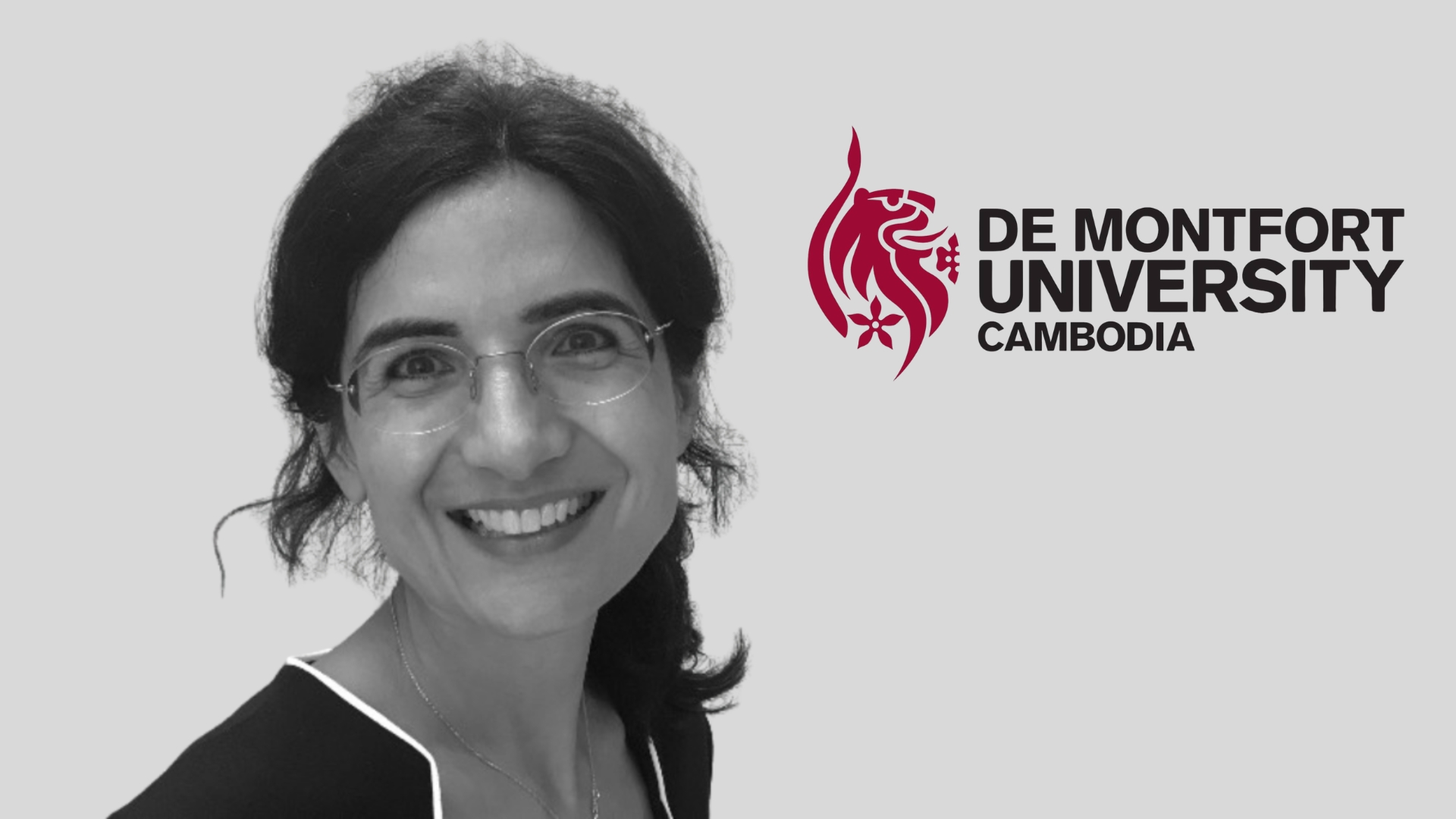
EuroCham Junior Communications Officer Henry Henderson spoke with Sakina Zafar, President of De Montfort University Cambodia, about launching Cambodia’s first British university branch campus and expanding access to international education in the Kingdom.
In the conversation, Sakina reflects on her global career across the UK, the Middle East, Central Asia, and Southeast Asia, the university’s mission to make British education more accessible, and the growing importance of employability, industry collaboration, and international mindsets in preparing Cambodia’s next generation of professionals.
Read More: EuroCham Interview: Eric Lou on Simplifying Digital Systems for Cambodian Businesses
Henry: To start, can you share a little bit about yourself, and a little bit about De Montfort University for our readers?
Sakina: My name is Sakina, and I am the President of De Montfort University Cambodia. De Montfort University Cambodia is the first UK university branch campus in Cambodia. The university opened back in October 2024, and we have now been running for about 19 months, so just over a year and a half.
Three decades working across education systems
Henry: You have spent nearly three decades working across education systems in the UK, the Middle East and Central Asia, as well as Southeast Asia. How has that shaped your leadership philosophy, and what inspired you to take on the challenge of opening Cambodia’s first British university?
Sakina: That’s a great question. I think I have always been really passionate about education. I was a teacher when I first started, so when I first graduated, I taught law and criminal law. I did that for about 10 years, and then I got into international education.
I have always wanted to have an international career. I really enjoyed travelling and wanted to learn more about different countries and cultures, and it all just came together. I was very lucky to get my first international role in the UAE.
Then in 2021, the opportunity came to open a university. A colleague and I had been working for other people, but we wanted to then do something for ourselves. We thought, okay, let’s do this. There was an opportunity in Central Asia.
Instead of going to the place where everybody was going, we thought, let’s pivot and go somewhere else. That is how we happened to set up in Kazakhstan. We were the first British university in Kazakhstan in 2021.
What this gives people is a greater choice and greater access. We are appealing to people who cannot afford to go away to the UK and pay a lot of money for a UK education. So, what we want to offer is an opportunity to get an international education locally. That has been an ambition of ours, to make international education as accessible as possible.
Henry: As you mentioned, launching the first British university in Kazakhstan was a resounding success. What made Cambodia the next step for expansion, and what stood out that made it attractive, both for the university’s ambitions and for spreading the wider mission?
Sakina: Again, what we wanted to do was pivot and go somewhere where there were not as many options. I think we struck gold, to be honest.
Ambassador Dominic Williams was amazing. Right from the get-go, he was such an amazing advocate for the university, and his support means the absolute world to us.
We also had such a great reception from the Ministry of Education, and His Excellency the Minister of Education, Dr. Hang Chuon Naron. He and his team were great advocates for the setup of the university.
Everybody was incredibly supportive of us coming in and setting up the university here.
The other thing, is that we are not here to compete with other universities. What we are here to do is provide people with alternatives, and more choices as well.
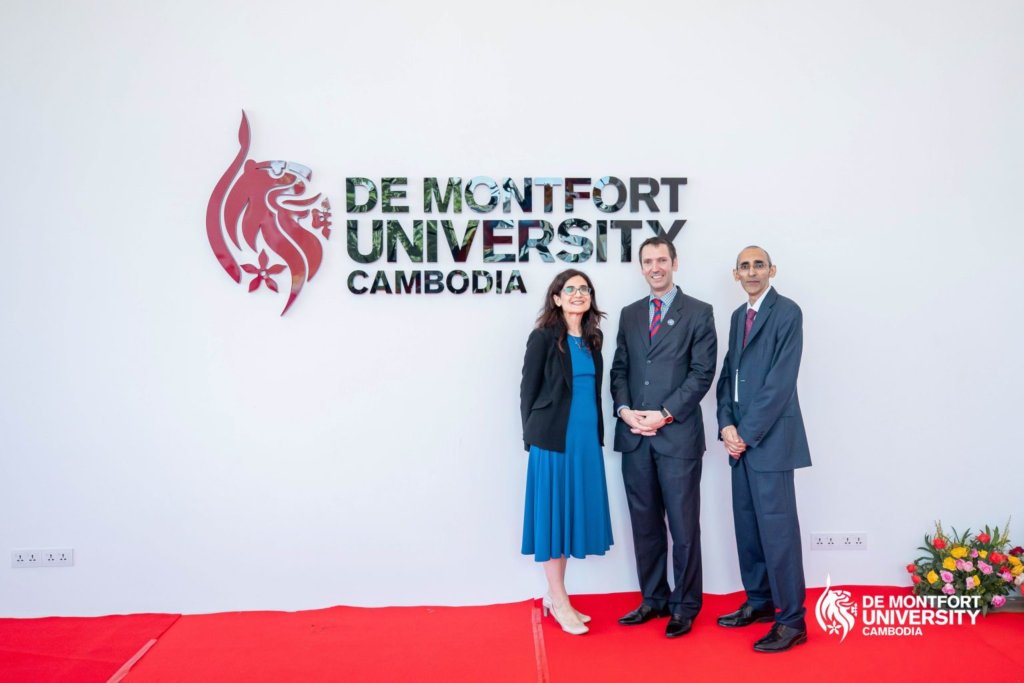
Henry: You touched a bit on what DMU offers, and its role as a historic first in Cambodia as the first British university. What does that actually mean for students, and what distinction does it bring in practical terms, both academically and professionally?
Sakina: Really good question. What does that mean? I think what DMU Cambodia represents is, a focus on developing young people who are going to excel in the world of work.
Also, having an international mindset is important because we want our students to understand, whether you live in Kazakhstan, whether you live in the UK, or whether you live in Cambodia, you are not just going to be working with people who are Cambodian, Kazakh, or British.
If you have a look in an office, you will have representation from many different nationalities. There will be so many different cultures and so many languages spoken as well. It broadens your horizons; it makes you much more open minded, and I think it makes you highly employable as well.
A lot of our students have aspirations, to not only work within Cambodia, but to work internationally as well. They want to have that international experience so they can bring it back here.
As an institution, we are very much focused on being a university that will set students up so that they can go and compete on any international stage. You can get an education here in Cambodia, which will mean that you are on par with any other country in the world.
How does DMUC’s model make a British degree more accessible
Henry: Studying abroad in the UK can cost almost $50,000 or £35,000 per year. How does DMUC’s model make a British degree more accessible, while still maintaining academic standards?
Sakina: For students in Cambodia, they are not paying international fees, and they are not having to incur the costs of moving to the UK.
What we have here is the option to get an international education locally. Everything that our students do here, from the syllabus to your assignments and your exams, is exactly what a student is doing in the UK.
There is no difference in terms of standard, quality, rigour, content, or exams.
We are offering students the same education, the same standard, and the same quality, but at a fraction of the cost. We are not compromising in any way whatsoever on quality.
The other thing that we offer is, since we are in international education, we have international staff as well. Our team members come from all over the world.
Henry: De Montfort University Cambodia has a strong focus on employability, including mandatory internships for students. Why is it important to embed these professional experiences directly into the academic journey, rather than leaving them until after graduation?
Sakina: I think it is never too early to start and there has been a shift in mindset about what is important.
What companies are seeing now, is that it is not only about your grades. It is about skills, competencies, mindset, and emotional intelligence as well. That is what makes you successful in real life and in business.
What companies are saying is that if you ask somebody to write an essay, they would be able to do it and get full marks. But if you ask them to mediate between two colleagues who are in conflict and not talking to each other, how do you do that? That comes from experience and the development of soft skills.
That is why when students start with us, right at the beginning during their foundation year, we push for internships with a lot of companies.
Companies are now taking students in their first year of university because they understand that over time, students are going to develop skills, knowledge, and improve year on year.
Over that period of four years, it allows you to build your network and build your connections. By the time you finish school, all the work has already been done, and the company can just take you and say, right, here you go, you are ready. You will hit the ground running when it comes to your first job.
Henry: As DMU Cambodia is still a young university, how do you see partnerships with organisations like EuroCham and the wider business community supporting the long term vision of DMUC? In particular, how can stronger collaboration between industry and academia help ensure graduates are equipped with the skills you mentioned, and contribute meaningfully to the Cambodian economy?
Sakina: We have started to do this already. We are approaching companies and asking them to give us projects, a brief, or a case study that our students can work on. For example, it could be a media plan, a marketing strategy, or a financial report for analysis.
Nobody is writing essays in companies, so rather than me asking you to write an essay on marketing theory, what I would like you to do is develop a marketing strategy for your account.
What we want companies to do is give us examples, briefs, projects, tasks, or activities that our students can work on, and then deliver back to the companies for input and feedback.
I think what that allows is for our students to build closer links with companies, companies to build closer links with us, and we can build on that.
That is great, and that is the plan.


