

By Raymond Sia
Prologue
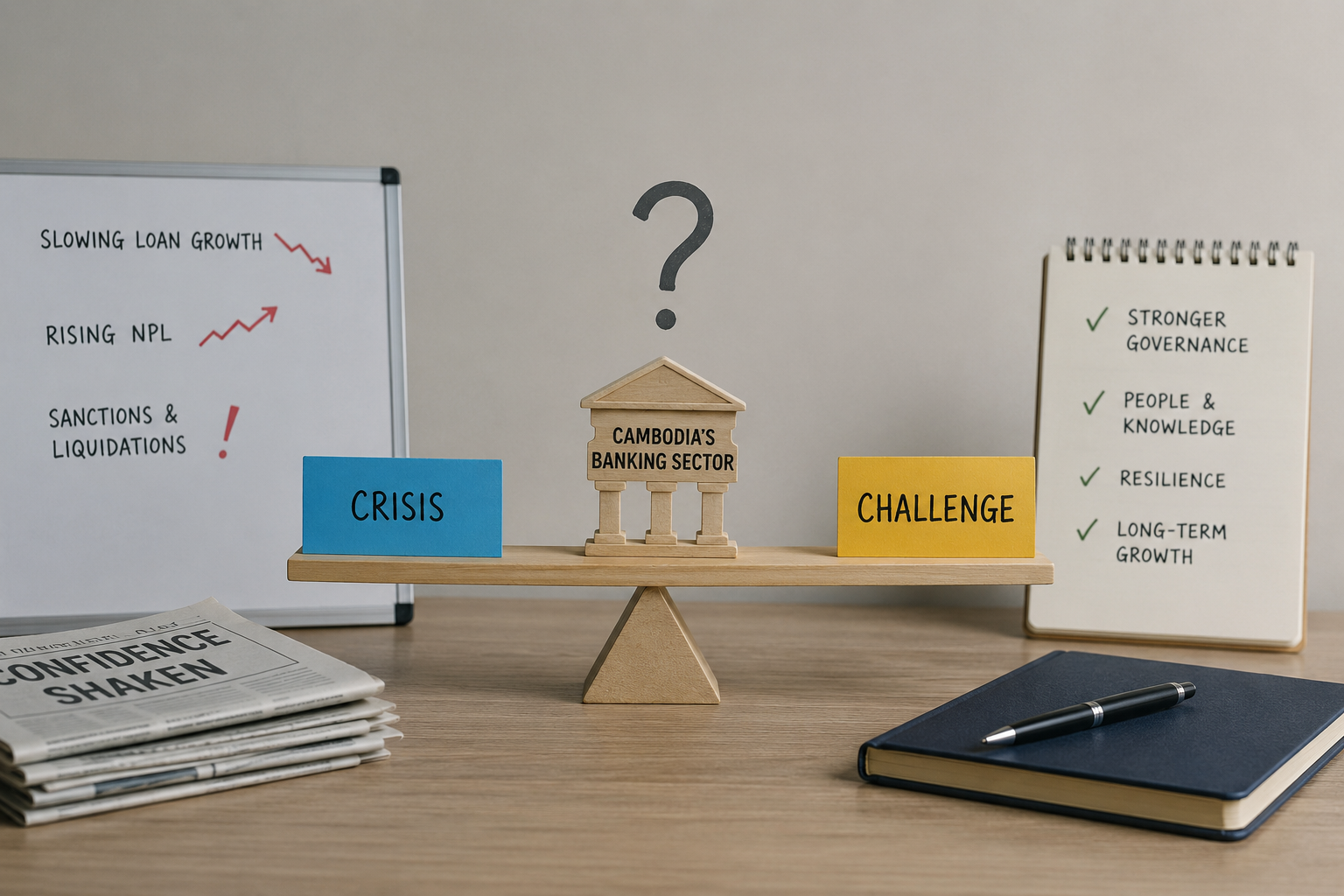
“Crisis” – An unstable or crucial time or state of affairs in which a decisive change is impending especially one with the distinct possibility of a highly undesirable outcome.
“Challenge” – A difficult task or problem or an activity whose difficulty provides enjoyable intellectual or physical stimulation.
(source: Merriam-Webster dictionary)
As at 31 December 2025, Cambodia’s banking industry stood at an impressive asset base that tells a remarkable story of growth; along with growing pains.
Over the past decade, the banking industry recorded an extraordinary 400% surge in asset value, climbing from USD 20.2 billion in 2015 to USD 101.8 billion in 2025. (Source: National Bank of Cambodia – Banking Supervision Report).
That kind of trajectory would be the envy of many markets across the region. Yet today, the conversation has shifted. The question being whispered; and increasingly spoken across industry circles and boardrooms is this: “Is Cambodia’s banking sector facing a crisis, or is this simply a challenging chapter in a longer growth story?”
Read More: Opinion – Banking Industry Priorities Today for Tomorrow’s Success
1. Loans & NPL | “We Get What We Give”
Lending growth has slowed to a decade low, while non-performing loan (“NPL”) ratios have climbed to historical highs; and continue to rise. These two indicators, moving in opposite directions, are telling us something important. As I have explored in previous articles, this is not a coincidence — it is the consequence of years of aggressive lending, (more) relaxed credit discipline, and an environment that (possibly) prioritised growth over governance. Cheaper and lower cost of funds (pre-Covid 19) also contributed to a period of aggressive lending growth.
We are reaping what we sow. The silver lining? Recognising the root cause is the first step toward course correction.
2. Sanctions & Liquidations | “Shaken, Not Stirred”
In less than 12 months, we have witnessed a troubling wave of financial institutions being sanctioned and placed under liquidation. Some observers suggest Cambodia may have recorded one of the highest numbers of bank sanctions and liquidations in Asia within this same period – a distinction no country wants. This is damaging, not just operationally, but also from a reputation angle.
Perception (besides trust) matters enormously in banking, and confidence, once eroded, is painfully slow to rebuild and regain.
It is easy; and frankly, lazy to engage in hindsight analysis after the fact. The industry is never short of “hindsight specialists.” But what we truly need are foresight practitioners – regulators, board of directors, shareholders and employees who ask the hard questions before such incidences occur, not after a bank collapse.
There is no perfect formula to prevent bank failures. But there is absolutely no excuse for allowing institutions with chequered histories and questionable shareholders to operate in the first place. Every stakeholder; regulators, external auditors, shareholders, and industry associations must play their proactive part in safeguarding the sector’s integrity & reputation.
Confidence has been shaken. But the industry remains resilient. We must act before it is broken entirely.
3. People & Power of Knowledge | “We Don’t Know What We Don’t Know”
Perhaps the least discussed but equally consequential impact of this weakening in lending growth & high NPL on human capital. The current environment is creating real headwinds for talent development. We see more banking professionals actively exploring new opportunities; evident by increasing industry attrition levels.
A slowdown in lending means fewer chances to work on complex transactions, develop credit skills, and grow professionally. We know a substantial part of Cambodia’s banking activity and profitability is driven by lending activities.
A slowdown in lending (and banking) activities could cause corresponding lower investments in learning & developing and this could cause a generation of bankers being stunted in their development.
Any successful banker (or person) will also tell you that a key recipe for success is continuous learning.
Institutions that invest in people during the difficult periods will emerge with a significant competitive advantage when the cycle turns; and it will certainly turn.
Epilogue
So, are we facing Crisis or Challenge?
This is, quite literally, the hundred-billion-dollar question.
We are facing a challenge on confidence, but not yet a crisis of collapse.
The foundations of the banking industry remain solid and continue to be resilient (based on prudential financial ratios such as solvency and liquidity ratios) but the cracks are appearing and visible enough to demand urgent, collective action — not deflection, not delay.
Cambodia’s banking sector has proven its capacity & track record for remarkable growth. The question now is whether its stakeholders have the discipline and courage to steer through this challenging period with accountability and enforcing on the correct actions needed.
The next chapter is still being written. And how it’s written will define the industry for the decade ahead.
Raymond Sia currently serves as Managing Director of Canadia Investment Holding Plc and Board Director for Canadia Bank and Credit Bureau Cambodia. Raymond believes in the long- term prospects of the banking industry in Cambodia. The industry needs foresight specialists rather than hindsight critics. Raymond is also the author of the “Right Angle – The Collection Volume One” which is available for sale. The views expressed above are strictly the author’s personal opinion and do not represent the organisations & institutions he is attached with or represents.