


Cambodia Investment Review
Cambodia’s banking sector remains well positioned to absorb a significant deterioration in asset quality, with a new stress test by the ASEAN+3 Macroeconomic Research Office (AMRO) finding that banks could withstand non-performing loan (NPL) ratios of up to 24% while remaining above the National Bank of Cambodia’s minimum capital requirement.
The findings suggest that, despite rising bad loans and continued weakness in several sectors of the economy, the banking system remains resilient overall due to strong capital buffers. However, AMRO cautioned that the strength of the sector is uneven, with several smaller banks facing growing pressure from thinner capital buffers, weaker profitability, and higher levels of distressed loans.
Stress Test Highlights Strong Capital Buffers
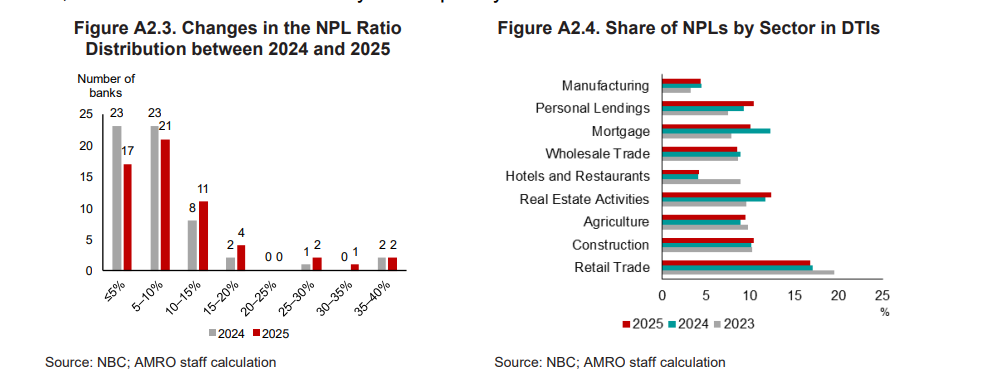
AMRO’s reverse stress testing assessed how much deterioration Cambodia’s banking system could absorb before average capital adequacy falls below the regulatory minimum.
The analysis found that the banking sector could withstand an NPL ratio of 24% before average capital adequacy declines to the National Bank of Cambodia’s minimum requirement of 15%.
Using a more conservative benchmark that includes the capital conservation buffer, banks could absorb an NPL ratio of 18.6%, equivalent to approximately US$6.3 billion in non-performing loans, before average capital adequacy falls to 17.5%.
The report said the results demonstrate that Cambodia’s banking system remains resilient at the aggregate level, providing an important cushion against further economic shocks.
Bad Loans Continue to Increase
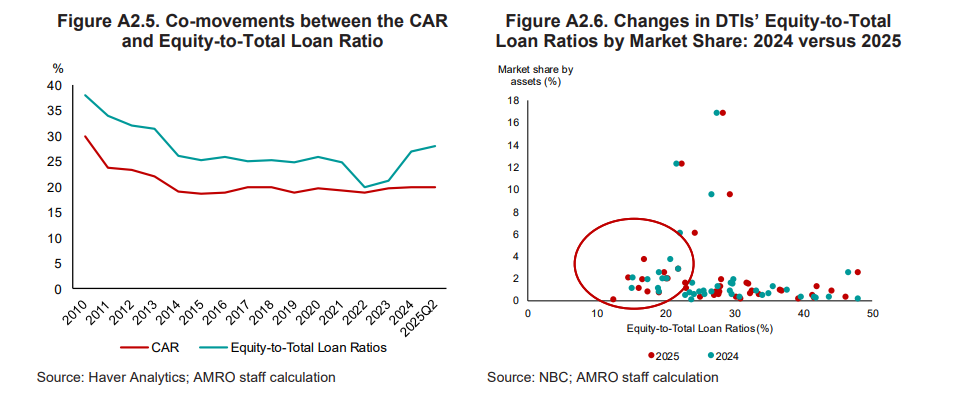
Although capital levels remain strong, AMRO noted that asset quality has continued to deteriorate.
The average NPL ratio among Cambodia’s deposit-taking institutions rose to 8.3% at the end of 2025, compared with 7.1% in 2024 and 5.1% in 2023.
The increase reflects subdued credit growth, prolonged weakness in the property market, the expiration of COVID-19 regulatory support measures, and broader economic headwinds.
At the same time, restructured loans accounted for around 9% of total loans, suggesting that additional distressed assets could emerge if economic conditions remain challenging.
Smaller Banks Face Greater Vulnerability
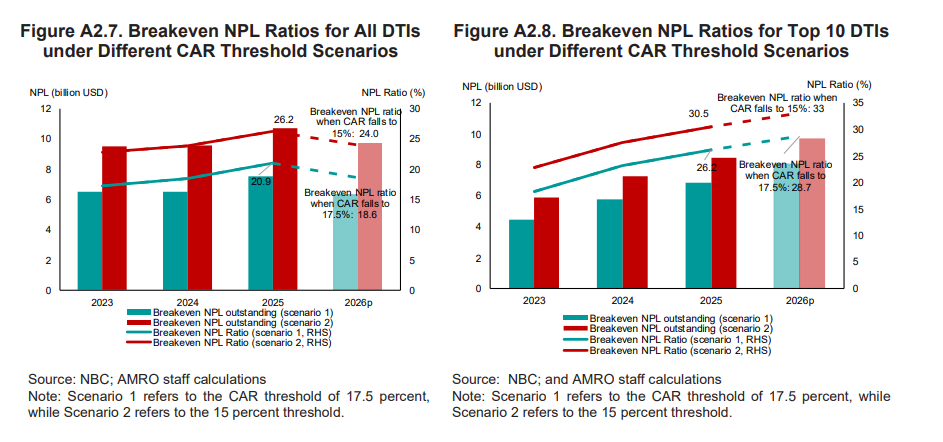
While the banking sector remains resilient overall, AMRO warned that several smaller deposit-taking institutions are significantly more exposed to further deterioration in credit quality.
These lenders generally operate with thinner capital buffers, weaker profitability, and higher NPL ratios, limiting their ability to absorb additional losses without raising fresh capital.
The report also noted that the number of banks operating with limited buffers above the regulatory minimum increased between 2024 and 2025, with further pressure expected during 2026 should bad loans continue to rise.
Property Sector Remains the Main Source of Credit Risk
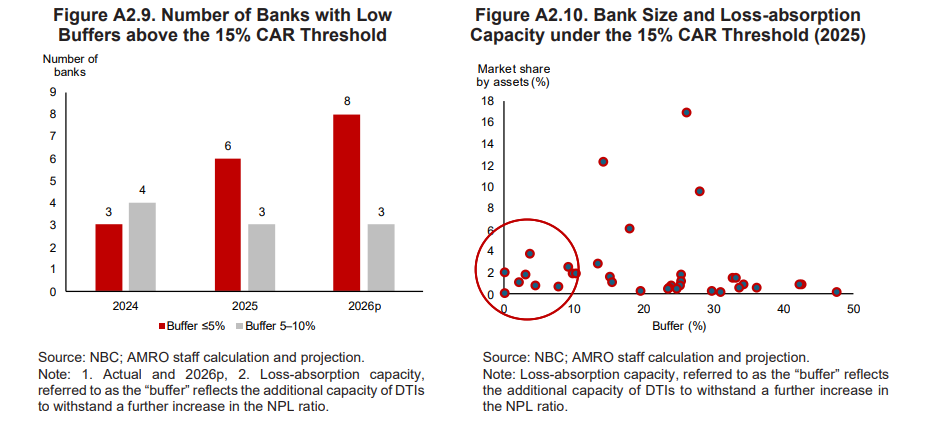
AMRO said distressed loans remain concentrated in sectors that have faced prolonged weakness.
Retail trade, agriculture, and real estate-related industries—including construction, property development, and residential mortgages—account for the largest share of non-performing loans across Cambodia’s banking system.
The continued concentration of bad loans within these sectors has contributed to banks maintaining a cautious approach toward new lending despite signs of gradual economic recovery.
Limited Risk of System-Wide Contagion
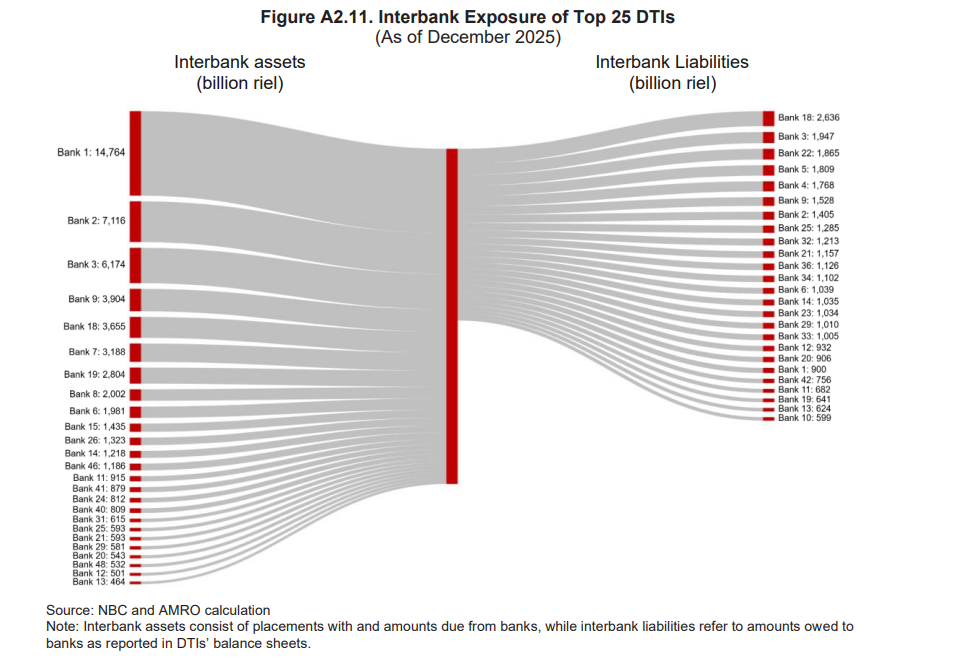
The report also assessed interbank exposures and concluded that systemic contagion risks remain relatively contained.
Although a small number of larger banks account for a significant share of Cambodia’s interbank market, overall interconnectedness across the financial system remains limited, reducing the likelihood that financial stress at one institution would rapidly spread throughout the banking sector.
Nevertheless, AMRO said these larger institutions remain systemically important and should continue to be closely monitored.
Priority Shifts to Resolving Legacy Bad Loans
Looking ahead, AMRO said the focus should now shift toward resolving legacy non-performing loans while preserving the banking sector’s strong capital position.
The agency recommended strengthening supervision of bank capital adequacy, ensuring sufficient loan-loss provisioning, improving asset valuations, closely monitoring sectoral credit risks, and removing legal and procedural barriers that delay the resolution of distressed assets.
While the stress test indicates Cambodia’s banking system has substantial capacity to withstand a sharp increase in bad loans, AMRO concluded that addressing legacy NPLs and strengthening the resilience of smaller lenders will be essential to maintaining financial stability as the country’s economic recovery continues.