

Raymond Sia
In June 2026, I published an article titled “Crisis or (Mere) Challenge? – The State of Cambodia’s Banking Industry” As expected, the feedback from the banking community was mixed. It also prompted a question that grows louder by the day, one that many bankers are now asking: “Is The Worst Over Or Yet To Come?“
Put that question to a room full of bankers (and non-bankers) and you will again hear differing views. The optimist and the pessimist will each make a compelling case, and neither is entirely wrong. Like two sides of the same coin, the answer depends on where you stand.
The Worst Is Over: Recovery Is In-Sight
- A Stronger Reputation.
The recent scam center clampdowns and the success in hosting the recent International Conference on Combating Online Scams (ICCOS-2026), are strong steps forward for the country. Criminal and scam networks must be eradicated for the good of society & business community; and it is unfortunate and shameful that some hid behind legitimate corporates and even banks/financial fronts.
According to Cambodia Ministry of Information, the authorities have investigated and inspected 793 suspected locations between July 2025 and August 20, 2026, leading to crackdowns on 624 sites and the detention of nearly 30,000 suspects of 39 nationalities. (source: Khmer Times 21 September 2026)
The removal of these nefarious network will strengthen the country’s image (over time), attract (more) foreign direct investments (“FDI”) from the right investors, and open the doors to more correspondent banking relationships for in-country financial institutions.
In banking, the reputation of a financial institution is built on the two important virtues of trust and integrity; and these virtues have to be closely guarded and protected.
- Provisioning Is Working.
The banking industry gross Non-Performing Loans (“NPL”) is deemed high at 9.6% as at 30 June 2026. However, under the prudent guidance of the Central Bank, financial institutions have set aside higher loan provisioning resulting in Net NPL at 3.3% (source: National Bank of Cambodia).
Financial institutions can also take additional comfort that almost all lending activities (and delinquent loans) are also collateralized and the loan-to-value (loan limit against collateral value) are often not exceeding 80%.
- Pockets Of Growth.
Despite the economic headwinds that has adversely affected many sectors, there are still certain parts of the economy that is showing encouraging results.
Manufacturing sector, notably garment, footwear and textile (“GFT”), is showing positive signs. In the first four months of 2026, Cambodian GFT exports grew 11.26% year on year to reach USD5.02 billion (source: General Department of Customs and Excise). This positive growth trend is expected to support new lending opportunities, a key driver of bank income and profitability.
We also observe there are more Special Economic Zones (“SEZ”) being set up in recent times; a potential positive sign of FDI into the Kingdom and a number of these SEZs have shown commendable year-on-year growth in business volume; creating employment and also improving both export and import activities; all of which will also be catalyst for growth for the banking industry.
The Worst Is Yet To-Come: Recovery Is At Least 12-18 Months Away
- Money is getting expensive (again).
Central banks worldwide are raising rates, most recently by the U.S. Federal Reserve; with their first interest rate hike (by 25 bps) in three years in September 2026.
The ongoing Middle East war has pushed oil price upwards and causing higher inflation globally. Higher inflation causes disposable income to decrease. Lower disposable income will have impact on borrowers’ ability to repay their loans and potentially elevating NPLs. This will result in higher loan provisioning and more cautious lending activities; which would impact the banking industry profitability.
Higher global interest rates will increase domestic competition for deposits amongst banks in Cambodia; exacerbated also by “flight to quality” as customers will be lured to place their hard-earned savings in other countries which have a higher sovereign rating and also offering attractive interest rates.
Liquidity being tighten will result in many financial institutions being more cautious in their lending activities and this will have an immediate impact on their profitability as at least 80% of income are generated from lending activities.
- Net NPL is not the full story.
Loans with day-past-due exceeding 90 days is a good gauge for delinquent loans and this portfolio of accounts have been on an upward trend over the past 12 months (save for December 2025) and continues to trend upwards (source: Credit Bureau of Cambodia).
While Net NPL remains at a manageable level of 3.3% as at 30 June 2026, every prudent and learned banker will remind us that collateral is often a financial institution’s last resort and a loan recovery is only deemed successful if the collateral is disposed and money collected.
Successful NPL resolution and collateral disposal is a multi-party responsibility.
Despite the good intentions in issuing a Prakas to allow the establishment of an Asset Management Institution in February 2026 to acquire and manage NPLs from financial institutions, there has not been much headway made thus far; or at least from the public news flow.
Rising (Gross and Net) NPLs are never a good sign for any economy. If NPL persist to be at current levels, lending activities will likely remain modest and muted; and this will have a corresponding negative effect on the economy.
- Costs and scrutiny are rising.
A higher cost of funds and elevated NPLs will make operating conditions harder.
Besides higher cost of funds, financial institutions are facing a rise in overall Cost-to-Income (“CIR”).
Cambodian banking sector (excluding microfinance sector) provides employment to a meaningful workforce population of 74,409 across 1,899 offices / branches; and has 5,869 ATM terminals (source: National Bank of Cambodia Annual Supervision Report 2025). The latest numbers may differ considering the banking industry has seen the liquidation of five commercial banks between January to August 2026. Most of the commercial banks would at least have a mobile app to complement their other banking services.
All these banking distribution channels and enablers/tools mentioned above would require regular maintenance and maintenance cost money. Any gaps in maintenance will potentially heighten operational risks, increase vulnerability and also affect customer experience.
Some of these enablers/tools such as mobile banking app will require more frequent updates and enhancements.
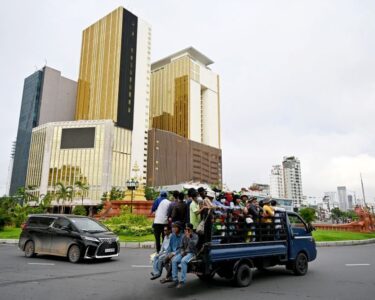
In recent years, we have seen more commercial banks investing in their own corporate towers / buildings. While this may be good to establish stronger branding presence, the investment outlay, continued maintenance and future deprecation expenses are huge and may outweigh the benefits; especially if industry lending growth remains muted.
In the immediate term, there will certainly be more pressure for CIR to rise and financial institutions’ shareholders will be urgently rethinking their strategy and also putting in placed more cost management & optimization initiatives.
Raymond Sia is the author of the “Right Angle – The Collection Volume One”. He has been with Canadia Group since 2018 and currently serves as the Managing Director of Canadia Investment Holding Plc. He is also a Board Director for Canadia Bank and Credit Bureau Cambodia. Raymond believes confidence and reputation may recover first in the banking industry but asset quality improvements will take longer. A strong advocate for financial literacy, Raymond also believes irrespective of our views on the above, all banks & bankers should practice Responsible Banking – a principle which applies to lending & deposit-gathering activities. The views expressed above are strictly the author’s personal opinion and do not represent the organizations & institutions he is attached with or represents.