
By James P. Brew
In an era where emerging market economies continually compete for global capital, foreign direct investment (FDI), and sustainable domestic growth, the mechanics of Public-Private Dialogue for Results (PPDR) can make or break a nation’s trajectory. Across Southeast Asia, few institutional frameworks match the unique structure, high-level political backing, and accountability of Cambodia’s Government-Private Sector Forum (G-PSF).
Far from being a ceremonial talk shop, the G-PSF is Cambodia’s highest and most authoritative platform for government and private sector engagement. Operating as a comprehensive, two-tiered system anchored by the high-level G-PSF Plenary Forum and driven by 16 Working Groups (WGs), the forum serves as the primary engine room for structural reform, regulatory streamlining, and investment risk mitigation in the Cambodian economy.
The Apex of Engagement: Plenary Forums and Binding Authority
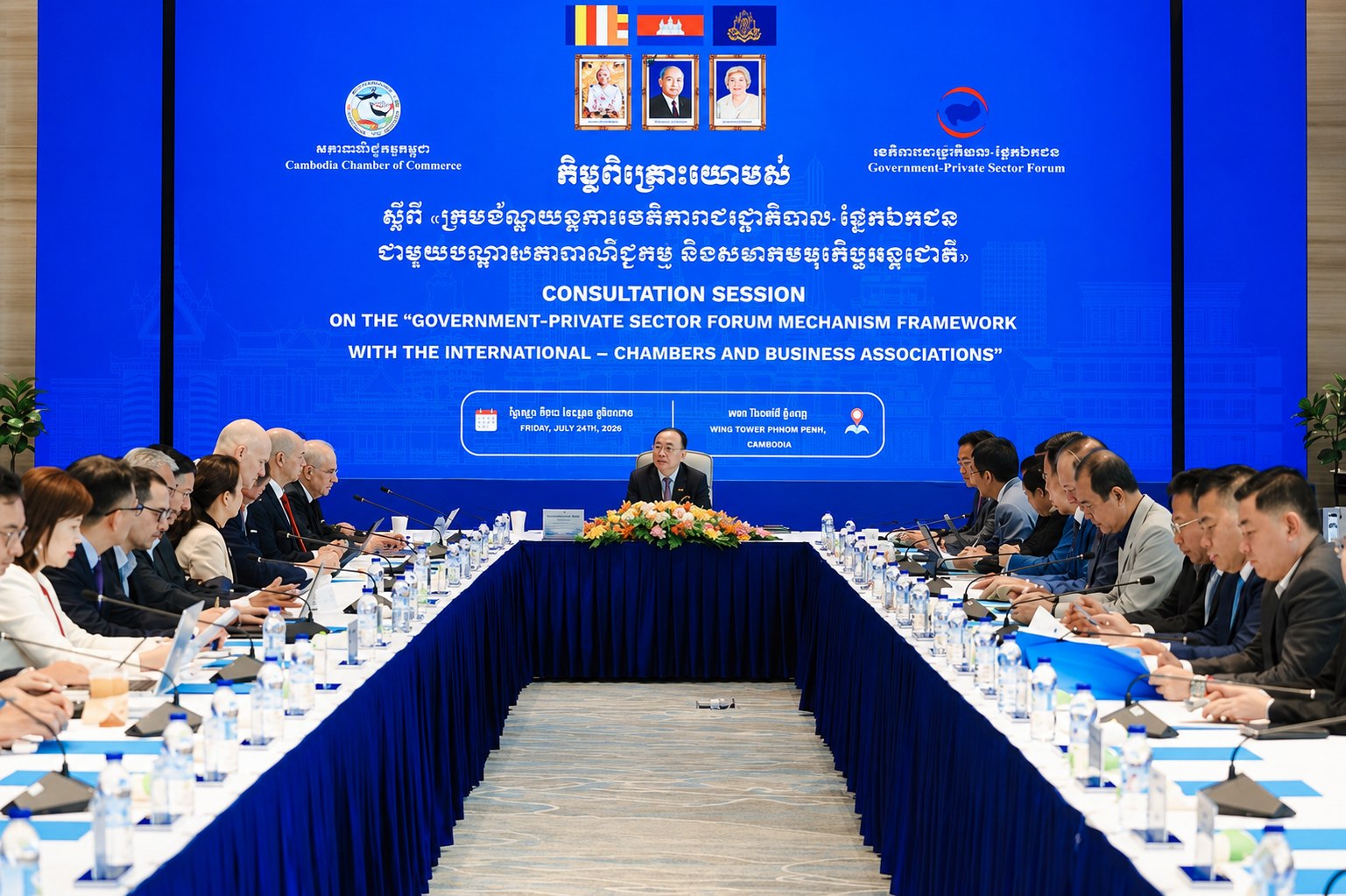
The most prominent face of the G-PSF is its Plenary Forum. These high-profile gatherings are chaired directly by the Prime Minister, bringing together cabinet ministers, senior government officials, and the business community as led by the Cambodian Chamber of Commerce (CCC).
Decisions made during these plenary sessions carry administrative and legal gravity due to the fact that the G-PSF Plenary Forum is considered a formal cabinet meeting.
The heavy lifting of the G-PSF mechanism happens in the year round circuit of the 16 WG meetings.
The Workhorses: Structure and Scope of the 16 Working Groups
The G-PSF encompasses 16 sector-specific and cross-cutting working groups. Each group is co-chaired jointly by a government minister and a designated representative from the private sector, establishing a genuine parity of voice between policy makers and the private sector.
The 16 working groups span the breadth of the national economy: A. Agriculture and Agro-Industry, B. Tourism C. Manufacturing, D. SMEs & Related Services E. Law, Tax and Governance. F. Banking and Financial Services G. Infrastructure and Transport H. Export Processing and Facilitation I. Industrial Relations J. Paddy and Rice K. Mine and Energy L. Education Sector M. Health Sector N. Non-Banking Financial Services O. Digital Economy, Socio-Digitalization and Telecommunications P. Territorial Administration, Security and Public Order.
The WG are not haphazardly organized gatherings convened on a minister’s whim. They operate under the shared understanding that neither government officials nor private sector executives have time to waste on meetings that fail to produce tangible outcomes. Every WG meeting requires rigorous technical preparation, clear agenda-setting, and robust follow-through.
Supporting each WG are hard working members of the private sector that volunteer their time and expertise in the interest of supporting Cambodia’s economic development. From the government, officials give valuable time and resources to facilitate inter Ministerial delegations to attend the WGs and consult with each and the private sector in the interests of resolving issues and implementing required legislative, regulatory and many other categories of reform.
Unprecedented Accountability and Measurable Results
The ultimate test of any public-private dialogue mechanism is its ability to turn issues into concrete policy adjustments. By this metric, the G-PSF is establishing a best practice standard for institutional accountability.
According to data presented by the Council for the Development of Cambodia (CDC)—the government agency responsible for managing the G-PSF Secretariat—the mechanism yields exceptional resolution rates. In the recent G-PSF Results Dissemination Workshop hosted by the CDC and the CCC, 97% of issues raised during the 19th G-PSF Plenary Forum were successfully resolved, while subsequent working group sessions boast an 88% resolution rate for newly tabled agenda items.
When a private sector association or business leader raises an issue within a working group, it does not disappear into a bureaucratic void. Every grievance and recommendation enters a centralized government database. This database is regularly monitored by the Prime Minister and the Cabinet, ensuring that line ministries remain accountable for addressing bottlenecks—regardless of whether the government ultimately agrees with every proposal. This level of tracking creates a transparent environment that is virtually unmatched in the region.
Political Will and Institutional Evolution: From 1999 to the Seventh Mandate
The longevity of the G-PSF is rooted in political will. Established in 1999 under the vision of then-Prime Minister Samdech Hun Sen, the framework was built on a foundational principle: the private sector co-chairs represent entire industries, and the working groups must serve as safe spaces where businesses can openly address the toughest constraints facing Cambodia’s economy.
Over two and a half decades later, that principle has only deepened. Under the seventh mandate of the Royal Government led by Prime Minister Hun Manet, the G-PSF has undergone significant modernization. Under the guidance of the Deputy Prime Minister and CDC First Vice Chair, H.E. Sun Chanthol, the introduction of cross-ministerial digital dashboards and integrated IT tracking systems has streamlined communication, allowing ministries to coordinate responses faster and more transparently than ever before.
For the private sector, the Cambodian Chamber of Commerce (CCC) under the Presidency of Neak Oknha Kith Meng, spearheads secretariat services under its core advocacy mandate. Working closely with national trade associations, sectoral bodies, and international chambers of commerce, the CCC ensures that private sector input is synthesized at the highest technical level. While the government benefits from decades of institutional capacity building, the private sector’s continuous strengthening of its own advocacy apparatus ensures a more balanced and effective partnership.
Resource and capacity challenges remain obstacles for the private sector. It is essential that the reforms to the institutional structure of the G-PSF during the 7th Royal Government Mandate are fully capitalized on. The G-PSF was initiated during the difficult years of transition from conflict to peace in Cambodia. At that time private sector associations were nascent.
Many associations and chambers that exist today have emerged as a consequence of the space opened for constructive dialogue that the G-PSF WGs have provided. It is no surprise that the institutions that support the G-PSF are now leading efforts to engage and support the maturing of the private sectors engagement in the future. It is clear that for the WGs to continue to grow then stakeholder institutional capacity, participation and shared resources are critical.
A Strategic After-Care Tool for Foreign Direct Investment
Beyond domestic economic reform, the G-PSF plays an indispensable role in national investment strategy. For foreign investors scanning emerging markets, operational risk and regulatory uncertainty are deterrents.
By functioning as an active after-care mechanism, the G-PSF gives foreign and domestic investors a clear, institutionalized recourse to flag regulatory hurdles, customs bottlenecks, or compliance issues with the confidence that there is an institutional mechanism that can address their concerns. Removing these friction points directly reduces business risk, making Cambodia an increasingly attractive destination for high-value Foreign Direct Investment (FDI).
Looking Ahead: Maximizing the Platform
As the G-PSF framework matures, its ambition remains simple yet transformative: to create a direct, quantifiable, and positive impact on Cambodia’s economic growth, job creation, and industrial diversification.
While the system is complex—engaging many hundreds of stakeholders across both public and private— flexibility is one of the strengths of the G-PSF model. This is fortunate as some WG such as the Law, Tax and Governance WG, have historically operated with great effectiveness, while others continue to refine their internal technical capacities.
Ultimately, the architecture is in place. The CDC and the broader government apparatus have heavily invested in transparency, digital tracking, and open dialogue. For the private sector, the challenge and the opportunity moving forward lie in fully utilizing this powerful machinery—building high-quality agendas, strengthening technical secretariats, and partnering hand-in-hand with the state to write the next chapter of Cambodia’s economic development.