

Cambodia Investment Review
Japan is encouraging its business community to take a fresh look at Cambodia as an investment and logistics destination, as Japanese companies adapt regional supply chains amid ongoing uncertainty surrounding land border movements between Cambodia and Thailand.
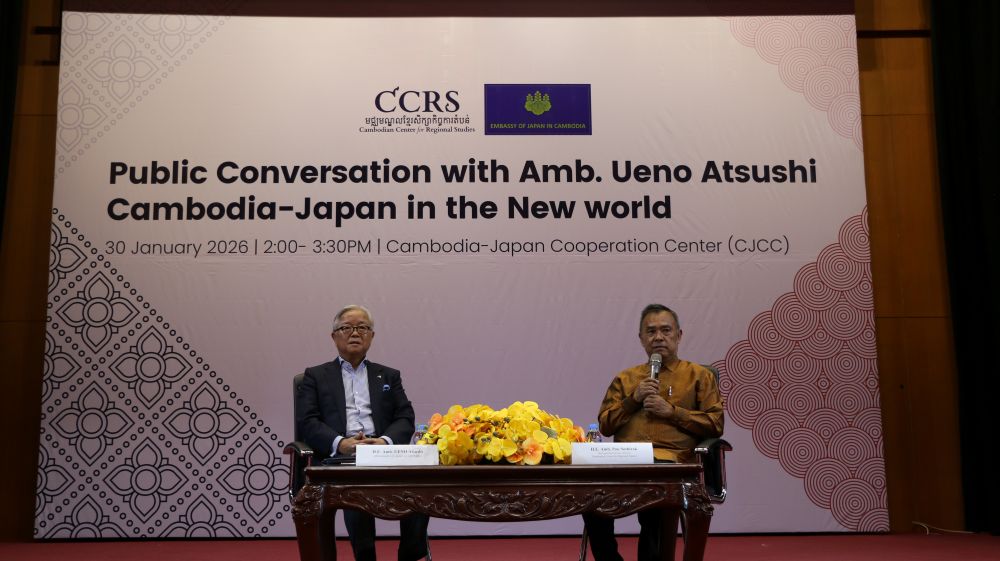
Speaking during a public discussion in Phnom Penh on January 30, Japanese Ambassador to Cambodia Ueno Atsushi outlined how intermittent land border closures have disrupted the operations of Japanese companies with activities spanning both countries. These disruptions have primarily affected firms reliant on cross-border trucking for the movement of raw materials and finished goods.
In response, Japanese companies have increasingly diversified transportation routes to maintain operational continuity. Early adjustments included air freight and indirect land routes through neighboring countries. Over time, maritime transport has emerged as a more stable and cost-effective alternative, accelerating reliance on Cambodia’s port infrastructure.
Shift toward maritime logistics and port capacity
As land-based routes became less predictable, Japanese companies operating in Cambodia and Thailand have leaned more heavily on sea freight. This shift has increased the strategic importance of Cambodia’s ports, particularly Sihanoukville Autonomous Port, as a gateway for international trade.
To support this transition, Japan has stepped up cooperation with Cambodia on logistics and customs modernization. In mid-January 2026, the Japanese government provided $7.6 million for the “Project for Strengthening Customs Functions at the New Container Terminal of Sihanoukville Port.” The project is aimed at improving customs clearance efficiency and expanding operational capacity at the new terminal, supporting higher cargo volumes and faster processing times.
The investment reflects a broader effort to strengthen Cambodia’s trade infrastructure and reduce friction for exporters and importers. Improved port and customs performance is expected to help offset the risks associated with overland transport disruptions and support the country’s role in regional value chains.
Cambodia within diversified regional supply chains
Beyond logistics adjustments, Japan has encouraged companies to position Cambodia as part of a diversified regional supply chain strategy. Firms considering new or expanded investments have been advised to integrate Cambodia alongside neighboring markets such as Vietnam, rather than relying on a single-country model.
This approach mirrors a wider regional trend, as multinational companies reassess exposure to geopolitical, logistical, and regulatory risks following recent global supply chain disruptions. Cambodia’s competitive labor costs, improving infrastructure, and growing manufacturing base have increasingly placed it on the radar of Japanese investors seeking alternative production and sourcing locations.
Japanese corporate presence in Cambodia has expanded steadily. Nearly 500 Japanese companies are currently operating in the Kingdom, covering sectors including manufacturing, construction, logistics, retail, and services. Around 248 of these firms are members of the Japanese Business Association of Cambodia, up from just 50 members in 2010, highlighting the deepening footprint of Japanese businesses over the past 15 years.

Trade ties continue to deepen
Japan remains one of Cambodia’s most important trading partners. According to data released on January 9 by Cambodia’s General Department of Customs and Excise, Japan ranked as Cambodia’s fifth-largest trading partner in 2025.
Read More: Wing Bank Named Official Payment Partner of Sihanoukville Autonomous Port
Bilateral trade reached $2.53 billion last year, representing a 17.1 percent year-on-year increase. Cambodia’s exports to Japan amounted to $1.57 billion, up 11.9 percent, while Japanese exports to Cambodia rose 27 percent to $956.23 million.
These figures underscore the resilience of bilateral trade flows despite logistical challenges and reinforce the economic rationale for continued Japanese investment in Cambodia.
Media visibility and investor perceptions
The ambassador also noted that Cambodia receives limited coverage in Japanese media, largely due to the absence of major Japanese or international outlets based in the country. When coverage does occur, it often focuses on political developments, elections, or scam-related issues, rather than economic fundamentals or investment opportunities.
In contrast, informal channels such as social media have played a growing role in shaping perceptions. Positive experiences shared by Japanese tourists and business visitors have encouraged broader interest in Cambodia, highlighting the country’s cultural heritage, urban development, and hospitality sector.
Since taking up his post in early 2023, the Japanese ambassador has visited all 25 of Cambodia’s capital and provinces. These visits have reinforced the view that economic potential extends beyond Phnom Penh, particularly as infrastructure investment and connectivity continue to expand nationwide.
As Japanese companies reassess supply chains and regional strategies, Cambodia is increasingly being positioned not as a peripheral market, but as a practical component of Southeast Asia’s evolving trade and logistics landscape.


