
Cambodia Investment Review
Cambodian businesses see stronger frontline leadership and middle-management capacity as critical to lifting productivity as companies navigate a changing economy, according to survey findings presented at the International Business Chamber of Cambodia’s September Regular General Meeting.
Held under the theme “Productivity Under Pressure — How Can Cambodian Businesses Achieve More in a Changing Economy?”, the meeting brought together IBC members to examine how companies can work smarter, adapt faster and generate more value from existing resources.
The discussion addressed digital transformation, operational efficiency, customer experience and cooperation between companies as potential drivers of sustainable growth.
Frontline Leadership Holds Greatest Productivity Potential
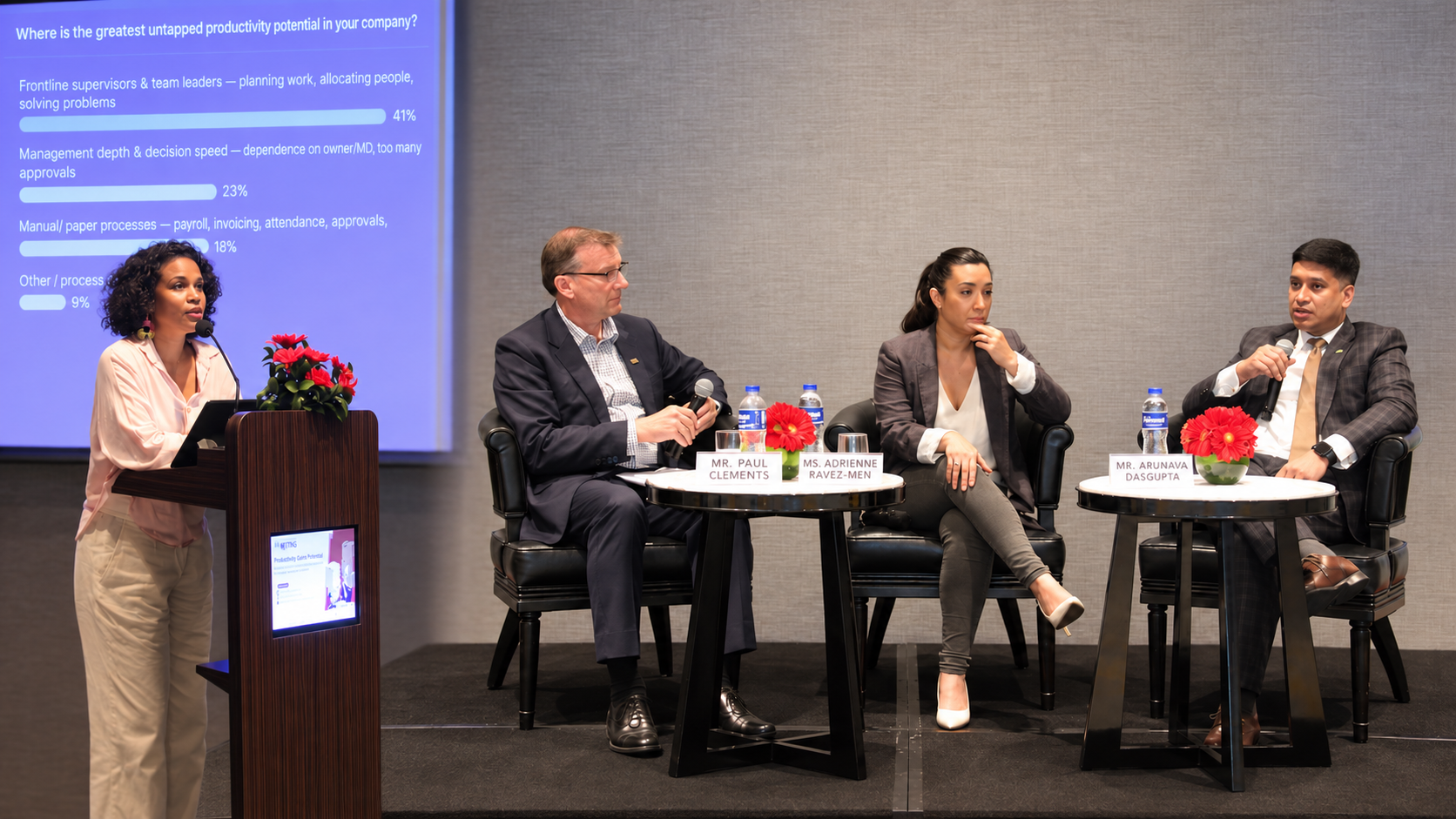
The first audience survey asked members to identify the greatest untapped productivity opportunity within their companies.
Read More: Opinion: From Policy to Impact – Building SMEs That Can Compete and Grow
The results placed frontline supervisors and team leaders firmly at the top, suggesting that businesses see significant room to improve everyday planning, staff allocation and problem-solving.

Key survey findings included:
- 39% identified frontline supervisors and team leaders as the largest untapped productivity opportunity.
- 22% selected management depth and decision-making speed.
- 17% pointed to manual and paper-based processes.
- 9% identified logistics and trade processes.
- 4% each selected equipment and energy productivity, scheduling and capacity planning, and employee onboarding and capability building.
None of the respondents selected rework and defects, absenteeism and turnover, worker health and working conditions, inventory and working capital, or measurement and data as their primary opportunity.
Middle-Management Capacity Is Leading Barrier
A second survey examined what most prevents businesses from capturing productivity gains in Cambodia.
Middle-management capacity emerged as the dominant concern, indicating that companies may understand the need for reform but lack sufficient managerial capability to translate plans into consistent operational improvements.
The main barriers identified were:
- 42% cited insufficient middle-management capacity.
- 19% selected a lack of management time to lead productivity initiatives.
- 12% said they did not know where to begin or which methods and providers to trust.
- 8% said improvements were launched but did not become permanent.
- 8% said employees did not raise problems.
- 4% each cited weak baseline data, staff turnover and head-office constraints.
Access to capital, energy and freight costs, informal competition and insufficient pressure to change received no responses.
Members Support Sharing Practical Business Tools
The final survey asked where IBC members could achieve more collectively than individual companies could accomplish alone.
Half of the respondents supported sharing practical case studies, tools, standard operating procedures and productivity methods. Another 23% backed visits to member companies to observe proven practices firsthand.
Advocacy on regulation, trade and informal competition attracted 9%, while productivity benchmarking, joint management development, specialist expertise and workforce collaboration each received 5%.
The results indicate that members are particularly interested in practical cooperation that can be applied directly within their organisations.

Businesses Must Generate More From Existing Resources
Arunava Dasgupta, Chief Customer Experience Officer at Wing Bank, said Cambodia’s next phase of growth could not depend solely on adding more resources.
“Cambodia’s next phase of growth cannot rely on adding more resources. It has to come from getting significantly more value from the capabilities we already have,” Dasgupta said.
Adrienne Ravez-Men, Founder and Senior Digital Specialist at Global Innovation and Change, said artificial intelligence could improve productivity but required strong organisational foundations.
“AI can be a powerful driver of productivity, but technology alone does not create transformation,” she said, adding that governance, accountability, safety and clearly defined processes must underpin sustainable innovation.
The panel was moderated by IBC Chairperson and J.A.D.E Managing Partner Paul Clements.
The findings suggest Cambodia’s productivity challenge is not primarily a shortage of technology or investment. Instead, businesses see management capability, leadership time and consistent execution as the areas requiring the most immediate attention.


