
Cambodia Investment Review
Business leaders, agricultural experts and policymakers gathered in Phnom Penh this week to examine the growing economic impact of soil degradation on Cambodia’s agricultural sector, with industry representatives warning that declining soil health is increasingly threatening farm profitability, productivity and long-term competitiveness.
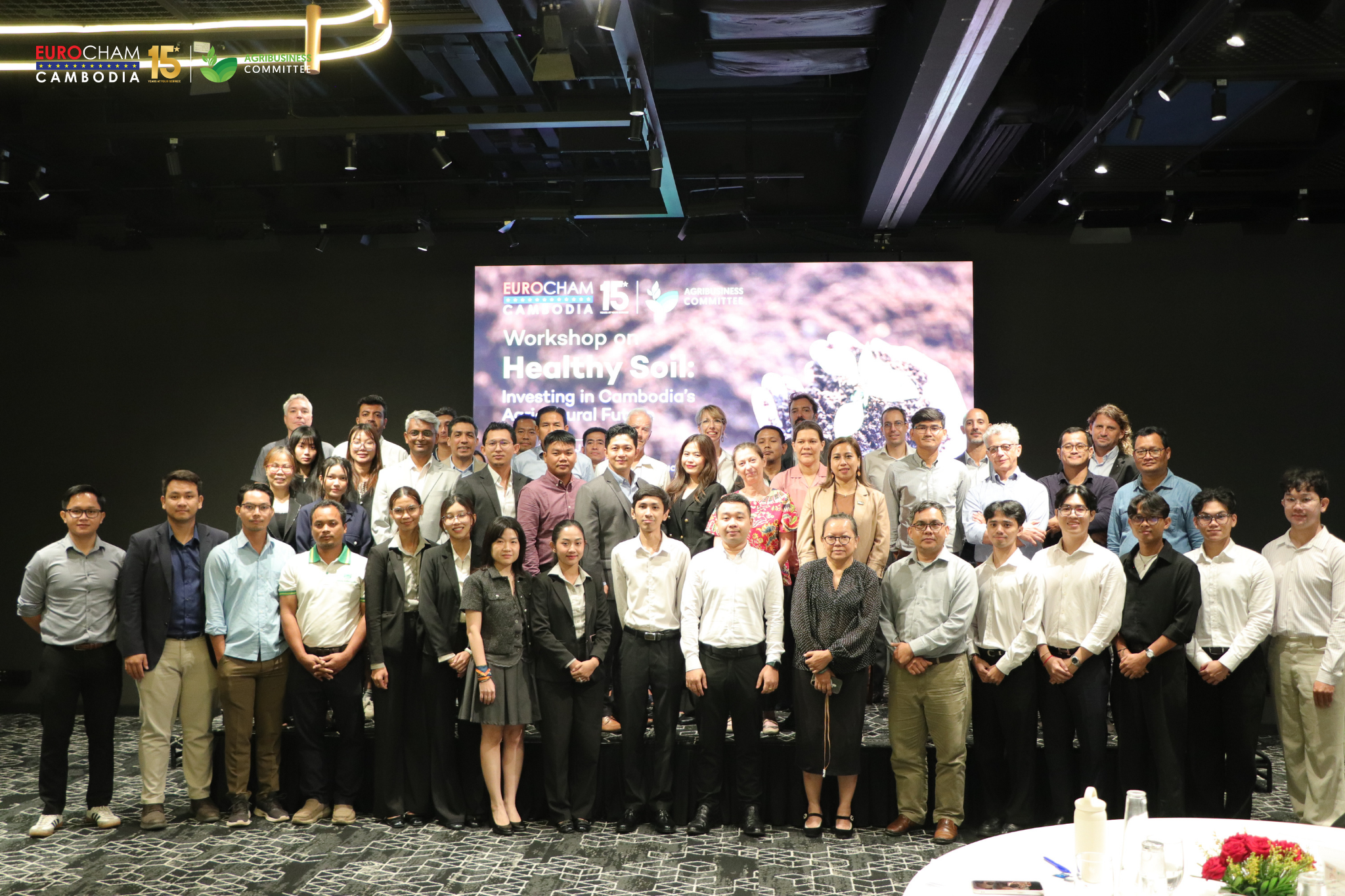
The discussion took place during the “Healthy Soil: Investing in Cambodia’s Agricultural Future” workshop, hosted by EuroCham Cambodia’s Agribusiness Committee in partnership with Swisscontact in Cambodia and Innovation for Sustainable Agriculture (ISA2).
Speakers highlighted research showing that approximately 42% of Cambodia’s land is affected by medium to severe degradation, driven by factors including deforestation, continuous monocropping and unsustainable farming practices. According to data presented at the event, the economic cost of soil degradation is estimated at approximately $677 million annually.
A major business challenge for the agricultural sector
Dr. Daniel Nugraha, Country Director of Swisscontact in Cambodia, said deteriorating soil quality has become a major business challenge for the agricultural sector as farmers increasingly rely on larger volumes of synthetic fertilisers and other inputs to maintain production levels.
Read More: ABA Bank Becomes Key Investor in Cambodia’s First-Ever Agriculture Bond
“As soil health declines, production costs rise and profitability comes under pressure,” he said, noting that the issue extends beyond environmental concerns and directly affects the financial sustainability of farming operations.
Despite the challenges, presenters pointed to growing evidence that regenerative agriculture practices can improve both productivity and profitability over the long term.
Field data shared during the workshop showed farmers implementing conservation agriculture techniques, including no-till farming, cover cropping and biochar-based fertilisers, recorded yield increases of 26% for maize, 33% for cassava and 24% for rice compared to conventional farming methods.
The financial benefits were also significant. According to the findings, cassava farmers using conservation agriculture methods achieved profits nearly five times higher per hectare than those using conventional approaches.
A two- to three-year investment period

Nugraha acknowledged that the transition requires patience, with farmers typically facing a two- to three-year investment period before reaching break-even. However, he said the long-term benefits include lower input costs, improved resilience to climate-related disruptions and stronger farm economics.
The workshop also examined the role of agricultural input suppliers in influencing farming practices and accelerating the adoption of sustainable production methods.
Ingrid Van Ginkel, Vice-Chairperson of EuroCham Cambodia’s Agribusiness Committee and Managing Director of Husk Venture, said farmer decisions regarding fertiliser use, pest management and residue handling are heavily influenced by product availability, pricing and supplier recommendations.
She argued that agribusiness suppliers could play a critical role in scaling regenerative agriculture if sustainable products and practices deliver clear financial returns for farmers.
“Healthy soil is not just a sustainability issue; it is a risk management strategy that supports food security, profitability and long-term resilience,” she said.
Van Ginkel added that collaboration across the agricultural value chain would be essential to achieving widespread adoption, bringing together farmers, input providers, investors and regulators to support the transition.
Adopt more sustainable agricultural practices.
A panel discussion featuring representatives from Olam Cambodia, the Department of Agricultural Land and Fertiliser Management and East West Seed explored the technical, financial and policy barriers facing businesses seeking to adopt more sustainable agricultural practices.
Participants also discussed the importance of partnerships between the private sector, development organisations and government agencies to help farmers manage the costs and risks associated with transitioning to regenerative farming systems.
Closing the event, EuroCham Agribusiness Committee Chairperson Oknha Sovithy Sothy called for greater alignment among stakeholders to strengthen Cambodia’s agricultural competitiveness and resilience.
The workshop concluded with a networking session aimed at fostering new partnerships and investment opportunities in sustainable agriculture, as industry leaders increasingly position soil health as both an environmental priority and a business imperative for Cambodia’s agricultural future.