

Harrison White
Speaking with Cambodia Investment Review following Canadia Impact Fund’s investment in NEWWAVE Tech Foundry, Chan AmrithVatey Kim discusses the company’s growth ambitions, its approach to enterprise AI transformation and its upcoming RE:AI platform for small and medium-sized businesses.
Founded in Phnom Penh in 2024, NEWWAVE has delivered products for clients in 15 countries. In this Leader Talks, Chan AmrithVatey Kim explains how the investment will support its expansion, why employee adoption matters as much as technology, and how Cambodian companies can prepare for AI to become part of everyday business operations.
Read More: Canadia Impact Fund Invests in Cambodian AI Company Newwave
Could you briefly introduce Newwave Tech Foundry and explain what the Canadia Impact Fund investment means for the company’s growth and its ability to serve business clients?
Chan AmrithVatey Kim: NEWWAVE Tech Foundry is an AI transformation and enterprise software company. We were founded in Phnom Penh in 2024 and today have a team of 17 engineers, AI specialists and designers. Our work has three parts. We build custom software, we help companies bring AI into their operations, and we are developing RE:AI, our own AI business operating system.
Our mission is for Cambodia to have its first global AI company, one that exports technology to the world. We’ve already delivered products for clients in 15 countries, including United States, UAE, Netherland, UK, Germany and more..
The investment from Canadia Impact Fund gives us more than capital. It shows that a Cambodian institution believes local companies can build world-class technology. Practically, it lets us do three things:
- Scale our team and delivery capacity so we can take on larger enterprise projects with the right structure, quality assurance and security practices.
- Bring RE:AI to market that allows us to build AI infrastructure for Small and Medium businesses.
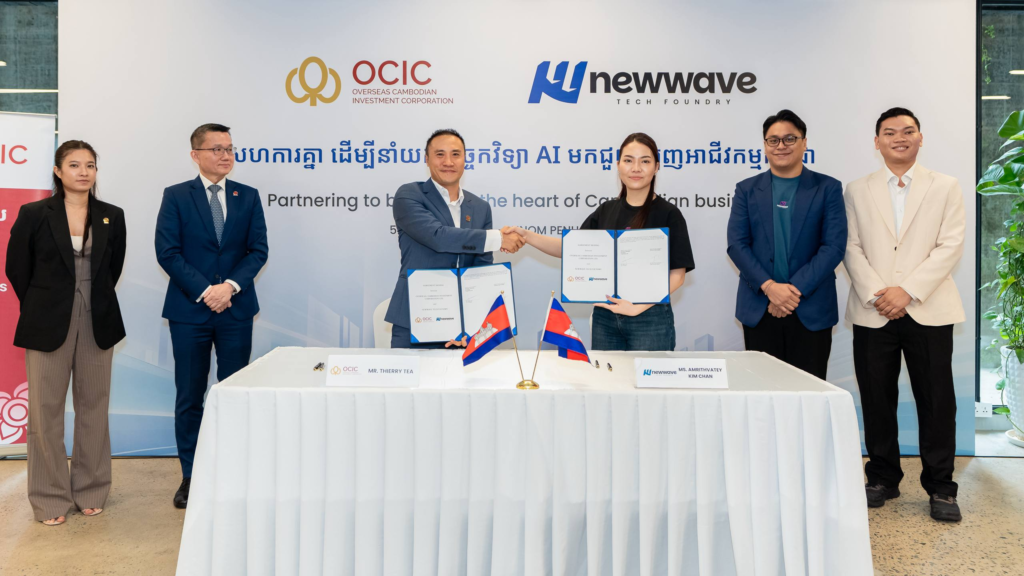
- Deepen our role in Cambodia’s business community. Alongside the round, we became OCIC’s certified AI Transformation Partner. That gives us a direct way to help established Cambodian businesses adopt AI.
For our clients, the investment means stability. They can trust that we’ll be here for the long term to support, maintain and grow the systems we build with them.
What business challenges do you help companies solve, and can you share an example of how your AI and software services have improved a client’s efficiency, reduced costs or increased sales?
Chan AmrithVatey Kim: The challenges look very different depending on the size of the company.
For large companies, capital is not the issue. Technology and user adoption are. They have the budget for digital and AI transformation. But they often have older systems that don’t connect, data spread across departments, and teams that aren’t yet comfortable working with AI. Buying a tool is easy. Getting hundreds of employees to use it every day is the hard part. We design AI around how their business already works and connect it to the systems they already run. Then we support their teams through the rollout so the technology actually gets used.
SMEs face the opposite problem. Many sign up for generic AI tools that were never built for the Cambodian market or for how their business operates. They end up paying for several subscriptions that don’t work together, and their staff still do much of the work by hand. We build AI that fits the local market and each company’s own way of working. We also connect it into one workflow instead of a stack of separate apps.
One example is a computer vision project we built for a market research company. Their team needed to count boxes of cigarettes accurately, which is very hard to do reliably by eye. We built an AI computer vision system that detects and counts the boxes from images with 98% accuracy. It processed more than 1 million images in under three weeks. A manual team would have taken far longer and made more errors.
We also automate sales and marketing. For example, our Lead Radar system brings leads from every channel into one place, follows up automatically and gives managers a live view of the sales pipeline. Sales teams using it respond to leads twice as fast, so fewer opportunities are lost.
With your upcoming RE:AI platform, how will you make AI practical and affordable for SMEs, particularly businesses with limited technical expertise or existing systems to integrate?
Chan AmrithVatey Kim: We built RE:AI for exactly the businesses you describe. Many SMEs in Cambodia don’t have an IT department or a modern ERP, and they can’t afford a large consulting project. So instead of asking them to integrate AI into systems they don’t have, RE:AI becomes their system.
RE:AI is an AI business operating system. At its center is an AI “Brain” that coordinates specialist AI agents, and each agent works like a virtual department. Four modules are live today: CRM, HR, Marketing and Customer Experience. They already run more than 50 automated workflows, and we’re building toward 10 connected modules.
We make it practical and affordable in three ways:
- Start where the business already works. RE:AI Neo, our lite version, runs through Telegram, an app most Cambodian business owners already use every day. There’s no new software to learn and no technical skills needed.
- Grow one department at a time. A business can start with one module, such as sales or HR, see results, and add more as it grows.
- Monthly subscription pricing. There’s no large upfront investment. SMEs pay a monthly fee, the same way they pay for any other business service.
We’re preparing a public launch in the early of 2027.
With more than 70% of your clients based overseas, how does Newwave compete with international AI and software providers, and what advantages can a Cambodian technology company offer business customers?
Chan AmrithVatey Kim: We compete on quality first, not price. Our European clients in Germany, France, Switzerland and the Netherlands hold us to the same standards they’d expect from any provider at home. We’ve delivered more than 10 products for them, and those clients keep coming back. That’s the clearest sign we can compete.
A Cambodian company offers business customers some real advantages:
- Speed and focus. We’re a lean. Clients work directly with the people building their product, not through layers of account managers, so we move from idea to working product quickly.
- Cost efficiency without cutting corners. Our cost base lets clients get enterprise-grade engineering and AI work at a price that makes sense for growing companies.
- Understanding of emerging markets. We know how to build for businesses that are digitizing fast, often skipping steps that Western markets went through. That’s valuable for clients across Southeast Asia and beyond.
- Security and confidentiality. We treat IP protection, data security and client confidentiality as core priorities. That’s what lets international clients trust us with their products.

For Cambodian businesses, there’s another advantage. They get the same international-level expertise from a team that’s right here, speaks their language and understands the local market.
How do you see business adoption of AI developing over the next three to five years, and what should Cambodian companies do today to prepare and remain competitive?
Chan AmrithVatey Kim: Over the next three to five years, AI will move from being a tool people try out to being part of how a business runs. Today, most companies use AI for one-off tasks like writing a post or answering a question. Soon, AI agents will handle whole workflows: following up with customers, processing documents, managing schedules and reporting to management. The question won’t be whether a company uses AI, but how much of its operations AI supports.
For Cambodia, this is a real opportunity. A small, well-organized company using AI will be able to compete with much larger players, at home and across the region. But the gap between companies that adopt early and those that wait will grow quickly.
My advice to Cambodian companies is to start now, and start small:
- Get your data in order. AI is only as good as the information it works with. Move key records out of paper, chat groups and scattered spreadsheets into proper digital systems.
- Invest in your people. Train your team to work with AI, not fear it. The companies that win will be the ones whose staff know how to use these tools well.
- Choose partners who understand your business. AI transformation is not only about technology. It’s about changing how work gets done, so work with partners who take the time to understand your operations.
“Your business doesn’t need to be big to operate like an enterprise. It just needs the right AI. Let’s build it together: hello@new-wave.io.“