


Cambodia Investment Review
Cambodia’s healthcare, insurance, banking and regulatory sectors are being urged to collaborate on shared digital infrastructure to support a more sustainable healthcare financing system, according to speakers at a recent breakfast forum organised by the European Chamber of Commerce in Cambodia.
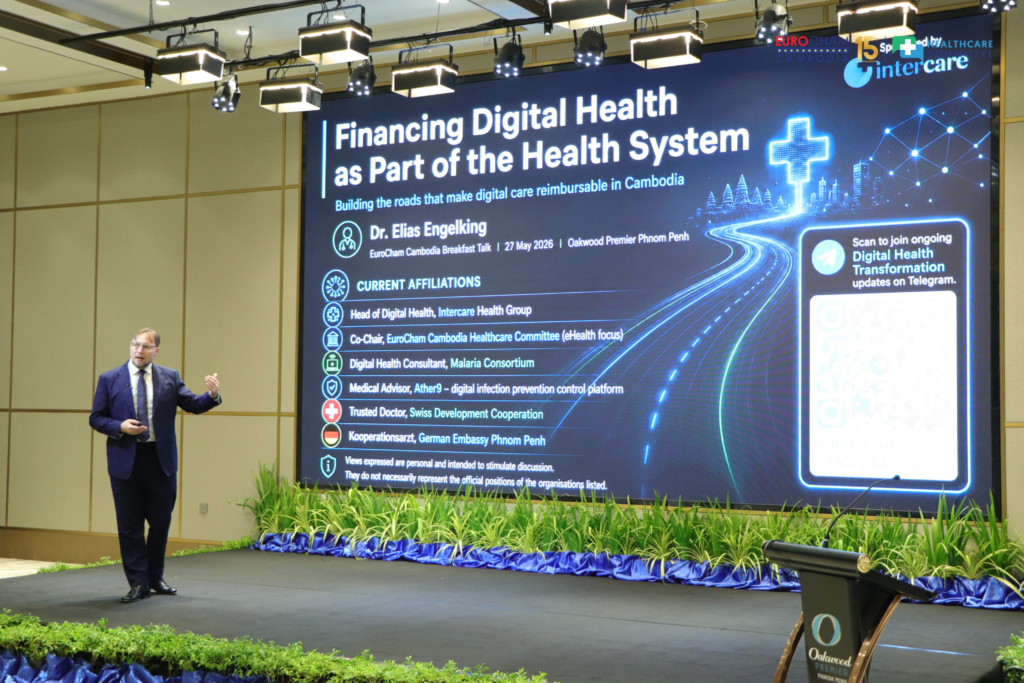
The “Financing Digital Health — Building the Financing Stack for Digital Care” event, hosted by EuroCham’s Healthcare Committee, brought together industry leaders, insurers, financial institutions and government representatives to discuss how Cambodia can scale digital healthcare systems while keeping costs commercially viable for providers, insurers and patients.
Speakers throughout the event argued that Cambodia has a rare opportunity to leapfrog more developed regional healthcare systems due to its relatively small market, high mobile penetration and limited legacy infrastructure.
Dr. Elias Engelking, Co-Chairperson of EuroCham’s Healthcare Committee and Head of Digital Health at Intercare Health Group, said Cambodia’s digital health ambitions would depend on the development of shared national infrastructure before advanced financing models could emerge.
He pointed to the Cambodia Digital Health Enterprise Architecture, currently being developed by the Ministry of Health with support from the World Health Organization, as a key framework for aligning the sector.
Engelking also called for the creation of a Cambodia Digital Health Alliance, modelled on the Credit Bureau Cambodia, to allow private healthcare providers to cooperate on shared digital systems instead of operating fragmented platforms.
“Fragmentation makes care expensive — for providers, for insurers, and for patients,” Engelking said during the forum.
“Cambodia has a real opportunity to do this differently, but we need to build the shared foundations first.”
Shift Away From Traditional Healthcare Payment Models
Mr. Edouard Lesellier, CEO of Safetynet, said rising healthcare costs across ASEAN markets were pushing insurers and healthcare systems to reconsider traditional fee-for-service models.
He outlined alternative approaches including capitation, bundled payments and value-based care, which are increasingly being adopted in other regional healthcare systems to better manage long-term medical inflation.
Lesellier said Cambodia’s smaller scale and growing digital connectivity could allow the country to implement reforms faster than larger neighbouring markets if policymakers and industry participants coordinate effectively.
“Cambodia has fewer legacy systems, high mobile penetration, and a more agile market than most of its neighbours,” he said.
“The conditions to build something genuinely forward-looking are all there.”
Panellists across the event broadly agreed that digitising healthcare claims processing represented one of the most achievable near-term reforms.
During one panel discussion, H.E. Khun Channarith, Deputy Director General of the National Social Security Fund, said a fully digital patient check-in and claims system had already been piloted successfully at the National Hospital.
He added that full digitalisation of NSSF claims processing is expected by the end of May 2026, with private healthcare providers progressively integrated into the system.
Insurers Highlight Operational Efficiency Gains
Mr. Suy Channtharong, CEO of Forte Insurance, said digitalisation and automation had already significantly reduced claims processing times within the company.
According to Channtharong, Forte has reduced claims processing time by approximately 90%, with most claims now settled within five to 20 days.
Other panellists, including Dr. Som Leakhena, President of the Private Hospital Associations of Cambodia, discussed the potential for co-payment systems and longer-term financing structures designed to improve sustainability across Cambodia’s healthcare ecosystem.
Discussions also focused on the role of artificial intelligence in healthcare administration and insurance operations.
Mr. Akhshy Thiagarajan of AIA said insurers were cautiously optimistic about the use of AI for claims automation and fraud detection, although he noted reliable implementation would depend heavily on strong data governance and high-quality datasets.
Mr. Dominic Notario, CEO of Canadia Bank, said the healthcare sector may eventually require mandatory data-sharing frameworks similar to those implemented in Cambodia’s banking sector through the Credit Bureau system.
Meanwhile, Mr. Chhay Sothun, Deputy Director of the Department of Digital Health at Cambodia’s Ministry of Health, stressed the importance of establishing a unified patient identity system as a foundational component of any integrated digital healthcare ecosystem.
EuroCham Signals Further Digital Health Discussions
Closing the event, EuroCham Executive Director Mr. Martin Brisson said the chamber intends to continue discussions on digital healthcare financing through a second digital health forum planned for later in 2026.
Founded in 2011, EuroCham Cambodia represents more than 450 members and six national chapters across 23 European countries, focusing on investment promotion, business advocacy and private sector engagement in Cambodia.


