

Cambodia Investment Review
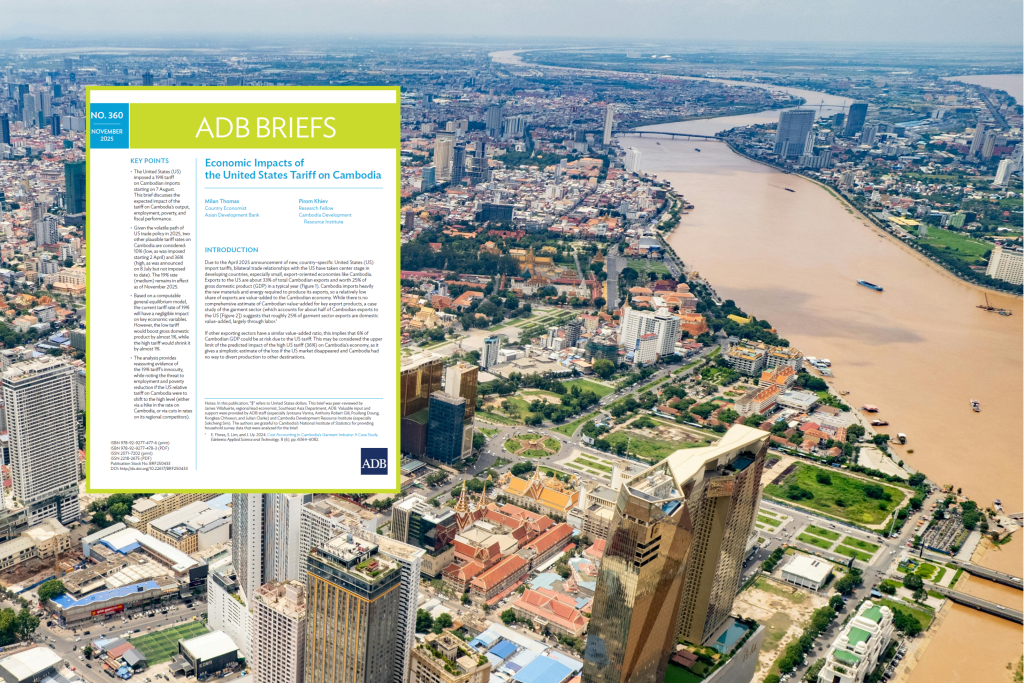
A new policy brief from the Asian Development Bank (ADB) warns that while the United States’ 19% tariff on Cambodian imports is currently manageable, any escalation could threaten growth, jobs, and poverty reduction efforts across the Kingdom’s export-driven economy.
The brief, Economic Impacts of the United States Tariff on Cambodia, developed in partnership with the Cambodia Development Resource Institute, models the effects of three possible tariff levels—low (10%), medium (19%), and high (36%)—on Cambodia’s economy.
Moderate Tariffs, Manageable Impact
ADB’s simulation shows that the 19% tariff, introduced in August 2025 following bilateral talks with Washington, will have minimal effects on economic stability in the near term. However, a 36% rate would reduce economic growth by nearly one percentage point, potentially leaving more than 100,000 people jobless and pushing the national poverty rate up by more than one percentage point.
“Government and industry experts have been monitoring the situation closely for months,” said Milan Thomas, ADB Country Economist for Cambodia and lead author of the brief. “Economic modelling confirms that the current tariff is indeed manageable, while demonstrating that a higher tariff would have dire consequences for Cambodian families through unemployment and poverty.”
Garment and Electronics Sectors Most Exposed
The ADB study underscores that Cambodia’s garment and electronics industries would be hit hardest by a steeper tariff, given their heavy reliance on U.S. export markets. Workers displaced from these sectors would likely shift into lower-paying jobs in agriculture or basic services, eroding household incomes and reversing recent gains in poverty reduction.
Cambodia’s export sector, a key engine of growth, employs hundreds of thousands and contributes significantly to national GDP. Any disruption in trade flows to the U.S.—one of Cambodia’s largest markets—would reverberate across supply chains, particularly in provinces where manufacturing is concentrated.
Policy Recommendations for Stability
The policy brief advises the government to prepare targeted relief measures in case of future tariff escalation. These include short-term interventions such as social assistance, employment services, and upskilling programs to help affected workers transition between industries.
For the longer term, ADB stresses that strengthening competitiveness through continued investment in infrastructure, human capital, and regulatory reform will be critical to sustaining resilience. Diversifying export markets and promoting higher-value manufacturing are also seen as essential to cushioning the economy against external shocks.
Broader Economic Context
The analysis, conducted with economic modelling support from Victoria University’s Centre of Policy Studies and using household survey data from Cambodia’s National Institute of Statistics, situates the tariff issue within Cambodia’s broader development trajectory.
While Cambodia has diversified its trade partners in recent years—expanding links with China, the European Union, and ASEAN—its export profile remains heavily concentrated in garments, footwear, and light manufacturing, much of which is U.S.-bound.
ADB’s findings suggest that maintaining policy flexibility and promoting private-sector adaptability will be vital as global trade dynamics shift.
The Asian Development Bank, established in 1966 and owned by 69 member countries, remains a key partner in Cambodia’s economic transformation. It continues to support inclusive and sustainable growth through projects focused on infrastructure, innovation, and social protection—critical tools as the country navigates an increasingly uncertain global trade environment.