
Cambodia Investment Review
Cambodia’s real estate market showed an uneven performance in the third quarter of 2026, with manufacturing investment supporting industrial expansion while residential prices, commercial occupancy and hotel development remained under pressure, according to APS Research’s latest Market Pulse report.
The findings point to a widening gap between property linked to export production and segments dependent on household spending, expatriate demand and international tourism. Developers and landlords are adjusting through smaller launches, more flexible leasing terms and a greater focus on affordability.
High-end condominium asking prices fell 6.7% from the previous quarter, while Grade A serviced apartment rents declined 13.5%. Phnom Penh’s average office occupancy stood at 63.9%, and retail occupancy reached 57.1%.
Industrial property moved in the opposite direction. Ready-built factory rents increased 3.6% quarter on quarter to $2.90 per square metre per month, while average long-term special economic zone land lease prices rose 1.96% to $67.60 per square metre over the lease term.
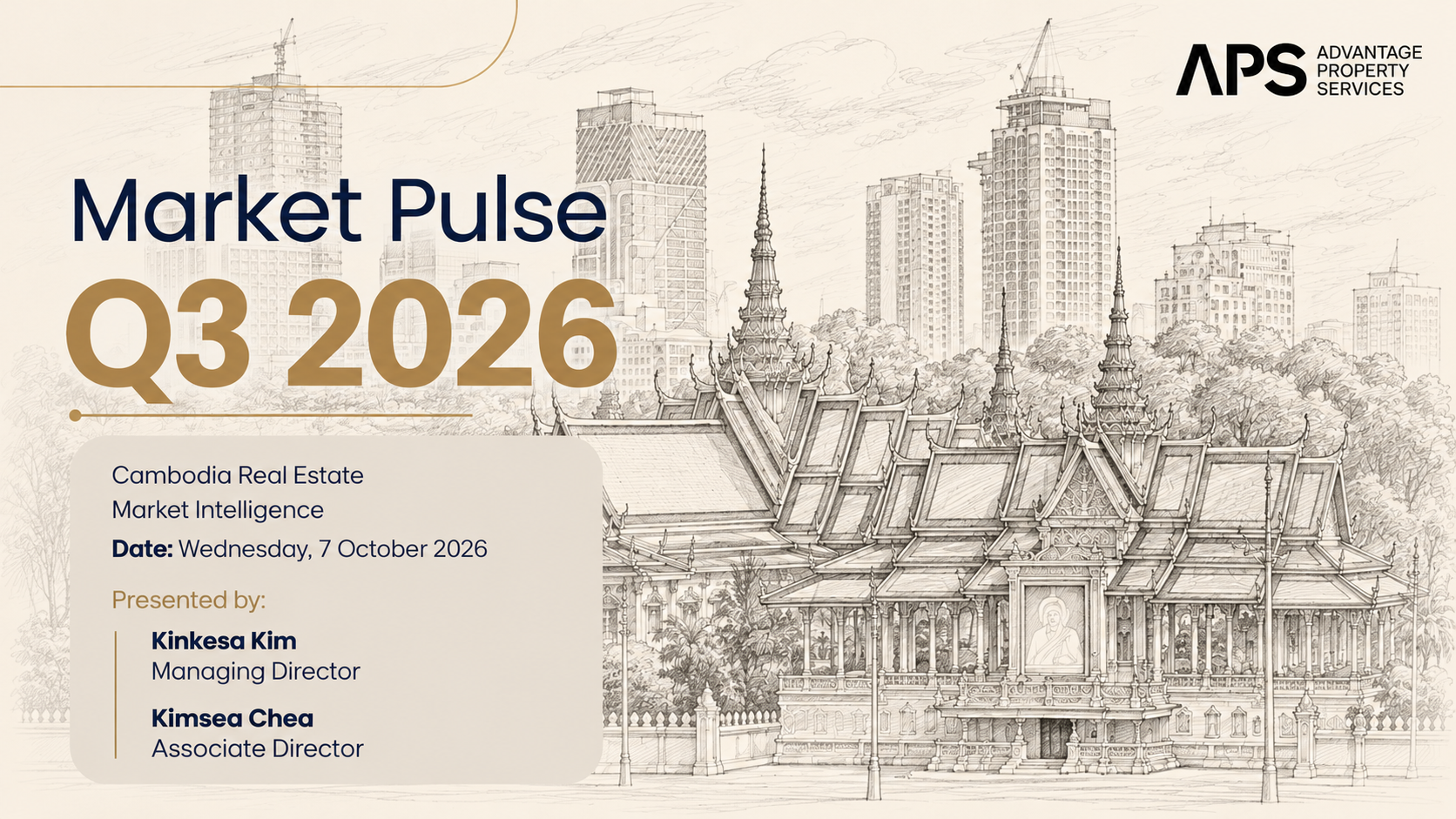
The report, presented on October 7 by APS Managing Director Kinkesa Kim and Associate Director Kimsea Chea, suggests that recovery will depend increasingly on individual locations, tenant requirements and developers’ ability to match supply with demand.
Manufacturing investment supports industrial growth
Special economic zones remained a focus of development activity, with seven projects announced through the third quarter. Approximately 1,400 hectares had received approval from the Council for the Development of Cambodia, while another 800 hectares were under review, according to APS.
The consultancy estimated accumulated SEZ land would reach approximately 23,700 hectares in 2026, representing expansion of about 42% from 2023. Around 55% was operational as of the third quarter.
Kampong Speu emerged as the main expansion corridor. Projects listed in the report include Canadia SEZ, KP Yan SEZ, Shanghai Special Economic Zone and SYS Special Economic Zone, alongside the Phnom Penh Logistic Complex.
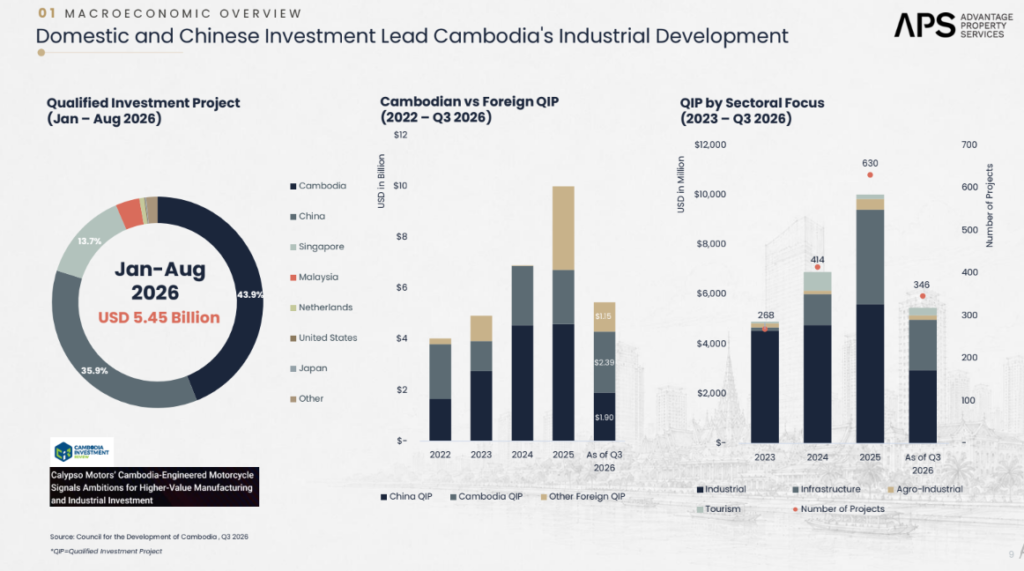
The industrial outlook was supported by investment approvals. Citing CDC figures, APS reported $5.45 billion in qualified investment projects during January–August 2026. Cambodian investors accounted for 43.9%, followed by Chinese investors at 35.9% and Singaporean investors at 13.7%.
APS also identified growing demand for factories built to tenants’ specifications, particularly among industries such as electronics assembly that require facilities beyond the capabilities of standard warehouses.
However, businesses continue to face a cost trade-off. The report identified an approximately 32% pricing gap between standalone industrial land and land within SEZs, where infrastructure and operational services can command a premium.
Residential launches rise, but luxury prices soften
Residential development showed selective activity rather than a broad rebound.
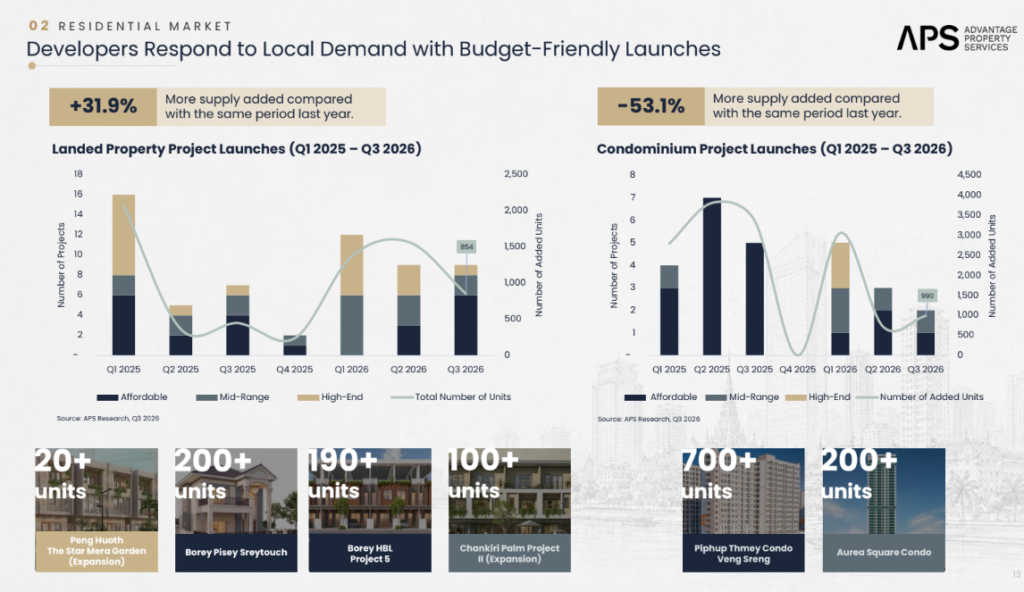
Developers launched 990 condominium units in the third quarter, up 37.5% from the previous quarter. Landed property launches totalled 854 units, down approximately 46% over the same period.
APS said developers continued to target affordable and mid-range demand, while cautiously returning to higher-end products. The report identified the first luxury condominium launch since 2023, with developers releasing projects in stages to manage sales risk.
That activity coincided with further price declines. High-end condominium asking prices averaged $2,599 per square metre, down 6.7% quarter on quarter. Mid-range prices stood at $2,045, while affordable units averaged $1,110.
Rental competition also intensified. Grade A serviced apartment asking rents fell to $17.30 per square metre per month, while Grade B rents stood at $13.
APS attributed the pressure to weaker occupancy, cost-conscious tenants and a growing choice of competitively priced apartments. It said landlords’ willingness to negotiate below advertised rates suggested effective rents could be weaker than listings indicated.
The secondary sales market offered a more constructive signal. Sellers were adjusting expectations, and buyers were responding to lower asking prices, narrowing the gap between advertised and transacted values. APS interpreted this as a possible sign that parts of the market were finding a floor.
Office landlords compete on incentives
Phnom Penh’s office market continued to favour tenants as additional supply increased competition.
APS estimated total office stock at approximately 1.3 million square metres, with more than 160,000 square metres of additional supply expected during 2026. Around 48% of that annual pipeline had been completed by the end of the third quarter.
Completed buildings included GDT Tower, RGC Tower and 598 Tower, while FTB Tower and Norodom Business Center remained under construction.
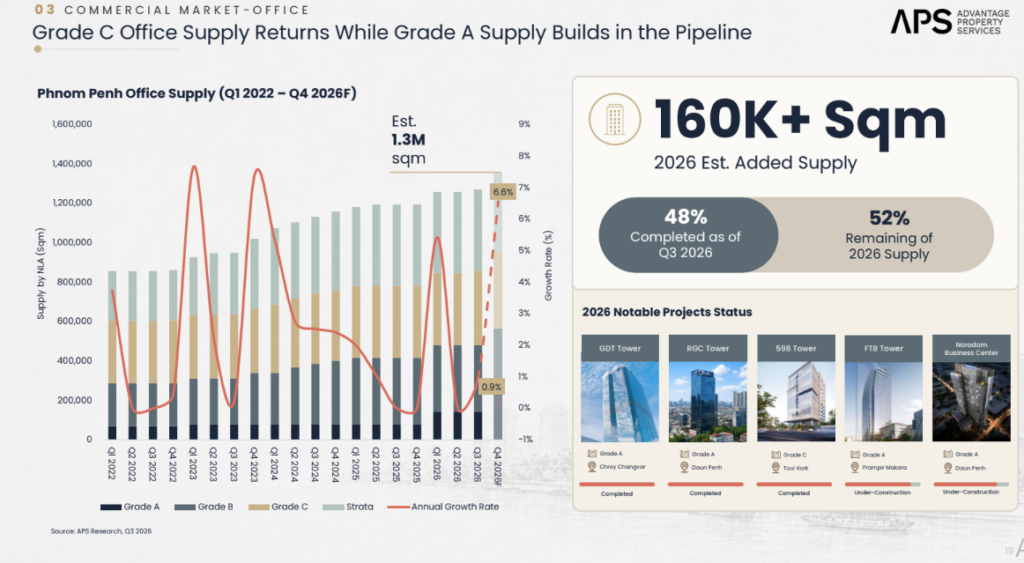
Average occupancy stood at 63.9%, with new Grade C supply weighing on that segment. Higher-quality buildings benefited from tenants’ preference for amenities and facilities, although businesses remained sensitive to costs.
Landlords increasingly offered fit-out support, flooring and leasing incentives to reduce tenants’ initial expenses. APS also identified demand from larger occupiers seeking more than 1,000 square metres and room to expand within the same building.
Retail shifts toward smaller formats
Retail developers were increasingly choosing community malls, standalone locations and alternative formats with lower investment requirements.
Phnom Penh’s retail supply was estimated at approximately 882,000 square metres. More than 42,000 square metres of additional space was expected during 2026, with about 65% completed by the third quarter.
Average occupancy remained subdued at 57.1%, although APS found that high-street locations benefited from visibility, accessibility and continued brand expansion.
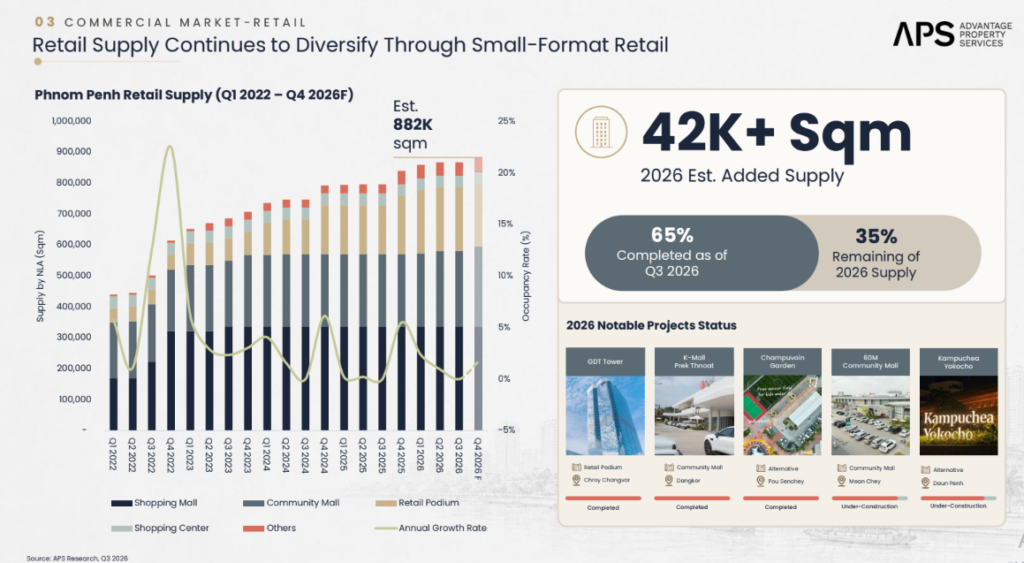
Prime high-street asking rents averaged $21.60 per square metre per month. Shopping mall rents averaged $25.90, community malls $17 and retail podiums $21.40.
Advertised rents were broadly stable, but landlords showed greater flexibility during negotiations. Community mall operators were also renovating properties, adjusting tenant mixes and strengthening marketing to retain customers.
Tourism weakness complicates hotel development
Hospitality faced pressure from weaker international arrivals and financing constraints affecting mixed-use projects.
Citing Ministry of Tourism data, APS reported approximately 2.25 million international arrivals during January–August 2026, down 44.4% from the same period a year earlier.
Slower property sales were reducing cash flow for some developers, potentially delaying construction and the handover of hotels to branded operators.
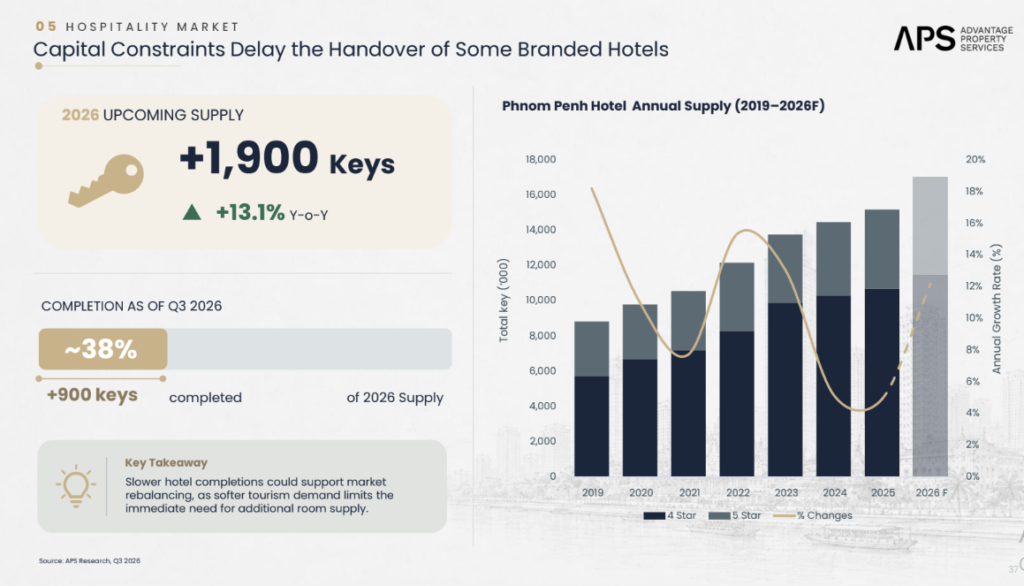
Five-star hotel room rates averaged $313 per night in the third quarter, down 43% from the previous quarter. Four-star rates averaged $104, while three-star rates stood at $75.
APS said luxury hotels retained greater pricing flexibility during high-demand periods, while three- and four-star operators faced stronger competition and relied more heavily on discounts to support occupancy.
Across the market, the report points to a recovery shaped by operational performance and targeted demand. Manufacturing and logistics offer support for industrial expansion, while residential, commercial and hospitality assets continue to require pricing adjustments, tenant incentives and careful management of development costs.