
Cambodia Investment Review
Cambodia’s circular economy plans are moving into a more practical phase, with businesses, government officials and development partners meeting this week to examine how waste reduction and more efficient resource use can create investment opportunities and jobs.
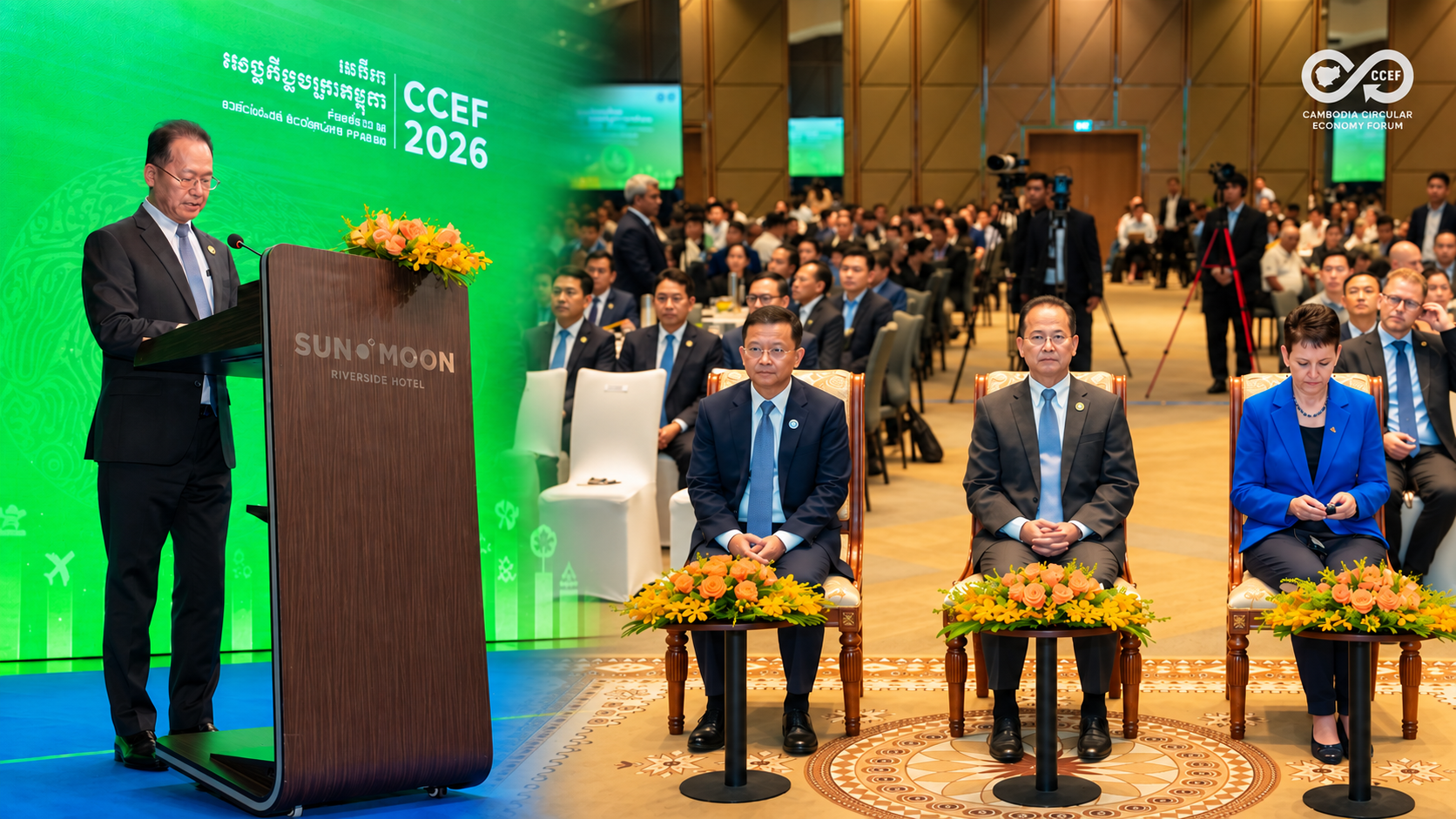
The third Cambodia Circular Economy Forum opened on September 30 at the Sun & Moon Riverside Hotel in Phnom Penh. Around 370 participants are expected over the three-day event, organised by Deutsche Gesellschaft für Internationale Zusammenarbeit (GIZ) GmbH and funded by Germany’s Federal Ministry for Economic Cooperation and Development.
This year’s theme, “Circular Economy in Action: From Policy to Prosperity,” puts the emphasis on turning national strategies into projects that businesses can finance and put to work.
Six areas shaping the discussion
- Agriculture and the bioeconomy: Turning agricultural waste into useful products, including biochar, wood vinegar and black soldier fly-based solutions.
- Waste management: Examining reuse systems and extended producer responsibility, which would give producers a greater role in managing products after use.
- Financing and investment: Identifying how circular projects can attract capital and become viable businesses.
- Circular trade and textiles: Exploring more resource-efficient production and what companies need to prepare for export markets.
- Green skills and jobs: Building the workforce needed to support new processes and businesses.
- Climate and inclusion: Connecting circular projects with climate goals while considering how women and other groups can participate in the opportunities they create.
The forum began with agriculture, including discussions on circular rice value chains and the business case for biochar. Its remaining sessions cover investment, waste, trade and textiles, with panels designed to draw out practical challenges as well as examples that could be scaled.
German Ambassador to Cambodia H.E. Silke Röfer said Europe’s experience showed that “regulatory ambition must go hand in hand with market incentives and behavioral change.”
Read More: Cambodia and UNDP Target Climate Investment as $40 Million in Financing Finalized
Minister of Industry, Science, Technology and Innovation H.E. Hem Vanndy called for businesses to rethink how products are made and used, including whether manufacturing by-products from one facility could serve as inputs for another.
Minister of Environment H.E. Dr. Eang Sophalleth said a circular economy goes beyond recycling and requires changes in how resources are produced, consumed and managed.
Cambodia’s policy framework includes its 2021 Circular Economy Strategy and Action Plan, the Circular Strategy on Environment for 2023–2028 and the Long-Term Strategy for Carbon Neutrality. The forum, which runs through October 2, is examining what it will take to turn those commitments into projects with measurable benefits for businesses and communities.