
By Suon Mach
If you’ve felt like things cost more in Cambodia lately, the data backs you up. Fresh numbers from the Penn World Table a well-respected international database economists rely on to compare living costs across countries show that Cambodia is steadily losing its reputation as an ultra-cheap destination.
The dataset uses something called a price level, which is really just a simple way of asking: how much more or less does everyday life cost here in Cambodia compared to the US? The US is always set as the benchmark, at 100 percent. Anything below that means things are cheaper.
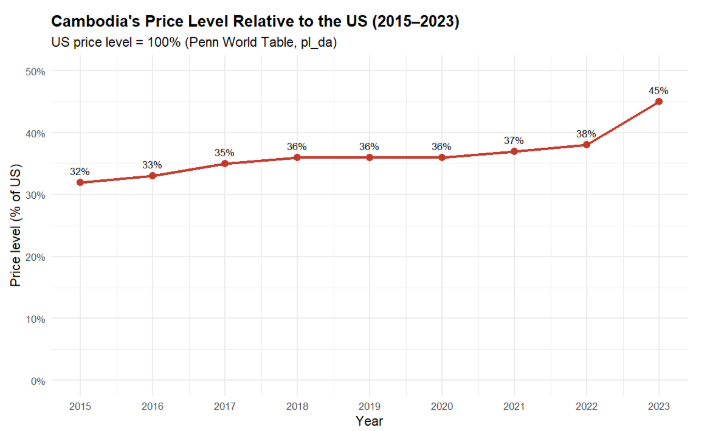
Back in 2015, Cambodia’s price level sat at around 32 percent of US prices. Picture it this way, a $100 basket of everyday goods in America, things like food, rent, and basic services, would only run you about $32 in Cambodia. Fast forward to 2023, and that same basket costs closer to $45. The trend crept up slowly at first, 36 percent by 2019, 37 percent in 2021, 38percent in 2022, then took a noticeably bigger leap to 45percent in 2023. Despite the increase, Cambodia is still the more affordable option, but that gap isn’t as wide as it used to be.
So, what’s driving this? A few things tend to feed into each other here. Everyday inflation is part of it, when local prices climb year after year, the gap with the US naturally narrows. The riel’s strength against the US dollar matters too, a stronger currency makes local prices look pricier on the international stage. And then there’s just the pace of growth itself. Fast-developing economies tend to see rising prices as incomes and demand pick up, and Cambodia is no exception.
That 2022 to 2023 jump is really what catches the eye. A seven-point rise in a single year is unusual, and it’s a big enough shift that economists would want to dig into what caused it, was it a one-time spike, a currency swing, or the start of something longer-term?
Either way, this isn’t just a number on a chart. For people living in Cambodia, it likely shows up in ways that are easy to feel, pricier groceries, higher rent, that sense that money doesn’t stretch quite as far as it used to.
For visitors, expats, or investors, it’s a signal that Cambodia isn’t the bargain it once was, even if it’s still cheaper than most Western countries. And for the people setting economic policy, it’s a number worth watching closely, since it can hint at whether growth is happening in a healthy, sustainable way or whether rising costs are starting to squeeze people harder than the headline numbers suggest.
Suon Mach is a second-year master’s degree student in Development Studies at the Royal University of Phnom Penh.