
By Drs Peter J. Brongers
Off the coast of Cambodia, a radical idea is taking shape: what if the best way to save a coral reef was to turn it into one of the world’s most extraordinary art galleries?
Kep is the kind of place that makes you wonder why the world hasn’t discovered it yet. It is a sleepy seaside town two hours from Phnom Penh, with crumbling French colonial villas, known for its crab market, and a coastline of quiet beauty. What it does not have (yet) is a reason for the world to pay attention.
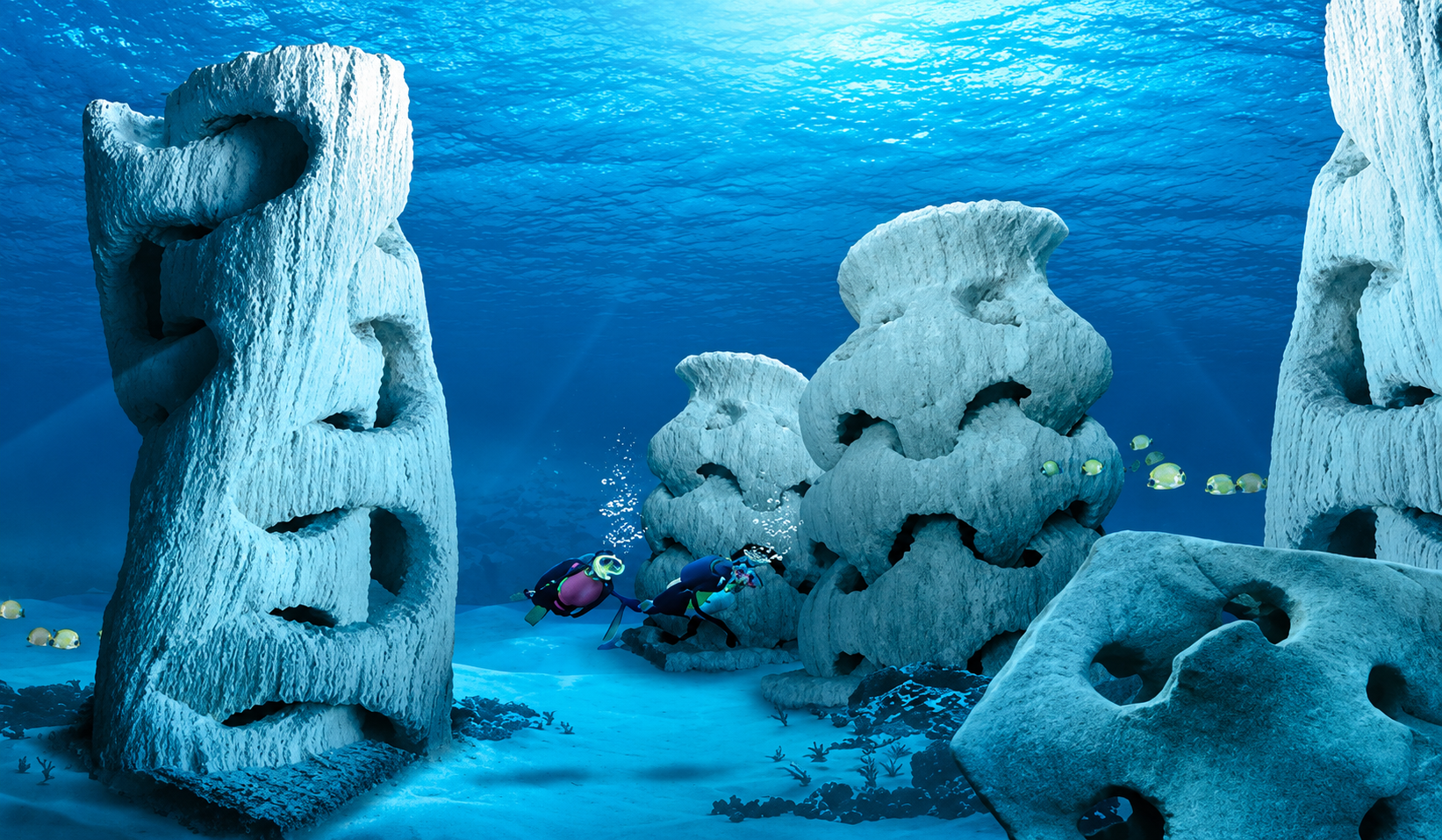
Just ten kilometres offshore that will change. Artists, marine scientists, architects, and visionary entrepreneurs are preparing to build something the world has never seen: an underwater art gallery where the sculptures are also coral reefs.
The Southeast Asian Ocean Gallery will commission works from international and local artists. These will be 3D-printed in a special marine-grade composite that coral loves to grow on. Each one will be exhibited publicly on land in Kep before being lowered to the seabed, where over years and decades it will be colonised by coral, inhabited by fish, and visited by divers, snorkellers, and glass-bottom boat passengers from across the globe.
By Year 10, close to 500 works will sit on the ocean floor. Together they will form the largest underwater art collection in Asia and one of the most significant artificial reef systems in Southeast Asia.
The Problem Nobody Has Solved
Cambodia’s coastal reefs have had a difficult few decades. Destructive fishing, coastal development, and a series of bleaching events have taken a heavy toll. Marine Conservation Cambodia, which has managed the protected area close to Kep, surveyed the Koh Karang site in 2016 and found significant damage. But they also found something more important: the reef could come back, if given the chance.
The problem is that giving a reef the chance to recover costs money. Quite a lot of it, sustained over many years. And the conventional ways of raising that money like government budgets, conservation grants, donor funding, have never been reliable enough, or large enough, to do the job properly. The Ocean Gallery is built around a different idea entirely.
Art as the Engine
The project is initiated by Kep West and Knai Bang Chatt, in partnership with Art for Kep Association and Marine Conservation Cambodia. The business model has six revenue streams: dive tourism, art sales, venue hire, artist residencies, media licensing, and corporate sponsorship. All of them get stronger as the collection and the reef around it grow.
Here is the insight at the heart of the model: in a normal reef tourism business, you need as many visitors as possible to cover your costs. The pressure to maximise numbers is precisely what damages the reef that is supposed to be protected. The Ocean Gallery breaks that trap. By generating serious revenue from the art programme, collector sales, limited editions, residency fees, documentary rights, the institution can afford to manage diver access responsibly. The reef and the business pull in the same direction.
The financial projections bear this out. The project reaches operational break-even Year 2. It turns cumulatively cash-positive in Year 4. By Year 10, it is generating USD 12 million in annual revenue against under USD 2 million in operating costs. Total ten-year net return: USD 45 million. Even if tourism drops 50%, the model still works. Even if art sales underperform, it survives.
What Goes Into the Water
The sculptures are made using technology developed by D-Shape, a company that has deployed over 500 artificial reef structures across more than 20 projects worldwide. The material is a pH-neutral cementitious composite. You can think of it as a concrete that reefs actually want to grow on. It stabilises to natural seawater conditions within three months of submersion. At comparable deployments in Hong Kong, independently monitored by engineering firm Mott MacDonald, the same process produced fivefold increases in species abundance and richness within months of deployment.
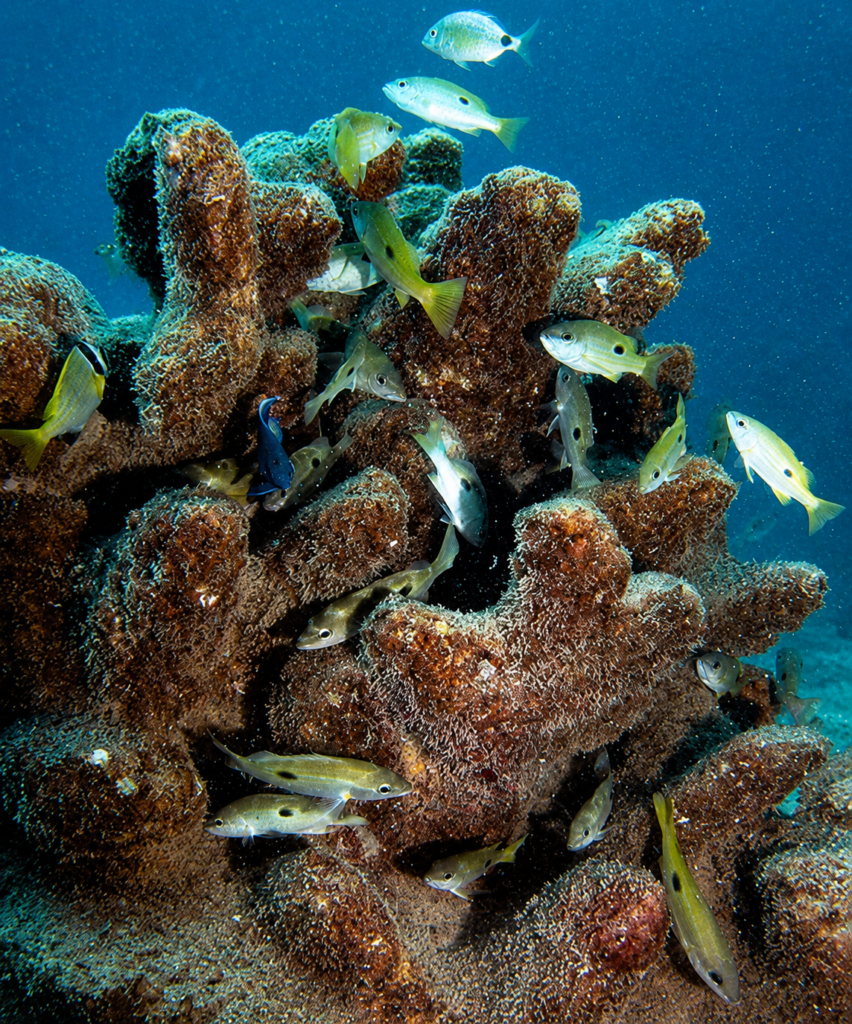
Each sculpture is around two cubic metres. This is large enough to create meaningful habitat and small enough to produce 50 a year without straining the system. At that cadence, the collection grows by four works a month. The onshore exhibition keeps pace: every work is publicly shown in Kep before going into the water, generating a continuous cycle of new art, new press, new collector engagement, and new revenue.
No other underwater museum in the world operates this way. Museo Atlántico in the Canary Islands, the closest global benchmark, draws 15,000 visitors a year and has no onshore programme. The Ocean Gallery is designed to draw 75,000 visitors by Year 10 and generate cultural programme revenue year-round, independent of weather, seasons, and dive conditions.
Why is this so important for Cambodia
The Gulf of Thailand’s reefs are actually recovering. Long-term monitoring in Thailand shows hard coral cover rising from 37% to 55% between 2014 and 2022, even on sites exposed to tourism and boat traffic. The offshore Koh Karang location is protected within Cambodia’s Marine Fishery Management Area. It is distant from the coastal pressures that have damaged shallower sites and is well-positioned to recover faster still.
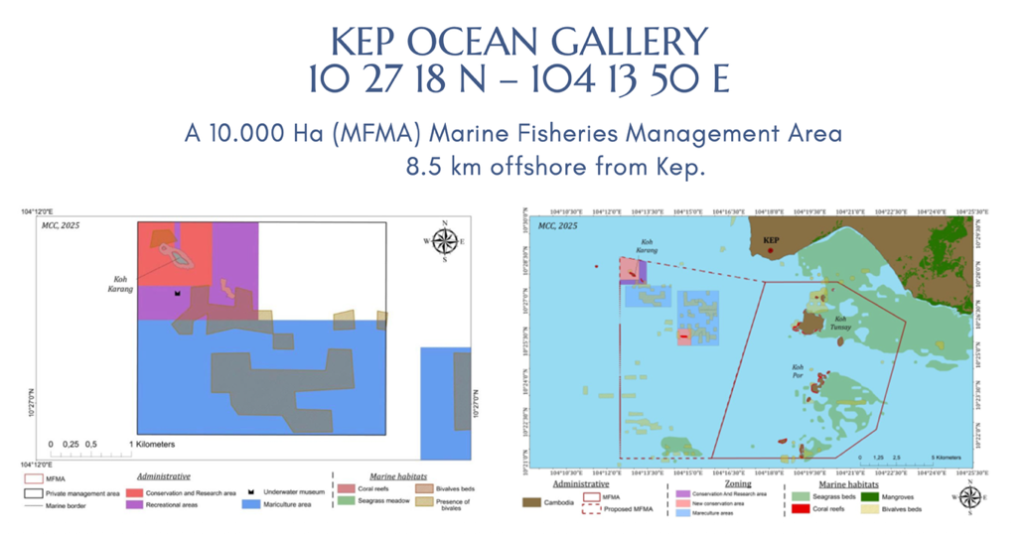
The project has the backing of multiple Cambodian ministries and a green light in principle from the Royal Cambodian Government as of March 2026. Marine Conservation Cambodia is the independent ecological monitoring partner, with published annual KPI targets for coral recruitment, fish species richness, and water quality. The institution is accountable to the science, not just to its own projections.
For the 175 fishing families and 35 communities in the Kep coastal area, the project brings direct employment, a residency programme that brings 50 international artists to the region annually, and a long-term economic presence grounded in the health of the local marine environment. The intended long term leasae is a signal of continuity. It tells every partner, every artist, investor, collector, and government official, that the Ocean Gallery is here to stay.
The Opportunity
The capital needed to begin is USD 2.5 million. The project hits cumulative break-even in Year 4 and generates USD 45 million net over ten years.
But the real value of the Ocean Gallery is not in the ten-year model. It is in what the collection becomes over time. Close to 500 site-specific commissioned works, with the ecology that has grown around them and the institutional relationships built over a decade, cannot be replicated. No competitor can build what the Ocean Gallery will have built. The collection, the reef, and the institution are jointly irreplaceable.
Cambodia has Angkor Wat. It is one of the great cultural destinations on earth. But Angkor Wat is ancient, fixed, and landlocked. The Ocean Gallery is alive, growing, and entirely new.
That combination, international art, proven marine technology, a business model that gets stronger every year, and a reef that no one else can touch, is the investment case. And the reef, once established, is priceless.
The author is a former Senior Executive Vice President of Royal Group of Companies, former CEO at HGB and Secretary General of the Art for Kep Foundation. He is pursuing a PhD in viability of marine conservation organisations at Paragon International University.
The SEA Ocean Gallery is an initiative of Knai Bang Chatt Cambodia Co. Ltd and Art for Kep Association, in partnership with Marine Conservation Cambodia. www.kepwest.com. For more information email strategy@kepwest.com