
Cambodia Leadership Review
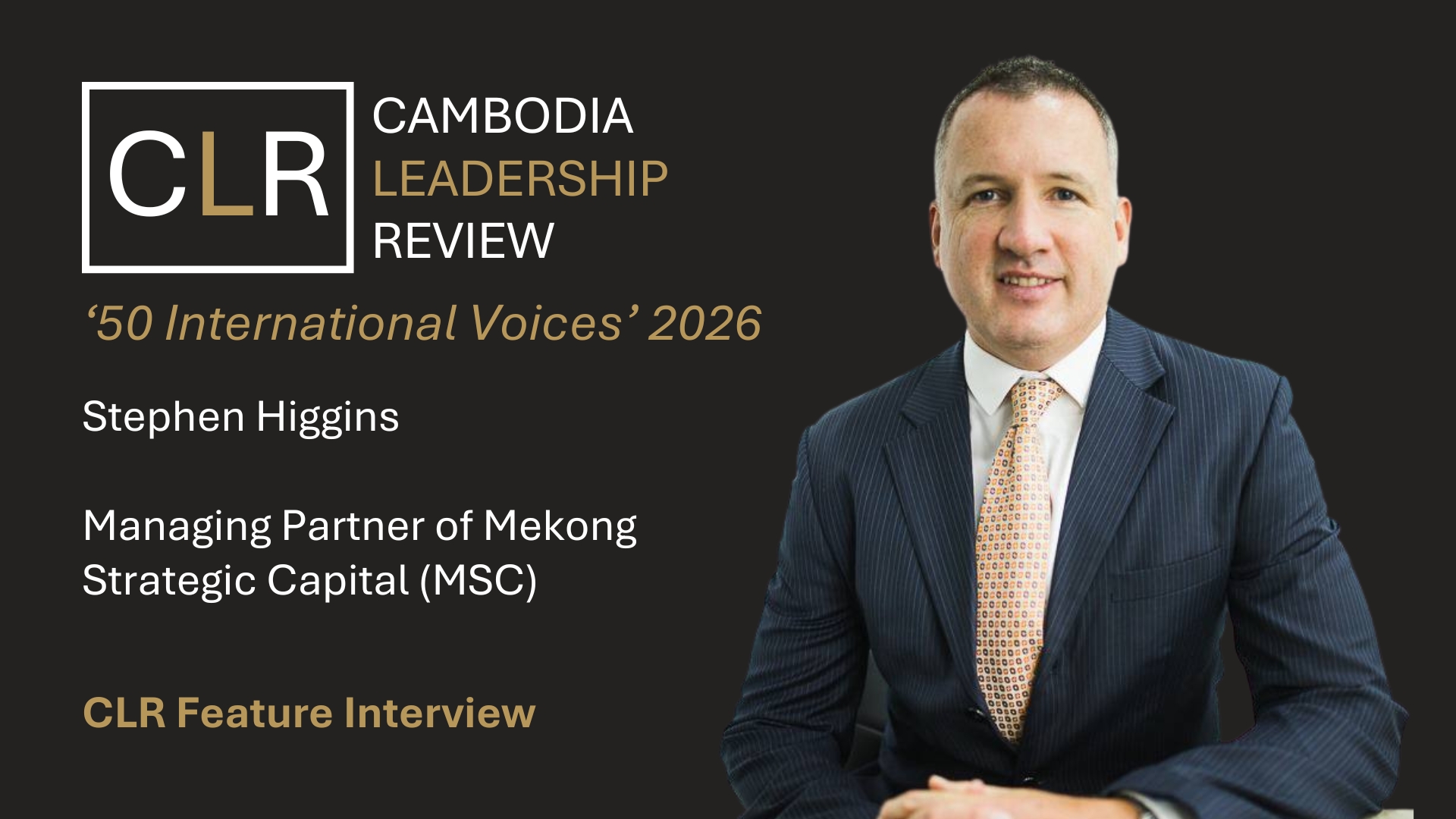
Stephen Higgins is the Managing Partner of Mekong Strategic Capital (MSC), one of the largest institutional investors active on the Cambodia Securities Exchange (CSX). With a long track record in frontier and emerging markets, Higgins has been an outspoken commentator on valuation discipline, IPO pricing, liquidity, and regulatory development within Cambodia’s capital markets.
In this conversation with Harrison White, he shares MSC’s investment approach, his views on specific listed companies, and what it will take for the CSX to move beyond its current stagnation.
Download the 50 International Voices Magazine 2026 here.
Access to MSC Funds and Investment Approach
CLR: MSC is one of the larger investors on the CSX. Can Cambodian retail investors invest in your funds?
At the moment, our investments in the CSX are for offshore investors only and are domiciled offshore. Part of the reason is that we’ve been waiting for greater clarity around the Cambodian regulatory framework, including the taxation of funds.
That said, we do want to establish domestic funds and make them available to local investors. Hopefully, that can happen reasonably soon once there is sufficient regulatory certainty.
Read More: ADB and SERC Launch 10-Year Securities Masterplan to Tackle Market Challenges
CLR: Do you follow a particular investment style or house approach?
Most fund managers typically fall into defined categories — growth investors, yield-focused investors, value investors, or index trackers.
We are taking a slightly unconventional approach, which the immaturity of the market currently allows. We are investing in stocks that are high growth, high yielding, and deeply undervalued. In more developed markets, that combination rarely exists. In Cambodia today, it does.

Preferred Stocks on the CSX
CLR: Can you give examples of stocks that fit that profile?
The two we currently like most are Acleda Bank (ABC) and Phnom Penh Autonomous Port (PPAP).
Acleda is trading at a PE ratio well under 4x and a price-to-book ratio under 0.5x. On any reasonable benchmark, those multiples should be two to three times higher. Add projected profit growth of around 65% in 2025, and it becomes very compelling.
PPAP also delivered strong results in 2025, with revenue growth of 21%, and January 2026 results confirm that momentum is continuing. With a PE ratio around 4x and a solid growth profile, we believe the valuation could easily justify a share price at least double current levels.
CLR: Are there others you favour?
Sihanoukville Autonomous Port (PAS) is also delivering solid results, with Q4 revenue up 50% year-on-year. There may be short-term capacity constraints, but a major expansion in the coming years supports long-term growth.
Phnom Penh Water Supply Authority (PWSA) is another. While earlier results were modest, urbanisation and network expansion underpin future revenue growth. Q4 revenue was up 80% year-on-year.
Across these names, you are effectively buying growth stocks at deep value prices.
Views on CAMGSM and MJQ
CLR: Two large stocks you have not mentioned are CAMGSM and MJQ. Why?
CAMGSM has the largest market capitalisation on the CSX at around $1.2 billion. However, its EBITDA was approximately $70 million last year and trending downward.
Using standard telecom valuation multiples of 4.5x to 6x EBITDA implies an enterprise value between $315 million and $420 million. After deducting net debt of roughly $250 million, the implied equity value is significantly below the current market capitalisation. That disconnect is difficult to justify.
As for MJQ, we think it is a good business, but at around 22x earnings, the valuation remains too rich. Either the share price needs to fall or earnings need to grow substantially before it becomes attractive.
CLR: Both are trading around IPO price. Were the IPO valuations wrong?
In our view, most IPOs since PAS in 2017 were priced too high. Even Acleda — which we like today — was priced aggressively at IPO during the early stages of COVID.
We have not participated in an IPO since 2017, and in hindsight that decision has proven correct. Unfortunately, the pattern of overpricing has led to under-subscription and weak aftermarket performance, which is damaging to the market overall.
Fixing IPO Pricing and Market Integrity
CLR: How can this be addressed?
The primary responsibility lies with issuers and underwriters to price IPOs more sensibly. However, both the Securities and Exchange Regulator of Cambodia (SERC) and the CSX should be asking tougher questions about valuation appropriateness.
CLR: You were vocal about PCG’s disclosure that two directors resigned just before its IPO. Why?
Even though we did not invest in the PCG IPO, market integrity matters. Directors resigning days before an IPO is generally a red flag. Failing to disclose that information until six or seven weeks after listing is difficult to understand and warrants fuller explanation.
A functioning market requires transparency and trust.
Smaller Listings and Liquidity
CLR: What about smaller stocks?
We have some exposure to Royal Group Phnom Penh SEZ. While the upside from the existing SEZ may be limited, we believe the broader opportunity lies in Royal Group leveraging that experience to develop new SEZs. That investment is as much about backing Kith Meng’s execution capability as it is about current fundamentals.
For other smaller stocks, we struggle to identify clear growth drivers.
The Future of the CSX
CLR: What will it take for the CSX to take off?
Calling it a “holding pattern” is generous. The exchange has underperformed relative to its potential. IPO pricing has been one issue, but the larger structural problem is liquidity.
Liquidity could improve significantly if the National Social Security Fund (NSSF) allocated even a small portion of its portfolio to the CSX. Given the size of its assets, even modest participation would materially impact trading volumes.
If the national pension scheme does not invest in its own domestic stock market, it raises important questions about confidence and long-term development. For the CSX to mature, domestic institutional participation must increase.