
Cambodia Investment Review
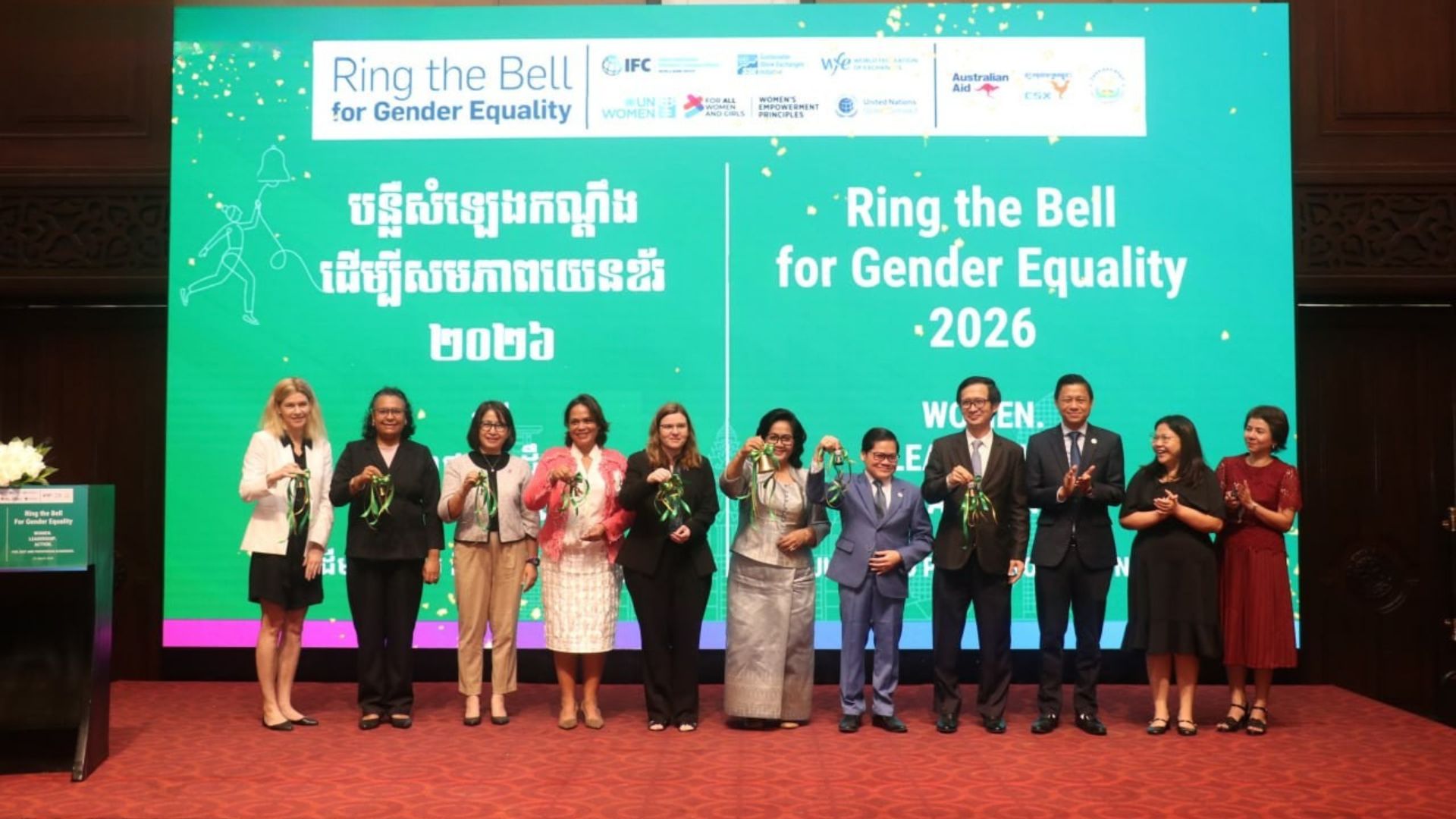
A ceremonial bell rang out in Phnom Penh on March 31, marking a renewed push to address structural barriers limiting women’s participation in Cambodia’s financial markets, as regulators, listed companies, and development partners gathered for the country’s second annual “Ring the Bell for Gender Equality” event.
Held at Sofitel Phnom Penh Phokeethra, the event was organized by the Securities and Exchange Regulator of Cambodia (SERC), the Cambodia Securities Exchange (CSX), the Australian Government, and UN Women. It forms part of a global initiative spanning more than 114 stock exchanges, aimed at advancing women’s economic participation and leadership.
While the event signaled broad-based support for gender equality, discussions focused on persistent gaps in access to finance, procurement systems, and investment opportunities that continue to limit the role of women in Cambodia’s growing capital markets.
Structural gaps in finance and market access
Speakers highlighted that despite women’s central role in Cambodia’s economy, particularly in managing household finances and participating in SMEs, their transition into formal investment and leadership roles remains constrained.
Derek Yip, Australian Ambassador to Cambodia, pointed to the importance of unlocking women’s economic potential to strengthen overall resilience. He noted that Australia’s collaboration with Cambodia and UN Women through the WE RISE Together program is focused on building more inclusive market systems and expanding access to opportunities.
Hong Sok Hour, Chief Executive Officer of the Cambodia Securities Exchange, emphasized that the challenge lies not in participation at the household level, but in scaling women’s involvement within formal financial systems. Expanding access to investment channels, he noted, could help deepen Cambodia’s securities market while improving financial inclusion.
Sou Socheat, Director General of the SERC, framed inclusion as a necessary step for market development, calling on companies, investors, and regulators to move beyond commitments and implement practical measures. He stressed that empowering women through finance is not only a social priority but a strategic requirement for sustainable growth.
Sophea Khun, National Country Programme Coordinator for UN Women Cambodia, highlighted that initiatives under WE RISE Together are targeting key bottlenecks, including gender-responsive procurement and access to financial services, as pathways to integrate more women into formal economic systems.
Procurement and financing barriers remain key challenges
A panel discussion titled “From Boardrooms to Supply Chains: Expanding Women’s Market Access” provided further insight into the operational challenges faced by women-led businesses.
Representatives from the Phnom Penh Water Supply Authority (PPWSA) and ACLEDA Bank outlined efforts to improve transparency and accessibility in procurement and financing. This includes digitalizing procurement systems to reduce barriers to entry and expanding lending frameworks beyond traditional collateral requirements, which often exclude women entrepreneurs.
However, participants noted that progress remains uneven. A woman entrepreneur on the panel highlighted fragmentation within agricultural supply chains as a major constraint, limiting the ability of women-led businesses to scale and access consistent market demand.
She called for more sustained investment in training and technology, as well as stronger commitments from large buyers and government agencies to prioritize locally produced goods. Without these interventions, she noted, many women-owned businesses remain locked out of formal market systems despite growing capacity.
Panelists broadly agreed that bridging these gaps requires coordinated action across regulators, financial institutions, and the private sector, with a focus on practical implementation rather than policy alone.
Turning commitments into measurable action
As Cambodia’s capital markets continue to expand, participants emphasized the importance of ensuring that growth is inclusive and reflects the full potential of its workforce.
Attendees were encouraged to renew their commitments to the Women’s Empowerment Principles, adopt more inclusive procurement practices, and support the development of gender-responsive financial instruments.
The WE RISE Together program, supported by the Mekong Australia Partnership, was highlighted as a key mechanism for advancing these reforms across the region, particularly in strengthening procurement systems and market linkages.
Despite growing awareness and institutional support, speakers noted that the next phase will require measurable outcomes, including increased participation of women in investment activities, leadership roles, and supply chains.
The event concluded with a clear message that while Cambodia has made progress in recognizing gender equality as an economic priority, addressing the structural barriers that limit women’s full participation remains critical. For the country’s financial markets, inclusion is increasingly being positioned not just as a social objective, but as a necessary condition for long-term growth and competitiveness.