
Cambodia Leadership Review
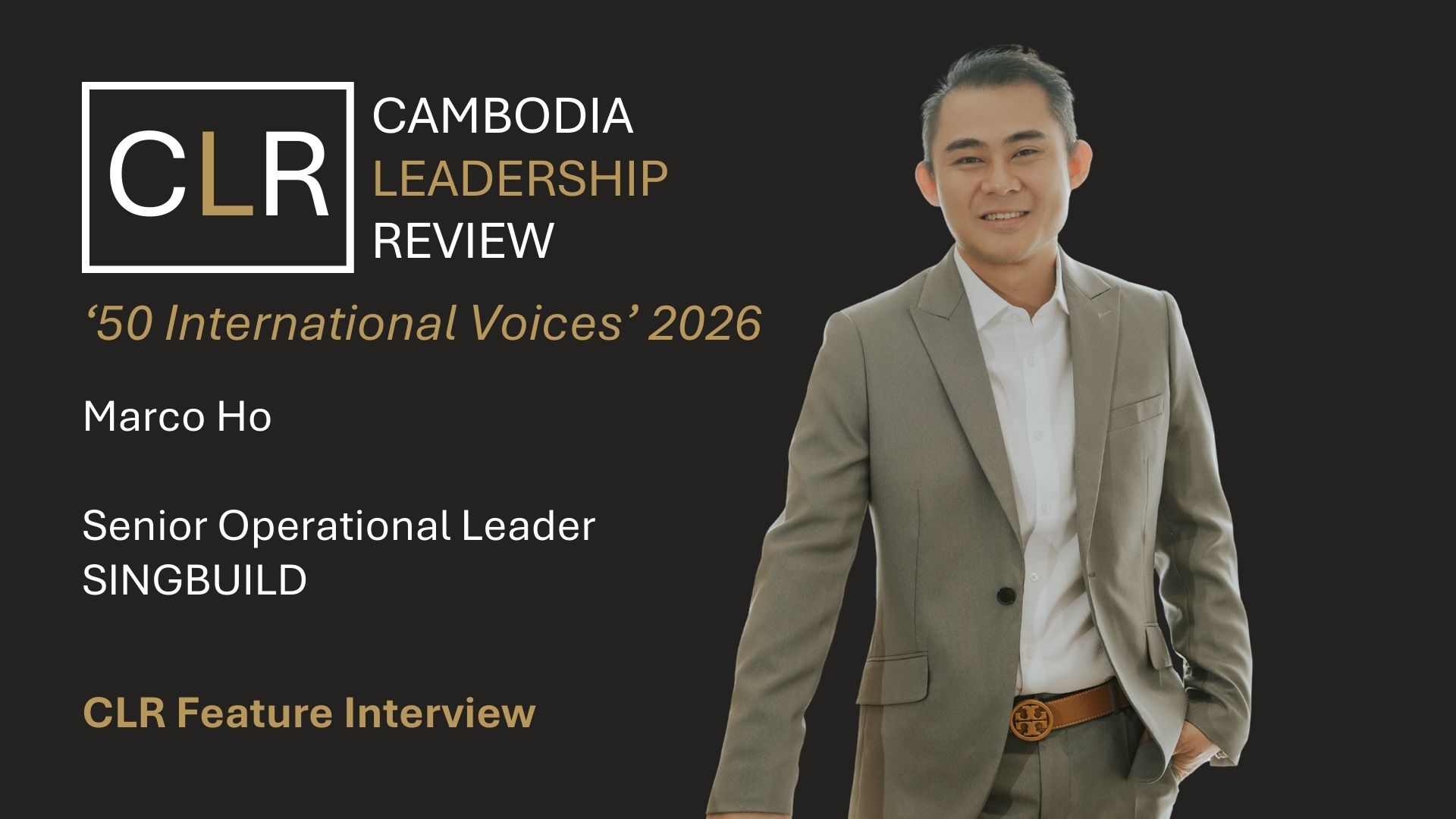
Marco Ho is a senior operational leader at SINGBUILD, bringing extensive experience in integrated design-and-build project delivery across emerging markets. With a systems-driven leadership philosophy, he focuses on aligning vision and execution through structured collaboration, technical integration, and operational clarity.
At a time when Cambodia’s construction sector is transitioning toward higher standards of quality, sustainability, and long-term value creation, Ho advocates for disciplined processes, multidisciplinary integration, and institutional capability-building. His approach emphasizes alignment across design, engineering, procurement, and construction functions, ensuring projects are delivered with consistency and technical integrity.
In this conversation, he reflects on operational leadership, integrated project delivery, sustainability, and the structural transformation underway in Cambodia’s construction industry.
Operational Leadership in a Design-and-Build Environment
CLR: In an integrated design-and-build environment, what does operational leadership mean to you, and how do you ensure consistency across disciplines?
Operational leadership in an integrated design-and-build environment is fundamentally about creating alignment between vision and execution. In my experience, many operational challenges do not arise from technical limitations but from fragmentation — fragmented communication, fragmented responsibility, and fragmented decision-making processes.
My leadership philosophy is centered on systems thinking. Strong operations are not driven by individual heroics but by well-designed structures that enable teams to perform consistently. At SINGBUILD, we focus on building an operational ecosystem where design, engineering, procurement, and construction operate as interconnected components rather than isolated functions.
One principle I strongly advocate is “clarity before speed.” The construction industry often prioritizes urgency, but without clarity in roles, expectations, and workflows, speed only amplifies risk. By defining structured processes, clear ownership, and measurable technical standards, we enable teams to move faster with confidence rather than uncertainty.
Operational leadership also requires fostering a culture of shared responsibility. In a design-and-build model, success cannot belong to one discipline alone. Architects must understand buildability, engineers must appreciate design intent, and project managers must bridge both perspectives. Consistency is achieved not through control alone but through alignment of values, processes, and professional mindset.
Turning Design Vision into Buildable Reality
CLR: How do you translate creative design intent into buildable reality without compromising quality or ambition?
One of the defining challenges in integrated delivery is transforming creative vision into buildable reality without losing its essence. Traditionally, the industry treats design and construction as separate phases, which often leads to misalignment and costly revisions.
My belief is that buildability is not a constraint on creativity — it is a catalyst for innovation. When designers engage early with engineering logic and operational considerations, solutions become more refined and realistic without sacrificing ambition.
This requires redefining collaboration models. We encourage early technical reviews, parallel workflows, and continuous dialogue between disciplines. Procurement strategy, material performance, installation sequencing, and long-term maintenance considerations are integrated into design discussions from the beginning.
Establishing a shared technical language is equally critical. Miscommunication between disciplines is often subtle but impactful. By standardizing communication frameworks and decision-making processes, we reduce ambiguity and improve precision in execution.
A successful project is not merely built; it is translated — from vision into reality through structured collaboration.
Quality Control, Sustainability, and Technical Compliance
CLR: How do you approach quality control and sustainability in an emerging market context like Cambodia?
Integrated technical capability is no longer a competitive advantage; it is becoming a necessity. In emerging markets like Cambodia, fragmented project structures often create gaps in accountability, leading to quality risks and inefficiencies.
By maintaining in-house civil engineering and M&E expertise, we ensure that technical integrity is embedded into decision-making from the earliest stages. This integration enables proactive risk management rather than reactive problem-solving.
Sustainability is also evolving. It is shifting from compliance-driven checklists toward performance-driven outcomes. Clients are increasingly focused on operational efficiency, lifecycle cost, and long-term asset value. True sustainability lies in balancing environmental responsibility with practical feasibility and economic viability.
Integrated teams allow sustainability goals to align with operational realities, ensuring that green strategies are implementable rather than theoretical.
Looking Ahead: Operational Excellence and Industry Outlook
CLR: As Cambodia’s construction sector evolves, what will define operational excellence over the next decade?
Cambodia’s construction industry is entering a phase of structural transformation. The era of purely cost-driven development is gradually giving way to a focus on quality, reliability, and long-term value.
Operational excellence will be defined by three major shifts.
First, digitalization and data-driven processes will reshape how projects are managed, improving transparency and predictability.
Second, sustainability will become a baseline expectation rather than a differentiator.
Third, talent development will determine industry leadership. The next generation of professionals must be multidisciplinary — capable of integrating design sensitivity, technical rigor, and operational strategy.
My personal leadership philosophy is simple: build systems that outlast individuals. True impact is not measured by a single project but by the capability an organization develops over time. Firms that can institutionalize knowledge, maintain adaptability, and deliver consistently will earn lasting trust.