
By Sao Phal Niseiy
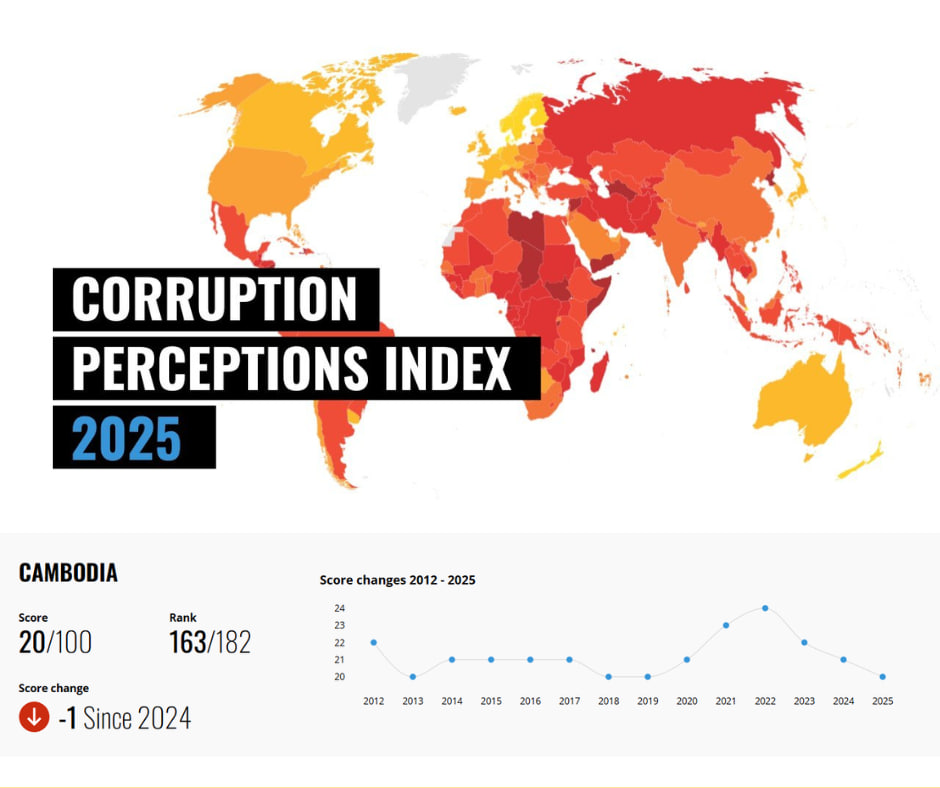
Corruption rarely collapses a country overnight. Instead, it seeps quietly into institutions, distorts opportunity, and erodes public trust—until one day, the damage feels irreversible. The 2025 Corruption Perceptions Index (CPI) is a sobering reminder that this slow erosion is happening across much of the world, and Cambodia is no exception.
The 2025 CPI shows that corruption remains a serious global threat, with only limited signs of meaningful progress. Around the world, abuses of power are growing more visible. Democratic backsliding, weakened checks and balances, and mounting pressure on independent civil society and media have become disturbingly common. These trends do not just affect politics—they hinder economic growth and create fertile ground for corruption to flourish.
Cambodia finds itself in a difficult position. In 2025, it ranked 163rd out of 182 countries, slipping from 158th in 2024. The decline is not merely about numbers or prestige. It reflects persistent, unresolved corruption challenges that continue to shape everyday governance and public life.
Government officials dismissed the ranking as senseless. Yet it is not unusual for governments to reject unfavorable assessments while celebrating positive ones. Whether we agree with the findings or not, indices like the CPI serve as mirrors. They may not capture every nuance, but they often reflect uncomfortable truths we must confront if we genuinely want to grow and thrive.
Corruption, after all, is not Cambodia’s burden alone. It is a global problem. Many countries are facing alarming trends. Even advanced economies such as the United Kingdom and the United States have seen their scores deteriorate, reaching historic lows. In these cases, concerns have been linked to the erosion of democratic institutions, opaque political donations, cash-for-access practices, and the targeting of campaigners and journalists. No country is immune.
The CPI provides a broad view of these global patterns. While 31 countries have significantly reduced corruption since 2012, many others remain stagnant or have worsened. The global average score has now fallen to 42, and more than two-thirds of countries score below 50. This suggests that the fight against corruption is not only slowing—it may be losing ground.
But these are not just statistics. When anti-corruption efforts fail, ordinary people pay the price. Corruption weakens governance, drains resources from public services, slows infrastructure development, and undermines social protection systems. It widens inequality and quietly steals opportunities from those who can least afford it.
In the end, it is young people—full of ambition and hope—who may find their futures constrained by systems that reward connections over competence.
As a least developed country, Cambodia is already navigating significant challenges: fragile institutions, economic vulnerability, and limited investment opportunities. Corruption has long been one of the most stubborn obstacles in this journey. Failing to address it does not merely harm the country’s image abroad—it directly affects livelihoods at home. It risks trapping communities in cycles of poverty and discouraging honest enterprise.
Corruption is not a simple problem with a single cause. It is systemic and structural—a social disease with many forms and many actors. In some environments, corrupt practices become normalized, quietly woven into daily transactions.
Social behavior can, at times, enable them. Those in power may exploit loopholes or evade accountability when regulations are weak and enforcement lacks teeth. Meanwhile, civil society organizations and journalists often struggle to perform their watchdog roles under mounting pressure and shrinking civic space.
What Cambodia needs is accountable and capable leadership—leaders committed not only to rhetoric but to building strong, independent institutions that protect the public interest. Integrity, transparency, and long-term vision matter. Denial will not make the problem disappear. Genuine reform, however difficult, can.
Even if we attempt to dismiss external assessments, citizens are not blind to their own lived experiences. People encounter governance quality every day—in the courts, in public services, in how rules are applied. Weak rule of law, abuse of power, and unequal treatment are not abstract ideas; they are realities that shape daily life.
We may try to downplay corruption, but we cannot deceive ourselves indefinitely. Recent border tensions and security challenges have exposed institutional weaknesses at a time when the international rule-based order itself appears increasingly fragile. These moments are not just crises; they are wake-up calls. The longer reforms to address petty corruption are postponed, the harder it becomes to confront the deeper structural issues that lie beneath.
Yet it is not too late to change course. The future cannot be measured in one-, two-, or even five-year horizons. Real reform demands a generational perspective. It requires moving beyond familiar slogans and delivering tangible improvements in key sectors—governance, defense, education, and beyond.
Fighting corruption is not the responsibility of government alone. It is a shared duty. Citizens, civil society, and public institutions all have roles to play. Reports like the CPI are not verdicts carved in stone; they are diagnostic tools. They highlight where weaknesses lie and why they persist. They can guide governments, investors, and citizens alike in understanding risks and identifying pathways for reform.
If we continue to refuse to acknowledge our flaws, we risk living in illusion. The cost of that illusion will not be borne by today’s leaders alone—it will fall heavily on future generations. Ignoring corruption today means passing its burden to the young tomorrow.
The real test is courage: the boldness to admit that corruption is a problem, the willingness to make difficult decisions, and the openness to foster honest public debate about what must change—and how to achieve it. Only then can reform move from words to reality.
Sao Phal Niseiy is Editor-in-Chief of Cambodianess. His coverage mainly focuses on the climate crisis and regional affairs. I hold a bachelor’s degree in Public Administration and International Studies and a master’s degree in Asian and Pacific Studies from the Australian National University. This opinion was first published in Cambodianess.