

Cambodia Investment Review
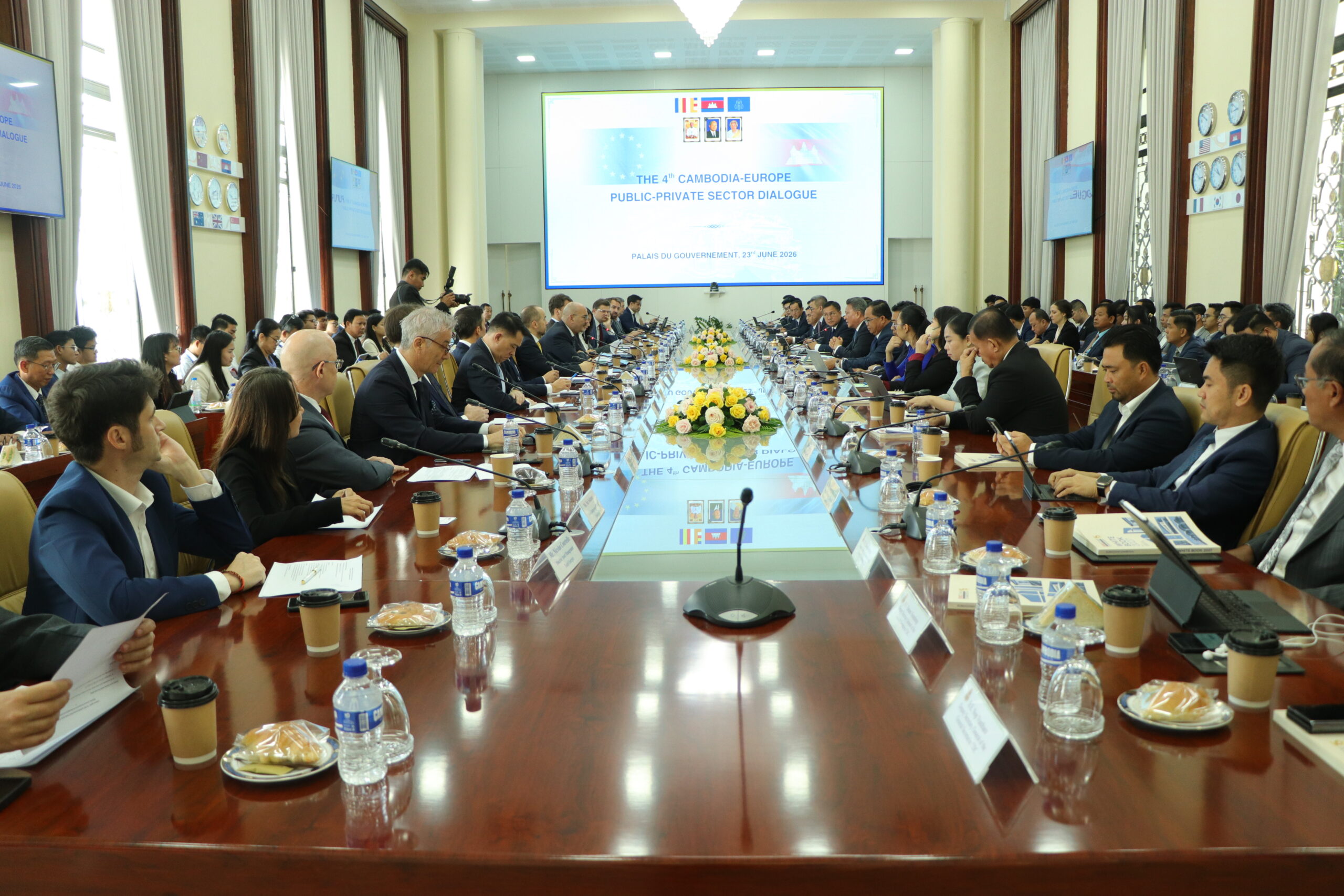
EuroCham Cambodia and the Council for the Development of Cambodia (CDC) have advanced a broad package of business reform initiatives covering taxation, trade facilitation, renewable energy, healthcare, and regulatory simplification, as government officials and European business leaders met for the fourth Cambodia-Europe Public-Private Sector Dialogue.
The high-level meeting brought together senior government officials, European diplomats and private sector representatives to review progress on longstanding policy issues while introducing new proposals aimed at strengthening Cambodia’s investment environment.
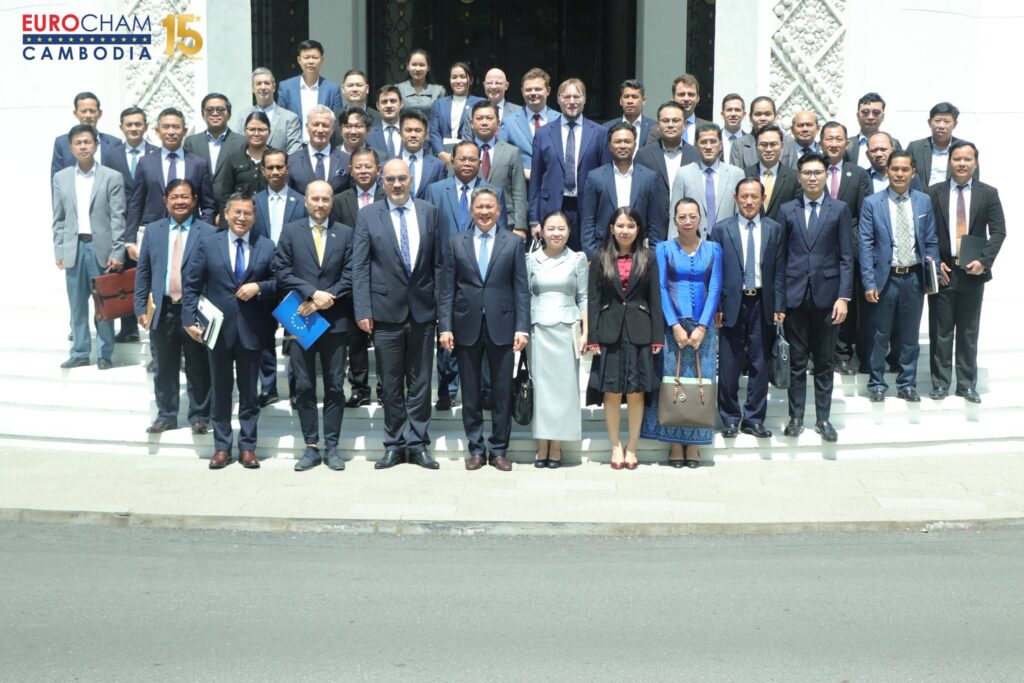
The dialogue was co-chaired by Deputy Prime Minister and First Vice-Chairperson of the CDC H.E. Sun Chanthol, EuroCham Cambodia Chairman Tassilo Brinzer, and Deputy Head of Mission of the European Union Delegation to Cambodia Andreas Berg.
Two Longstanding Business Issues Resolved
Among the most significant outcomes was the resolution of two issues that European businesses have raised for several years.
The first concerns the definition of a “new car,” where technical alignment between the General Department of Customs and Excise and the Ministry of Commerce has closed a regulatory loophole that had allowed grey-market vehicle importers to compete against authorised distributors.
The second relates to open-lid promotional campaigns for alcoholic and non-alcoholic beverages. Following sustained advocacy from EuroCham, Cambodia will prohibit such promotions from October 1, 2026 under Prakas No. 4528 issued by the Ministry of Economy and Finance.
European beverage producers welcomed the move, arguing that the promotions created unfair competition and conflicted with responsible consumption policies adopted by international brands.
Renewable Energy Framework Advances
Progress was also reported on Cambodia’s Renewable Energy Certificate (REC) framework.
The certificates, which enable companies to verify renewable electricity use throughout their supply chains, have been unavailable since 2025, creating challenges for manufacturers supplying European markets with increasingly stringent sustainability requirements.
The Ministry of Mines and Energy committed to continuing discussions on pricing, availability and implementation as Cambodia develops an internationally recognised REC framework later this year.
Red Tape Reduction Remains Priority
The dialogue also reviewed progress on a joint initiative between EuroCham and the CDC to simplify administrative procedures for businesses.
Technical working groups identified five priority areas, including Qualified Investment Projects (QIPs), online business registration, sectoral licensing, certificates of origin and commercial exhibition permits.
According to EuroCham, approximately 59% of documents required during QIP applications and business registration are currently requested multiple times by different government agencies. The CDC reaffirmed its commitment to improving data sharing through digital platforms and reducing duplicate documentation requirements.
Trade facilitation also featured prominently during discussions, with EuroCham raising issues surrounding customs digitalisation, integration of line ministries into the Cambodia National Single Window, and operational efficiency at the Autonomous Port of Sihanoukville.
Textile Recycling Reform Could Unlock New Industry
EuroCham’s Garment and Manufacturing Committee also highlighted opportunities to develop Cambodia’s textile recycling industry.
The chamber estimates Cambodia’s garment sector generates approximately 200,000 tonnes of textile waste annually, while existing VAT and import duty requirements make transferring waste to formal recycling facilities commercially difficult.
EuroCham believes regulatory reforms could help unlock a textile recycling market valued at approximately US$126 million while strengthening Cambodia’s position as a sustainable manufacturing destination.
Tax, Healthcare and Arbitration Reforms Proposed
The dialogue also introduced several new reform proposals.
EuroCham’s Tax and Governance Committee called for changes to Cambodia’s 1% Prepayment Tax on Income, recommending the tax be calculated on profit before tax rather than gross turnover to better reflect business profitability, particularly in low-margin industries.
The chamber also encouraged the government to establish a commercial arbitration court accessible to international businesses, while offering technical expertise to support its development.
Meanwhile, EuroCham’s Healthcare Committee proposed allowing Cambodian regulators to formally recognise scientific assessments conducted by leading international agencies such as the European Medicines Agency when registering pharmaceuticals.
The chamber estimates the reform could reduce medicine approval timelines from between 22 and 26 months to approximately 14 to 16 months, improving patient access while reducing costs for pharmaceutical companies.
In the consumer goods sector, EuroCham also called for Cambodia to introduce a minimum legal drinking age of 18. The Ministry of Commerce indicated it is studying a sub-decree that would align Cambodia with every other ASEAN member state.
Investment Climate Remains Central Focus
Speaking following the dialogue, EuroCham Chairman Tassilo Brinzer described the fourth dialogue as the most productive since the initiative began, citing both the depth of discussions and the government’s responsiveness to business concerns.
Deputy Prime Minister Sun Chanthol reaffirmed the government’s commitment to maintaining regular dialogue with the European business community, noting that some reforms could be implemented immediately while others would require longer-term coordination across ministries.
He also described EuroCham as an important partner in promoting Cambodia internationally and supporting foreign direct investment.
The meeting concluded with both sides agreeing to continue technical-level discussions on outstanding reform proposals ahead of the fifth Cambodia-Europe Public-Private Sector Dialogue.


