

Cambodia Invesment Review
Cambodia’s industrial parks and special economic zones (SEZs) are entering a critical period as the country prepares for the loss of key trade preferences and seeks to attract higher-value manufacturing investment, according to government officials, developers and industry leaders gathered at EuroCham Cambodia’s Industrial Parks & Special Economic Zones Forum 2026.
Held in Phnom Penh on June 9, the forum brought together policymakers, investors, logistics operators and construction specialists to assess the country’s industrial real estate market and the challenges that could shape its competitiveness over the coming decade.
The discussions come as Cambodia continues to position itself as a regional manufacturing destination, supported by competitive labour costs, relatively affordable industrial land and strong export growth. However, speakers warned that maintaining momentum will require significant improvements in infrastructure, workforce skills, energy reliability and industrial planning.
Cambodia’s Manufacturing Base Continues to Expand
Presenting an overview of the sector, Virak Ouproum, Deputy Director General of the Directorate General of Industry at the Ministry of Industry, Science, Technology and Innovation (MISTI), said Cambodia had 3,266 operating factories as of April 2026, employing more than 1.31 million workers.
Read More: Opinion – Barriers to Growth in Cambodia’s Food Processing and Manufacturing Sector
Women account for approximately 70 percent of the country’s industrial workforce.
Within Cambodia’s network of special economic zones, 33 operational SEZs host 642 factories employing more than 200,000 workers, while an additional 20 industrial parks accommodate roughly 150 factories and over 90,000 employees.
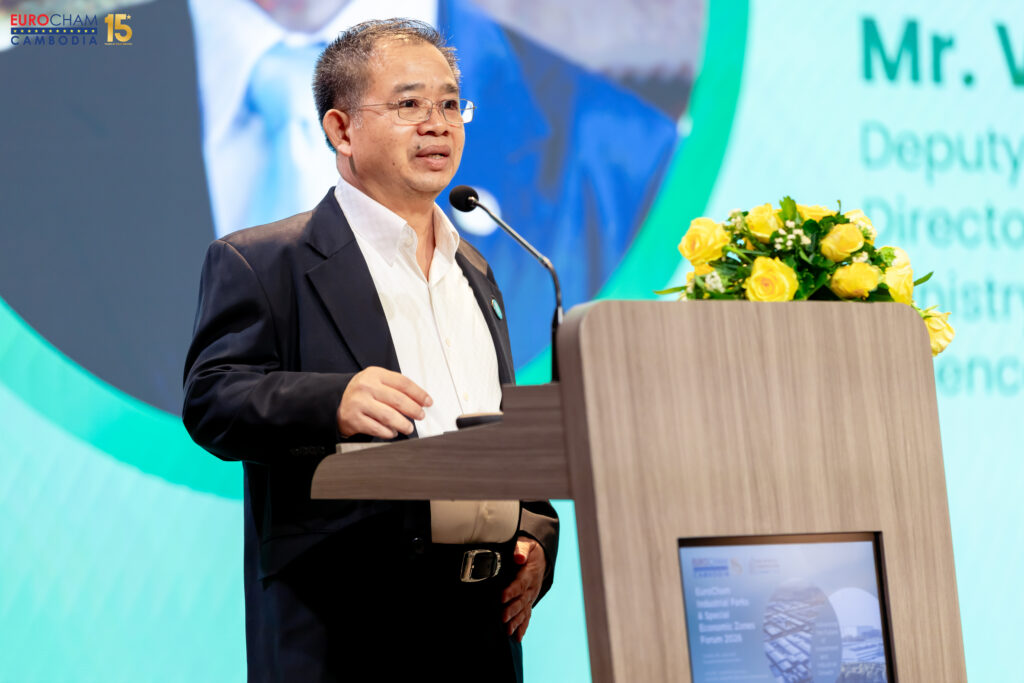
Despite the sector’s growth, Virak highlighted Cambodia’s upcoming graduation from Least Developed Country (LDC) status in 2029 as a major structural challenge.
The transition will gradually reduce access to several preferential trade arrangements that have helped underpin Cambodia’s export-led manufacturing expansion, including the European Union’s Everything But Arms (EBA) scheme and certain U.S. trade preferences.
To remain competitive, he argued Cambodia must accelerate its move into higher-value industries such as electronics, automotive manufacturing, precision engineering and agro-processing while continuing to invest in logistics infrastructure, energy systems and workforce development.
Cost Advantages Remain a Key Selling Point
Kim Kinkesa, Managing Director of APS Cambodia, formerly CBRE Cambodia, said Cambodia continues to offer a cost advantage relative to several regional competitors.
According to market data presented at the forum, ready-built factory rents average approximately $3.05 per square metre per month, significantly below the roughly $4.70 reported in both northern and southern Vietnam.
Long-term industrial land leases also remain comparatively affordable, with average 50-year lease rates of approximately $69.25 per square metre.
Cambodia’s licensed SEZ network has attracted an estimated $13.8 billion in cumulative investment across more than 8,300 hectares of active industrial land.
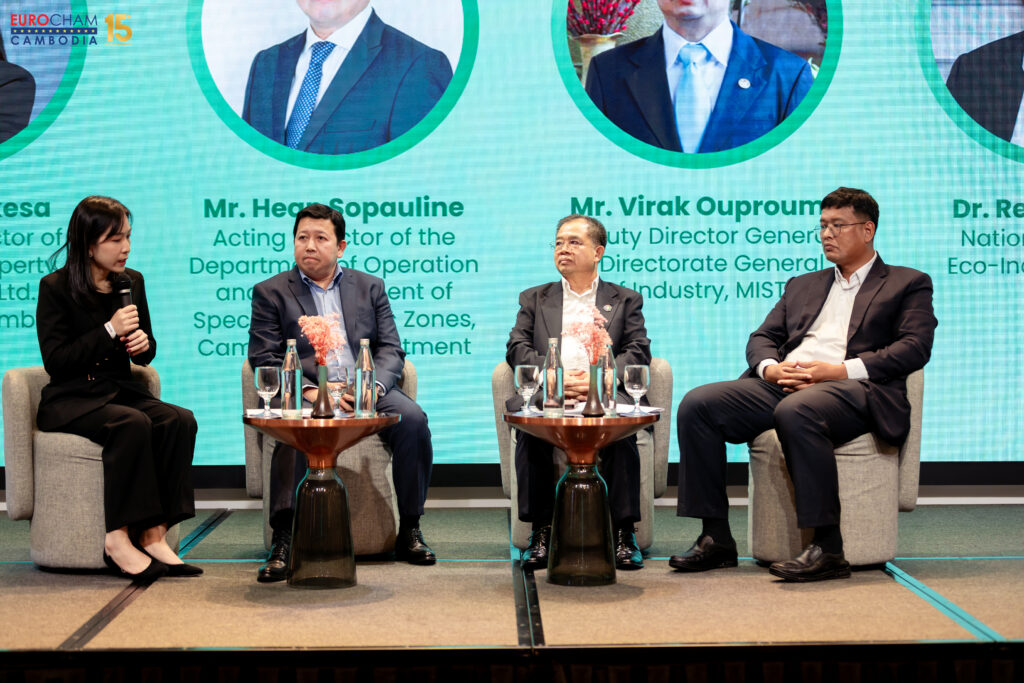
Occupancy rates vary significantly by location, however. Sihanoukville’s industrial zones have reached approximately 90 percent occupancy, while some emerging locations, including Banteay Meanchey, remain below 50 percent.
Kinkesa said Cambodia’s next phase of industrial development will depend on more than cost competitiveness.
“From my perspective, Cambodia’s industrial market remains competitive, supported by affordable land and relatively low operating costs,” she said.
“However, the next phase of industrial development will require a much more coordinated ecosystem from national zoning and reliable logistics networks to skilled labour, energy efficiency, sustainability, transparency and investor confidence.”
ESG and Eco-Industrial Parks Gain Importance
A panel discussion involving representatives from the Cambodian Investment Board, MISTI and eco-industrial park specialists focused on how Cambodia can strengthen its industrial offering as global investor requirements evolve.
Participants noted that SEZs continue to provide important advantages for export-oriented manufacturers through streamlined customs procedures, investment incentives and shared infrastructure.
At the same time, non-SEZ industrial parks remain attractive for businesses focused on domestic markets due to greater operational flexibility and potentially lower costs.
Panelists also highlighted the growing importance of eco-industrial parks, which are increasingly viewed as a way to attract multinational manufacturers seeking stronger environmental, social and governance (ESG) credentials across their supply chains.
As global brands place greater emphasis on sustainability standards and carbon reduction targets, industrial developers may face increasing pressure to incorporate energy efficiency, waste management systems and green infrastructure into future projects.
Infrastructure and Execution Seen as Critical
While speakers broadly agreed that Cambodia possesses many of the foundations needed to attract additional industrial investment, several emphasized that execution remains the key challenge.
François Magnier, International Director and Design Director of IDEC Group Asia, presented examples from industrial projects across 22 countries, highlighting how logistics integration, sustainability standards and purpose-built infrastructure can influence long-term tenant demand.
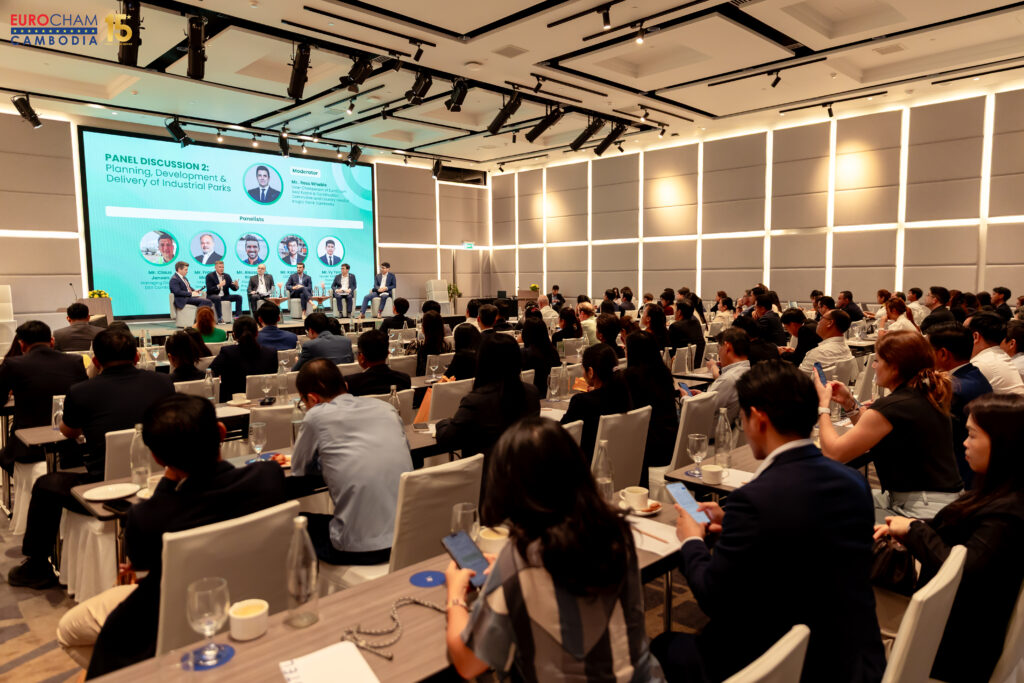
A second panel featuring representatives from DSV Cambodia, BEE Incorporations, ISI Group and Standard Construction & Engineering examined the practical realities of industrial park development, including financing, planning, construction and occupancy.
Ross Wheble, Vice-Chairperson of EuroCham Cambodia’s Real Estate & Construction Committee and Country Head of Knight Frank Cambodia, said Cambodia’s industrial sector continues to benefit from strong fundamentals despite growing regional competition.
“What came through clearly this afternoon is that the fundamentals are there: land availability at competitive rates, access to labour, conducive trade frameworks, and the continued growth in exports and expansion of the manufacturing ecosystem despite disruptive external factors,” Wheble said.
“But the gap between Cambodia’s potential and its realisation as a serious industrial destination comes down to forward planning and execution.”
Industry leaders concluded that stronger coordination between government agencies, developers, logistics providers and construction firms will be essential if Cambodia is to successfully move beyond its traditional manufacturing strengths and establish itself as a higher-value industrial hub in Southeast Asia.
The forum was organised by EuroCham Cambodia’s Real Estate & Construction Committee and sponsored by Sika, Standard Construction & Engineering and Menard.