
Cambodia Investment Review
Cambodia’s communications landscape is undergoing a significant transformation, as industry leaders point to the growing influence of algorithm-driven platforms, the importance of trust, and the rise of niche business media in shaping how audiences consume information.
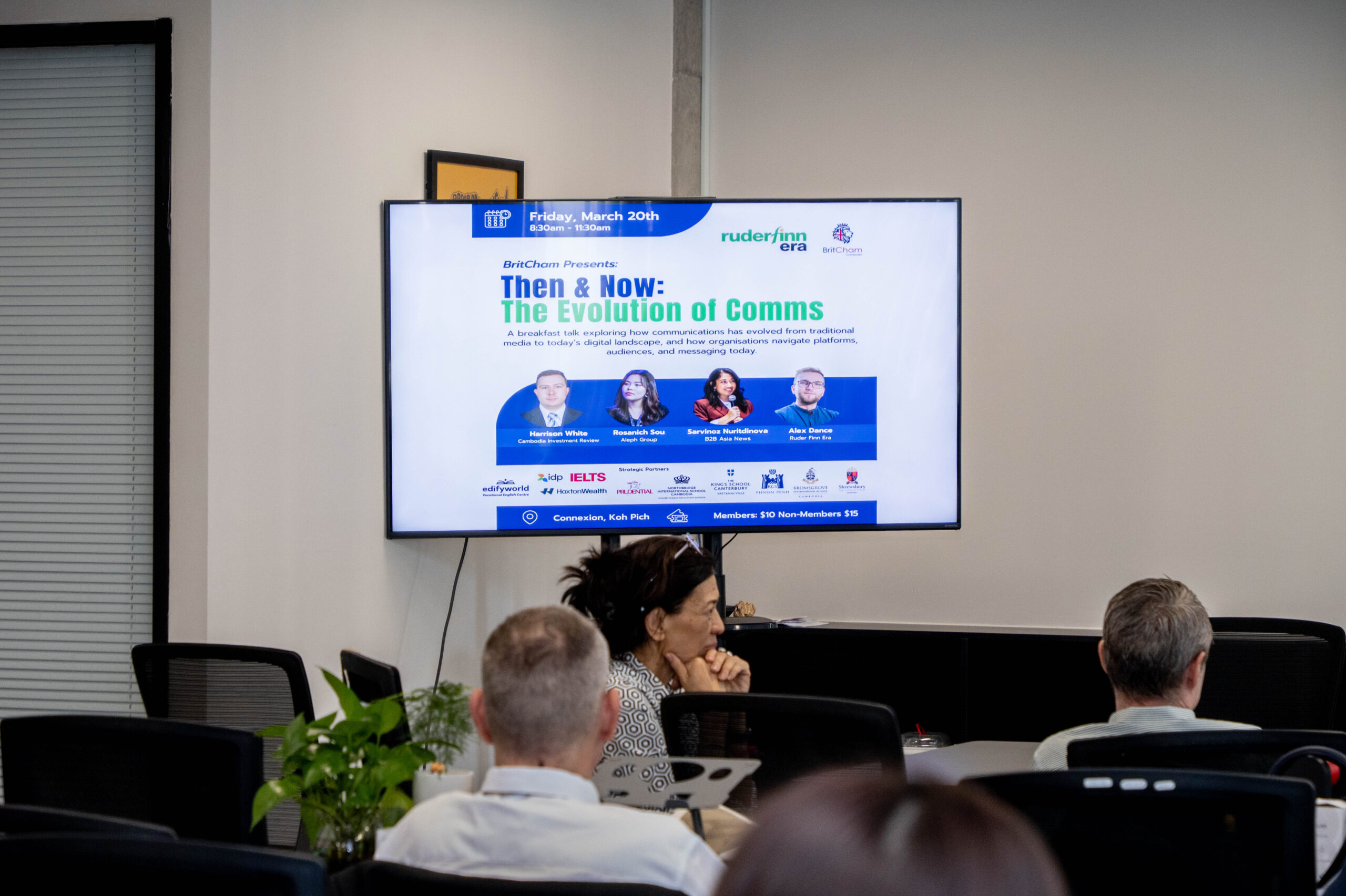
These insights were shared at a panel discussion hosted at the Ruder Finn ERA office on March 20, where speakers from across media and communications will explore how the industry has evolved and why reputation management is increasingly becoming proactive rather than reactive.
From search to algorithm-led ecosystems
Harrison White, Founder and Editor of Cambodia Investment Review, highlighted a fundamental shift in how audiences access content, noting a move away from traditional search-based discovery.
“Cambodia’s information landscape has shifted from search-driven discovery to a mobile-first, algorithm-led ecosystem, where audiences increasingly consume content through platforms like LinkedIn, as well as private groups and networks, rather than actively seeking it out,” he said.
He added that this shift is also changing how business audiences engage with content.
“At the same time, niche media site like Cambodia Investment Review, alongside the rise of curated communities, are redefining how decision-makers engage with business content—highlighting a clear move toward more targeted, high-value B2B communication and owned networks.”
This reflects a broader trend toward more focused, high-value engagement rather than mass distribution.

Trust becomes central to communications
Alex Dance, Managing Director of Ruder Finn ERA, emphasized that the most important shift is not purely digital, but rooted in credibility.
“The bigger shift in communications is not simply digital. It is about trust. Organisations are now operating in an always-on environment where people are constantly judging credibility across different platforms, voices, and formats. That is why communications today needs to be integrated, disciplined, and built around trust, not just visibility.”
He noted that in an always-on environment, organisations must maintain consistent messaging across channels, with trust forming the foundation of long-term reputation.

Media credibility under pressure
Sarvinoz Nuritdinova, CEO of B2B Asia News, said the evolution of media has fundamentally changed its relationship with audiences, particularly as trust levels struggle to keep pace with the speed of information.
“Media hasn’t just changed channels over the last twenty years — it has changed its relationship with its audience. At B2B Asia News, we’ve seen the shift to always-on, real-time communication, but trust hasn’t kept up,” she said.
She pointed to declining global trust in news, alongside increasing uncertainty among audiences about the reliability of online content.
“Today, only 40% of people globally trust news most of the time. In Southeast Asia, more than half of internet users aren’t sure what’s real and what’s fake. For business media, that’s not just an editorial problem — it’s a business problem.”
In response, she said B2B Asia News has focused on four key principles: relevance, reliability, responsibility, and relationship.
“In a world full of noise, the most valuable thing a media brand can offer isn’t speed or scale — it’s a voice you can trust, built story by story, every single day.”

Integration and platform diversification
Rosanich Sou, Partner Director for TikTok at Aleph Group, highlighted the growing role of digital-first platforms and the need for businesses to adopt integrated strategies.
“It is the era of digital-led media. In this whirlwind of changes, leaning towards integration is key. Neither leaning towards one channel nor existing everywhere is the key to success for businesses,” she said.
She added that platforms such as TikTok are enabling more interactive engagement between brands and audiences.
“Being present is significant for audience – brands are not static; they are as interactive as consumers. Rising platforms like TikTok, represented by Aleph in Cambodia, allows this engagement to happen in ways that businesses and audience intended. It’ll be best to catch on with the opportunities and grow in another dimension.”

Proactive reputation management
Across the discussion, speakers pointed to a clear shift toward more proactive communications strategies. As audiences fragment across platforms and trust becomes a key differentiator, organisations are increasingly required to focus on credibility, consistency, and targeted engagement.
The panel reflects a broader evolution in Cambodia’s media landscape, where success is no longer defined solely by visibility, but by the ability to build and maintain trust over time.