
Cambodia Leadership Review
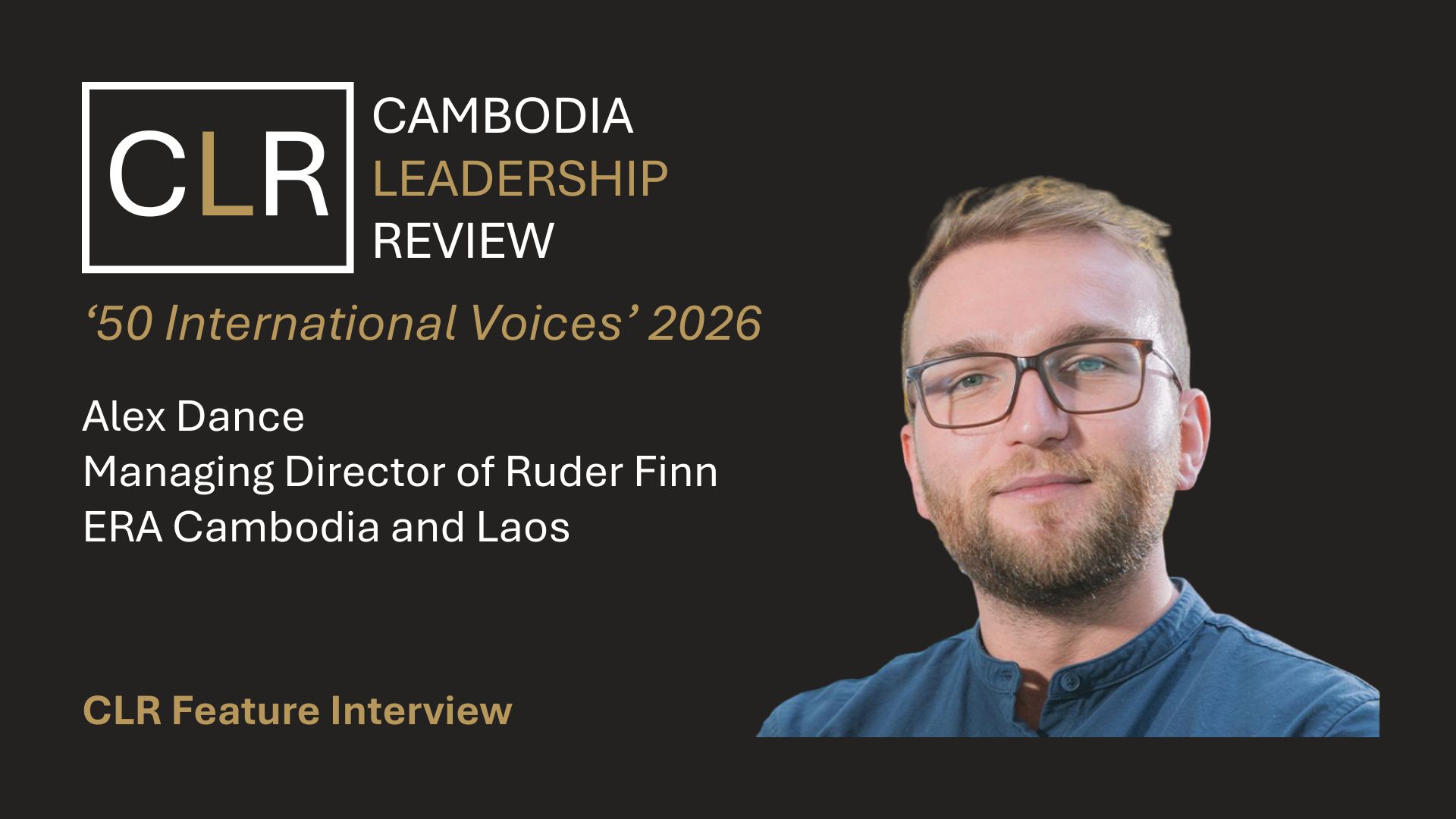
As Managing Director of Ruder Finn ERA Cambodia and Laos, Alex Dance oversees the agency’s operations across the Mekong markets, advising clients on reputation, brand positioning, and stakeholder engagement in increasingly complex business environments. Based in Phnom Penh, he has spent nearly a decade working in Cambodia’s communications and marketing sector, helping organizations navigate media ecosystems, regulatory dynamics, and cross-border growth.
Following the integration of ERA with Ruder Finn, the firm now operates with the backing of a global communications network while maintaining a locally built and Cambodian-led structure. In this interview, Dance reflects on leadership, industry evolution, regional integration, and the future of communications in Cambodia.
Download the 50 International Voices Magazine 2026 here.
Leadership and Style
CLR: As Managing Director of Ruder Finn ERA Cambodia, how would you describe your leadership style, and how has leading in Cambodia shaped the way you think about teams, decision-making, and long-term growth?
My leadership style is centered on building a specific cultural chemistry. I’ve moved away from standard recruitment toward hand-selecting individuals who contribute to a high-energy, cohesive environment. Clients in this region are increasingly looking for teams that are not only knowledgeable but also culturally attuned and dynamic; to deliver that, I focus on ensuring the team is supported and given the genuine freedom to make decisions, and the psychological safety to make mistakes.
Working in Cambodia over the last nine years has fundamentally changed my approach to decision-making. It has taught me that sustainable growth doesn’t come from a rigid top-down strategy, but from the ability to listen to the people on the ground. This philosophy will be central as I take on my expanded responsibilities across Laos, where we are clustering our Cambodia and Laos offices to create a more unified Mekong presence. By trusting our local teams to experiment and identifying what truly resonates in these unique markets, we ensure our growth is organic, resilient, and deeply rooted in local expertise.
The Public Relations Industry in Cambodia
CLR: From your perspective, how is Cambodia’s public relations and communications industry evolving, particularly as businesses become more sophisticated, digital-first, and increasingly focused on reputation, trust, and stakeholder engagement?
The most significant shift over the past year is the transition from a transactional media landscape to one where trust is the primary currency. In a market saturated with content and rising misinformation, businesses are finding themselves ill-equipped to manage reputational threats. Looking toward 2026, I believe two major shifts will define how brands succeed.
First, we are seeing the rise of Generative Engine Optimization. The search landscape has changed; consumers now ask AI for direct recommendations, such as the best schools or services in Phnom Penh. If a brand does not surface in those top recommendations, they become invisible. Our focus is on ensuring brands are referenced by the high-authority sources these models rely on.
Second, there is a necessary move toward proactive crisis management. Misinformation travels faster than ever, yet many businesses lack the protocols to handle a digital crisis. In 2026, we will see a surge in demand for “always-on” reputation management. PR is no longer a reactive tool to be used only when things go poorly. It must be a continuous investment that builds the muscle memory teams need to navigate issues and protect their brand’s integrity in real time.
The Ruder Finn x ERA Merger
CLR: What was the strategic thinking behind the merger of ERA and Ruder Finn in Cambodia, and how does the combined platform change the way you support clients locally while connecting them to regional and global communications capabilities?
The strategic intent was to bridge the gap between world-class resources and local execution. Unlike the traditional model of importing consultants, our team has been built from the ground up in Phnom Penh. We remain a Cambodian-led agency, but we are now backed by 75 years of global experience and the infrastructure of a pan-Asian network.
With direct offices in key hubs such as Singapore, Malaysia, Indonesia, and China, we are positioned to support the increasing flow of regional business. Many of our clients operate across the Mekong and wider Southeast Asia, with leadership often based in regional hubs. Traditionally, these leaders had to manage a fragmented roster of multiple agencies.
By leveraging this expanded reach, we provide a single point of coordination for the entire region. This ensures that quality, processes, and brand voice are aligned across every market, while significantly reducing the administrative burden for regional leadership. Whether it is a brand entering Cambodia or a regional player streamlining communications, we offer the agility of a local firm with the scale of a global platform.
Looking Ahead
CLR: Looking forward, what do you see as the key challenges and opportunities for communications leaders in Cambodia over the next few years, and how is Ruder Finn ERA positioning itself to stay relevant as the market and client expectations continue to evolve?
The primary challenge remains the limited talent pool and the competition to retain the best people. We also frequently navigate a landscape of high expectations paired with restricted budgets. Our role is to provide creative, high-impact strategies that prioritize results over volume. I also see a major opportunity for more collaboration among industry peers. Working together helps elevate professional standards across the sector.
Regarding AI, it is often viewed as a threat, but those who think it can replace nuanced communication are mistaken. AI is a tool for efficiency, not a substitute for strategic thinking. Good communicators use it to enhance their work, but authentic, human-led storytelling remains essential.
To stay ahead, we remain focused on staying culturally relevant and continuously reviewing our approach to align with emerging trends. At the core, our investment remains in people — ensuring our teams are equipped to deliver thoughtful, strategic communications in a market that is evolving rapidly.