
Socheata Chey
In the context of Phnom Penh, we must ask an honest question: are we financially and institutionally ready to maintain a large-scale park in the middle of the city? The answer, at least for now, is no. While the vision of a grand Central Park is appealing, we need a more realistic and achievable approach to it. In this opinion piece, I propose a more feasible framework for how Phnom Penh can expand green space at the neighborhood level, drawing from my personal observations and professional experience in both Phnom Penh and New York City.
New York City’s public parks did not become globally admired overnight. They are the result of decades of planning, public–private partnerships, conservancies, and grassroots advocacy. Central Park, for example, is over 160 years old, and the Central Park Conservancy was established more than 45 years ago. They work closely with the City of New York to manage, fund, and maintain the park. This long-term governance structure is a critical factor behind its success.

Everyone Wants a “Central Park”
In a recent online discussion about the retired Phnom Penh International Airport, many residents and social media influencers expressed hope that the site could be transformed into a massive park like Central Park in New York or Hyde Park in London. While this desire reflects a growing civic awareness and demand for public space, it also risks oversimplifying the realities behind such projects.

Phnom Penh does need more public space, especially for children and families. Numerous studies have shown that parks contribute to cultural life, social cohesion, physical health, and overall well-being. However, large-scale parks also require long-term funding for maintenance, security, operations, and programming. In a city where resources are limited, these complexities cannot be ignored. If we aim to improve public space quality, we must explore alternative and more distributed ways to bring greenery into the city.


Phnom Penh’s Public Space
When residents think about public spaces in Phnom Penh, places such as Wat Botum, Wat Phnom, Riverside Park, and Olympic Stadium often come to mind. Many of these spaces were developed in the 1960s as visual elements of the urban landscape rather than as fully equipped recreational parks. Despite this, residents have creatively adapted them for handball, soccer, group dancing, and picnics demonstrating a strong demand for shared public space.


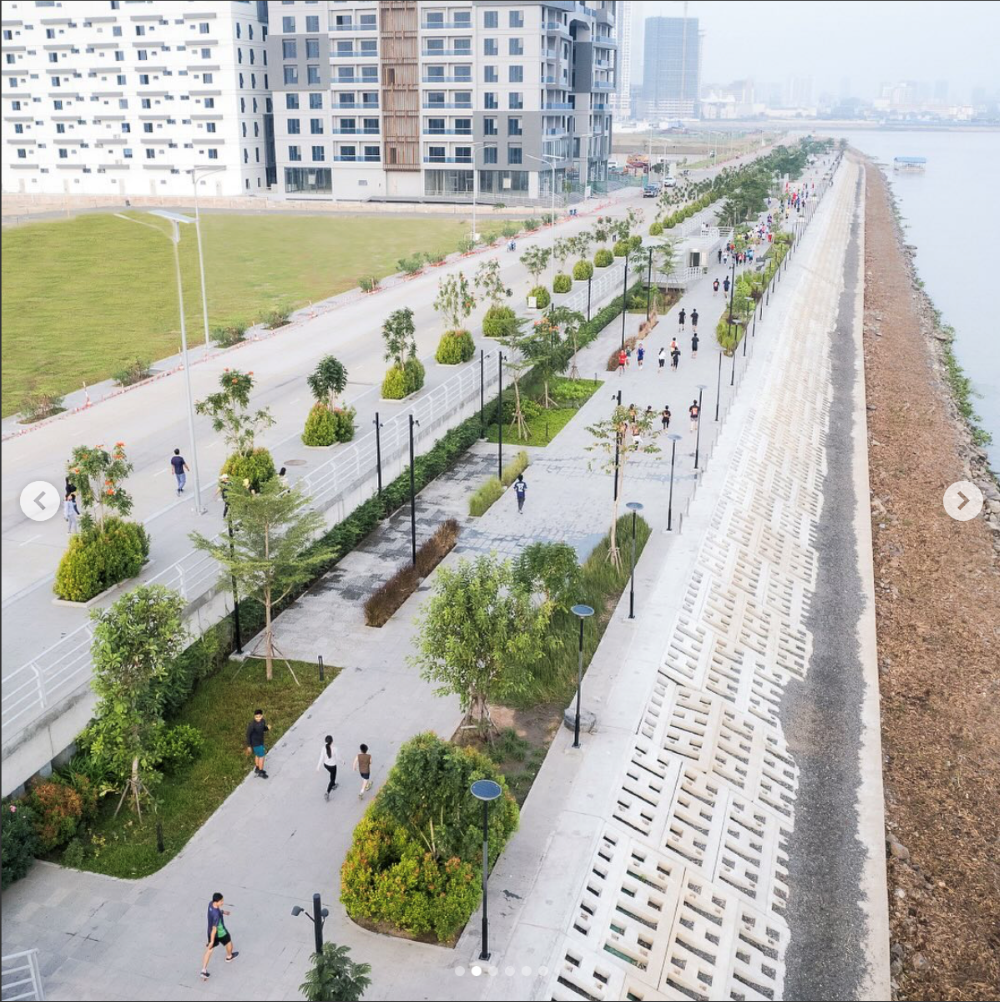
In recent years, new public realm projects such as Koh Norea Park and the Walking Street along the riverside have emerged. Other spaces including the park in front of NagaWorld, Diamond Island Park, Treelion Park, and the Tonle Sap Promenade also hold significant potential. With thoughtful redesign and improved amenities, these areas could become safer, more inclusive, and more functional neighborhood parks.
Use What Is Already There
Creating effective public space does not require monumental scale or prime locations. Instead, it should focus on where communities need it most. The “15-minute city” concept, introduced by urbanist Carlos Moreno, emphasizes that residents’ daily needs should be accessible within a 15-minute walk or bike ride from home. From this perspective, medium-sized and pocket parks can serve more people than a single, centralized park.
Vacant lots in each district could be converted into community gardens or small open spaces with seating for local gatherings. Abandoned railway corridors, areas beneath elevated highways, or spaces under bridges could be transformed into skate parks, playgrounds, or street art spaces—providing much-needed recreational areas for children and youth while activating underused land.
How Can Phnom Penh Get There?
Currently, most public parks in Phnom Penh are maintained by the municipal government, while some privately owned spaces manage their own operations. If city authorities are serious about expanding the public realm within a dense urban fabric, several practical strategies could be pursued.
Using streets as public space is one proven model. The Walking Street along the riverside demonstrates how temporarily closing streets to traffic can foster community life, support small businesses, and create safer spaces for children. This approach could be replicated in neighborhoods such as Boeung Kak, Tumpong, and Sen Sok, helping to decentralize activity from the riverside while strengthening local identity.

Vacant lots as pocket parks or community gardens are another opportunity. Many unused parcels across the city could be temporarily or permanently allocated for community use. In New York City, for example, community gardens are often managed by volunteers, schools, or youth organizations with light oversight from the city. A similar policy framework in Phnom Penh could turn empty land into meaningful shared space.

Public–private partnerships also deserve serious consideration. While this model is still relatively unfamiliar in Cambodia, it has proven effective elsewhere. Bryant Park in New York is publicly owned but privately managed through a nonprofit corporation and a business improvement district, with revenue generated through events and sponsorships. A locally adapted version of this model could encourage long-term private-sector involvement beyond short-term event sponsorships.
Finally, supporting grassroots and youth initiatives is essential for building civic ownership. Phnom Penh could establish annual grants that allow students and community groups to propose and implement small-scale projects in their neighborhoods. With 14 districts in the city, friendly competition and modest funding could spark creative programs related to sports, arts, or food, while empowering young people to shape their own urban environment.
A More Realistic Vision
Phnom Penh does not need a Central Park to become greener. What it needs is a network of well-distributed, well-maintained, and community-driven public spaces. By focusing on neighborhoods, leveraging underused land, and fostering partnerships between government, citizens, and the private sector, the city can create a more inclusive and livable urban future – one small park at a time.
Socheata Chey is an architectural designer and urban planner based in Phnom Penh City, Cambodia. She holds a Master’s degree in Design and Urban Ecologies from Parsons School of Design in New York City, USA.