

CIR Explainer
As Cambodia’s bond market develops, an unfamiliar financial term offers a familiar proposition: lend money today, receive an agreed return, and get your money back at a specified date.
For a Cambodian household with money to set aside, deciding where to put it can be difficult.
Cash is easy to reach when an emergency arrives. Bank deposits can earn interest. Gold offers something tangible to hold. Property may promise growth, but usually requires substantial money and patience. Shares offer another opportunity, with prices that can rise or fall.
Between keeping savings readily available and pursuing investments with uncertain returns, bonds offer another choice: lending under written terms, with a defined repayment date and, often, scheduled interest payments.
That choice is becoming more relevant in Cambodia. The country began its modern domestic government securities programme in September 2022, and the Ministry of Economy and Finance has published an issuance plan for 2026 covering maturities from one to 15 years. Bonds are already part of the financial landscape, rather than simply an idea for the future.
For everyday savers, the question is straightforward: what does a bond actually do, and when might it make sense?
A familiar idea with written rules
A bond is a form of borrowing. A government or company raises money by issuing bonds, and investors who buy them become lenders.
The bond’s terms explain how much interest is payable, when payments are due and when the original investment—known as the principal—is to be repaid. That repayment date is called maturity.
Consider a simplified example. Someone buys a three-year bond at its face value of one million riel, paying fixed interest of 5% annually. The investor would receive 50,000 riel each year and the original one million riel at the end of the third year, assuming the issuer makes every payment. Taxes and fees could reduce the amount received.
This is an illustration, not a current investment offer. Actual bonds have different rates, payment schedules and conditions.
The underlying idea may feel familiar. Lending money to a relative for a motorbike, or participating in a tontine, known locally as តុងទីន, involves providing money now with an expectation about what happens later.
These arrangements are not identical to bonds. A tontine pools and distributes contributions according to its own rules; a wedding envelope belongs to a social relationship rather than an investment contract. But they provide a useful starting point for understanding money, time and trust.
A bond turns a lending arrangement into a formal financial instrument. Instead of relying primarily on a personal relationship, the investor assesses an issuer, written obligations and financial disclosures.
What sits in the “middle”?
The appeal of a fixed-rate bond is the visibility of its promised payments.
A shareholder owns part of a company. Dividends depend on company decisions and performance, while the share price changes with the market. A bondholder lends to the issuer and has contractual payment terms.
For someone saving toward an expense several years away, that schedule can help with planning.
Yet describing bonds as the missing middle requires care. Bank fixed deposits already offer agreed interest over a defined period. Gold and property carry their own risks. Bonds expand the available choices; they do not automatically outperform the alternatives.
Nor does a repayment schedule guarantee repayment.
A company may struggle to pay interest or return principal. Government bonds also carry risks. If an investor needs to sell before maturity, the price may be below the amount originally paid, and a buyer may not be available immediately. Inflation can reduce the purchasing power of future payments, while currency movements matter when the investment and household expenses are in different currencies.
The useful distinction is predictability of the agreed terms. Whether those terms are fulfilled depends on the issuer’s ability to pay.
Cambodia’s market is taking shape
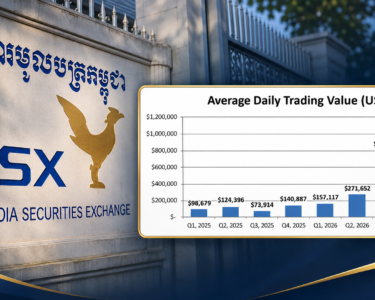
Cambodia’s bond market now includes both government borrowing and corporate debt listed on the Cambodia Securities Exchange, or CSX. Corporate issuers include financial institutions and businesses outside the financial sector, with different interest rates and structures.
The market is also developing beyond conventional borrowing. In May 2026, the Securities and Exchange Regulator of Cambodia, or SERC, and the United Nations Development Programme launched detailed guidance for green, social and sustainability bonds. Such instruments connect fundraising with specified environmental or social purposes.
According to background information supplied for this article, Royal Group Securities is working with SERC to improve public awareness and understanding of bond investment.
That educational effort addresses a practical gap. Having more bonds available does not mean households automatically understand how to compare them, assess repayment risk or find an investment they are eligible to buy.
Why 2026 matters
Tax incentives provide a timely reason to learn more.
A Ministry of Economy and Finance notification dated July 21, 2026 sets out incentives for government securities issued in 2026. These include an income-tax exemption on interest, a 50% reduction in applicable withholding tax on interest, and a capital-gains-tax exemption on purchases and trading. For resident taxpayers, the stated withholding rate falls from 6% to 3%; for non-residents, from 14% to 7%.
The distinction matters: an income-tax exemption does not mean every investor receives interest without any withholding.
These incentives are tied to qualifying government securities issued in 2026. Readers should check the rules for the particular bond and their own tax status, rather than assume every corporate or government bond receives identical treatment.
A tax benefit can improve the return an investor keeps. It does not change the issuer’s obligation—or ability—to repay.
What should a saver check?
Before buying, a prospective investor should understand a few basic points:
- Who owes the money? A government and a company have different financial positions. Regulation and listing do not themselves guarantee repayment.
- What will be paid, and when? Check the interest rate, payment dates, maturity and any conditions allowing early repayment.
- Can the money stay invested? Selling early may involve a loss or a wait for a buyer.
- What is the return after costs? Taxes, fees and the purchase price affect what the investor actually earns.
- Can an individual buy this issue? Minimum investments, eligibility and access arrangements vary. A licensed securities firm can explain the requirements.
Investors should also read the offering documents and understand any collateral or guarantee. A guarantee has specific terms; the word alone does not explain its protection.
From personal trust to informed trust
The strongest case for bonds in Cambodia begins with understanding, not a promise of easy returns.
Many households already recognise the basic logic of lending: provide money today, agree on repayment and wait. Formal bonds make those obligations clearer and give investors information they can examine before committing their savings.
The next step is learning how to judge that information.
For some savers, a suitable bond could provide scheduled income and help fund a future goal. For others, a deposit or readily accessible savings may better match their needs.
As Cambodia’s market develops, bonds can give households one more way to put savings to work. Their place in the missing middle will depend on whether ordinary investors can understand both the promised return and the risk behind it.