
The dependence on fossil fuels makes our daily lives hostage to distant wars like the escalating conflict in Iran. Iran’s declaration to close the Strait of Hormuz sent a shockwave to the global economy and caused the price of oil and gas to increase in every part of the world.
Despite the geographic distance, Cambodia becomes an energy hostage to volatile supply chains.
The surge of fuel prices affects every farmer’s tractor, every delivery driver’s motorbike, households, road users and across all sectors.
However, there are ways to escape this cycle of global energy crisis and geopolitical anxiety. The green exit offers Cambodia a permanent shield against the global market shocks.
In economic terms, when demand increases while supply remains constant, it pushes the prices up. This is the scenario unfolding today. The United States and Israel’s war with Iran has spilled over into the strait, causing disruption in the global oil and energy supply, which is beyond our control.
In January, Cambodia’s total imports of such fuels reached $220 million according to the Ministry of Commerce, a surge of 1.6 percent over the same period last year.
This surge is largely driven by the expanding and growing activities such as in the industrial sector and logistics, machinery use in construction and infrastructure development, and growing use of domestic vehicles.
It signals a robust and expanding economy but acts as a double-edge sword for a nation vulnerable to volatility in global energy markets.
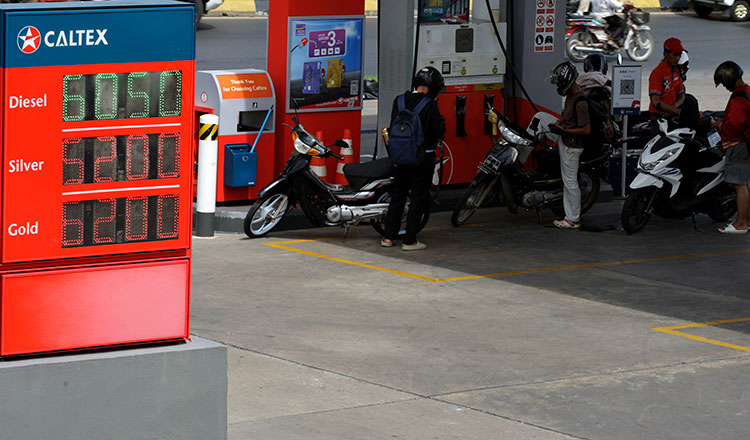
The situation reached a breaking point this week as the escalation in Iran tested our energy security. On 10 March, the price of oil increased by 800 riel for gasoline, and 900 riel for diesel from 11 to 13th March, the Ministry of Commerce saidt.
This inflationary pressure serves as a reminder that the high import costs are not isolated factors. They cause a rippling economic crisis that erodes industrial output, tears the margins of logistics providers, and places an unsustainable financial burden on every family and farmer.
The Green Exit: A Strategy for Sovereignty
In the current climate, the government has authorized a subsidy to help citizens from oil prices. This might serve for a short term in helping citizens from financial burden during this energy crisis.
Green Exit is an alternative tool, and is strategic and practical for energy sovereignty. Green exit, exit from dependence, offers a permanent shield against global market shocks and provides climate resilience. It encompasses climate-positive energy, infrastructure, mobility and lifestyle.
The transition to renewable energy moves power production from foreign territories to Cambodian soil, which promotes not only green energy transition, but also investment, pushing more commercial presence in the nation.
In Cambodia, between 2019 and 2022, about half of Cambodia’s electricity was generated from renewable energy, including 44% from hydropower and 6% from solar.
In recent years, there have been many more energy projects in the nation such in Koh Kong, Prey Veng, Pursat, and a solar farm in Battambang.
The number shows that Cambodia is significantly reaching its 70 percent clean energy target by 2030 as the nation is committed.
As evidenced by the Ministry of Mines and Energy, during the EAC’s annual meeting, Cambodia was reaching more than 63 percent of clean energy in 2025, the second highest clean energy rate in ASEAN.
This phenomenon has opened doors for switching from gas-powered vehicles to electric vehicles (EV). By September 2025, there were 10,568 electric vehicles registered in Cambodia, including cars, tricycles and motorcycles. This reached 12,968 by the end of 2025, according to officials.
These are small numbers out of Cambodia’s 17 million population but we are on the right track for energy security.
The sun and wind cannot be blocked by a maritime blockade or a foreign declaration of war. Green energy from solar panels continues for decades.
It will redefine our national mobility. By incentivizing the shift to EVs and equipping electric-powered public transit, Cambodia will effectively plug its logistics sector into the sun.
For the delivery drivers or riders in Phnom Penh or the farmers in the provinces, an EV represents a fixed cost — predictable and shielded from the whims of a general in a distant land.
Instead of navigating the rising costs and congestion of private car usage, road users can embrace efficient public transport as an economical, smarter, and more sustainable alternative. For a tuk-tuk driver, switching to an EV will reduce operating costs in comparison to gasoline.
Expand Green Infrastructure
Instead of sending millions of dollars out of the country every month, costs should be cut and the money kept inside Cambodia to improve and expand green infrastructure, which facilitates the nation’s mobility.
According to the Ministry of Public Works and Transport Cambodia, Cambodia aims to exceed 770,000 electric vehicles by 2030.
This growth demands more charging stations. As now, in accordance with the Ministry of Mines and Energy, we have the order on Principles and Procedures for Governing and Regulating the Development and Provision of Electric Vehicle Charging Services (No. 0389), aiming to establish the framework for the safe, sufficient, and effective development of charging infrastructure.
This is the right path for encouraging Cambodian households to switch to EVs. In addition, infrastructure development should also be friendly to public transport users as in France, Norway and Luxembourg.
The vulnerability of our tractors, motorbikes and factories to a conflict in Iran is not merely an economic hurdle, but it is a national security flaw.
The Green Exit is a strategic fortress that moves from a nation at the mercy of global tremors to a kingdom of self-reliance. It does not only improve the energy friendly supply to Cambodians, but is also stepping forward to climate resilience.
Sithan Silida is a graduate student specializing in International Economics at the Institute for International Studies and Public Policy.