
Arnoud Darc
The border explains the shock. It does not explain why we keep measuring the wrong thing.
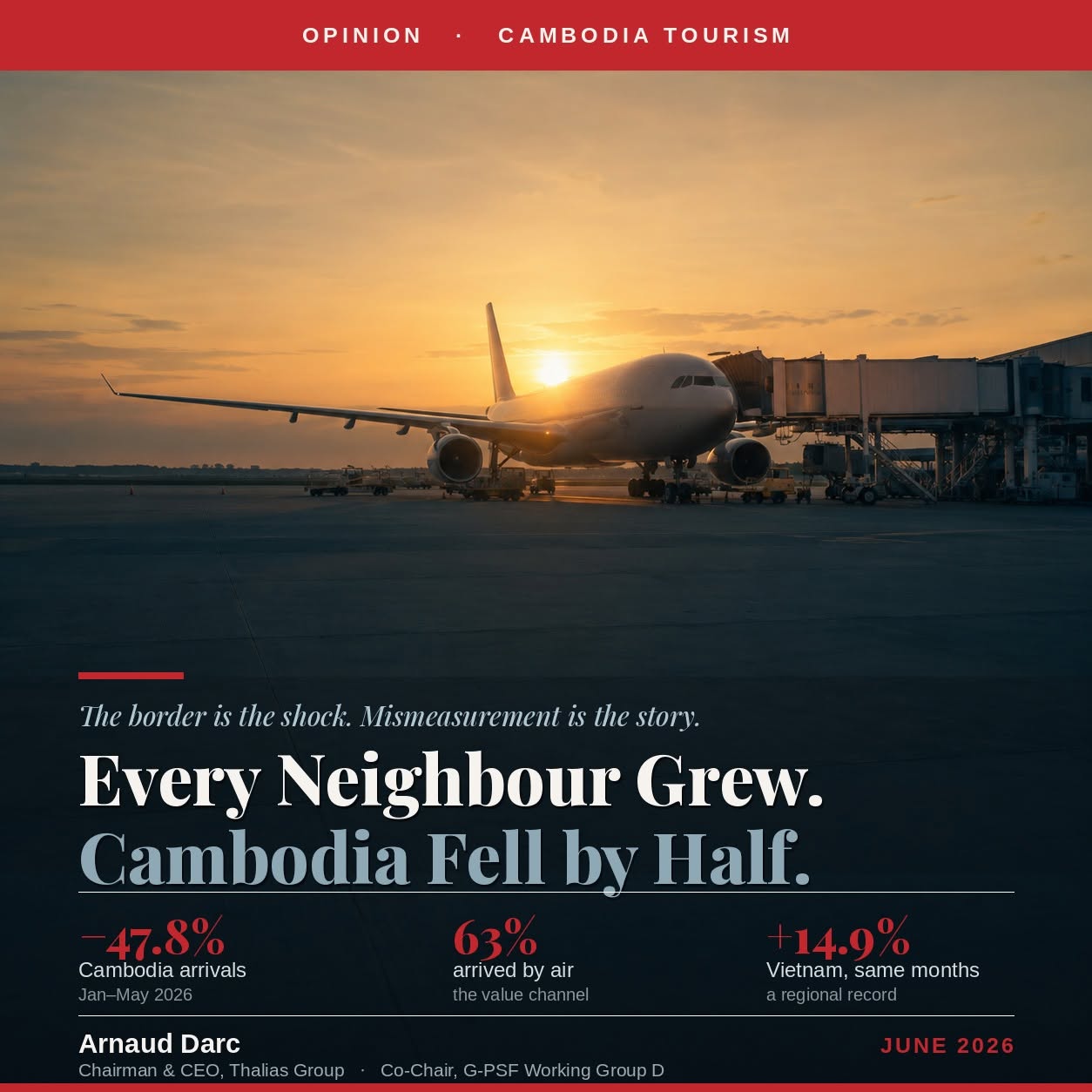
In the first five months of 2026, every one of Cambodia’s neighbours saw international tourism hold steady or grow. Vietnam set a record, up 14.9 percent. Thailand was almost flat, down 2.3 percent. Laos, in the first quarter, grew 8 percent. Cambodia stood alone: international arrivals fell 47.8 percent, to 1.54 million, according to the Ministry of Tourism’s own monthly reports.
That is not a rounding error. It is the steepest decline in the region, and it deserves an honest conversation rather than a reassuring one.
The proximate cause is no secret. The closure of the land border with Thailand removed, almost overnight, Cambodia’s single largest source of arrivals. Thai arrivals fell 96.2 percent; Lao arrivals, also mostly overland, fell 91.4 percent. Land crossings, which only a year earlier had carried more visitors than air, collapsed by more than two-thirds. When you lose your biggest channel, the headline falls hard.
But the border is the shock, not the underlying story — and the underlying story is one we have been avoiding for years.
Cambodia’s celebrated tourism “recovery” was, to a large degree, a statistical illusion. The 6.7 million arrivals reported in 2024 — narrowly above 2019 — rested on a near-doubling of land-border crossings. The part of tourism that actually builds an economy, air arrivals, never came back: even before the 2026 closure it was running at barely half its 2019 level, and in the first five months of 2026 it fell a further 19.8 percent.
This is the heart of the matter: Cambodia measures the wrong thing. We count arrivals, and an arrival is an arrival — a day-tripper crossing at Poipet and a French couple flying in for a week at Angkor each count as exactly one. So we manage to the number we publish, and the number we publish flatters us. Volume is easy to celebrate. Value is what pays the wages.
Read through a value lens, the data say something more useful — though here we meet a real limitation. Cambodia publishes no monthly figures for receipts, length of stay or yield, so the air-versus-land split is the best available proxy for value, and that gap is itself part of the problem. On that proxy: 975,769 visitors — about 63 percent of the total — arrived by air, the longer-staying, higher-spending guests. The markets that held on are the high-value ones: the United States, Australia, the United Kingdom and France fell by only 10 to 16 percent, against a regional collapse. Those four are roughly a quarter of a million visitors — one in six arrivals, but almost certainly a far larger share of what the sector earns.
The fragility lies elsewhere, and the channel data sharpen it. China and Vietnam now make up more than half of all arrivals, yet the two behave very differently — Chinese visitors come almost entirely by air, while a large share of Vietnamese traffic crosses overland. A dependence on two markets is risk enough; a dependence split across the very channel we most need to grow is riskier still. And the near-60 percent fall in Korean visitors, far steeper than Korea’s softness elsewhere in the region, is a warning that confidence and reputation, not only borders, are now at stake. The distinction matters for policy: the land collapse will reverse when the border reopens; the air gap will not.
None of this is an argument for pessimism. It is an argument for honesty — and honesty points to a clear path.
First, measure what matters. The Ministry publishes arrivals every month, but not receipts, length of stay or yield — the very figures an argument about value needs. A country cannot manage value if it only counts heads; that data should sit beside the arrivals figure every month.
Second, defend and grow the air channel. Connectivity to and from Phnom Penh and Siem Reap is the single highest-return lever Cambodia has; the markets that proved resilient can only be reached by plane.
Third, diversify. A tourism economy resting on two regional markets is one disruption away from exactly the position we are in today. India, Australia, Korea, Japan, the Gulf and Europe are all within reach with the right routes and the right message — and the goal is not more visitors at any cost, but the right visitors, reliably.
Fourth, protect confidence. Visitors choose destinations they trust. The Korean numbers tell us that perception is already costing us real arrivals; restoring confidence is now a commercial priority, not a public-relations afterthought.
Cambodia holds assets the rest of the region would envy: Angkor, a coastline, a deep and living culture, and a hospitality workforce that has rebuilt this industry once already. The question is not whether visitors will return. It is whether we will compete for the visitors worth having — or keep congratulating ourselves on a number that conceals more than it reveals.
The 2026 figures are hard to read. But difficult numbers, read honestly, are worth more than comfortable ones. They are telling us, plainly, where to go next. We should listen.
————————————————————–
Arnaud Darc is the founder and chief executive of Thalias Hospitality Group, President of the Cambodia Restaurant Association, and a co-chair of Working Group D (Tourism, Hospitality and Gastronomy) of the Government–Private Sector Forum.
Sources (all figures): Ministry of Tourism of Cambodia — Tourism Statistics Reports, January–May 2026 and 2025 Annual Report; Ministry of Tourism and Sports of Thailand (Jan–May 2026); National Statistics Office of Vietnam / GSO (Jan–May 2026); Ministry of Information, Culture and Tourism of Lao PDR (Q1 2026).