
Cambodia Leadership Review
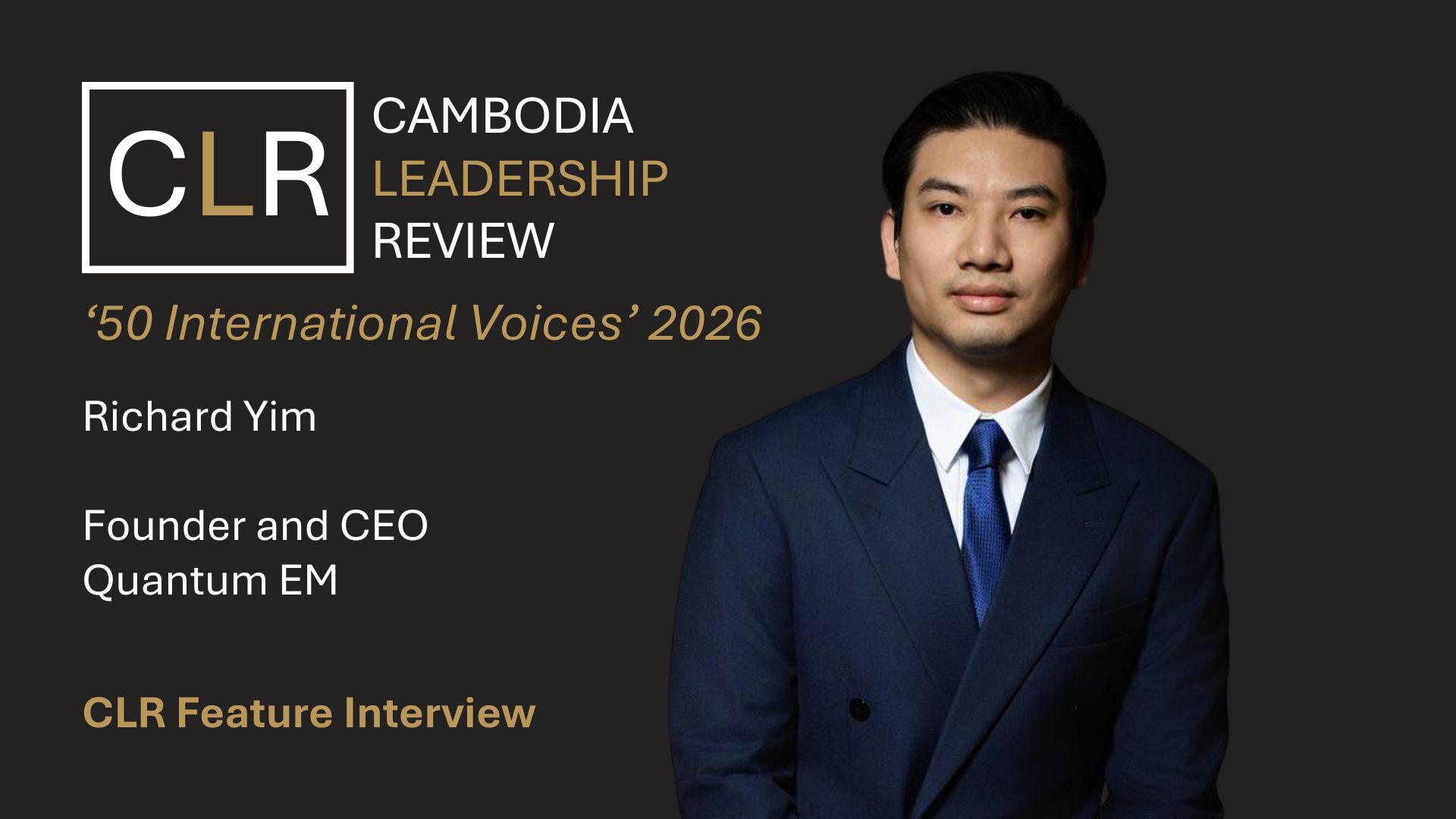
Richard Yim is the Founder and Chief Executive Officer of Quantum Engineering and Manufacturing, a Cambodian-based advanced engineering company built from the ground up to serve industrial, infrastructure, and agro-processing sectors. After studying and working abroad, Yim returned to Cambodia with a clear ambition: to help establish the country’s missing industrial backbone through locally developed engineering capability.
Since its founding in 2020, Quantum has grown into a fully integrated manufacturing facility with over 50 staff and more than 30 machines, including over 20 CNC machines. Serving clients ranging from multinational manufacturers to local conglomerates, the company operates across customised machinery, precision parts, architectural metal fabrication, and agro-processing systems.
In this interview, Yim reflects on leadership, redefining “Made in Cambodia,” industrial capability-building, and his long-term vision for positioning Cambodia as a credible regional manufacturing hub.
Leadership, Vision, and Building from Scratch
CLR: You returned to Cambodia after studying and working abroad to build Quantum Engineering and Manufacturing from the ground up, entering a space that barely existed locally at the time. How would you describe your leadership philosophy, and what convinced you Cambodia was ready for advanced engineering and manufacturing capability?
I believe leadership is about building people up, giving them real ownership, and creating a culture where taking calculated risks is normal. When you build a company in an industry that barely existed locally, you cannot wait for the ecosystem to catch up. You have to create capability yourself, and that requires a team willing to experiment, learn quickly, and improve through real projects.
Read More: E144: Richard Yim on Tariffs, Startup Reforms, and Sector Growth in Cambodia (VIDEO)v
At Quantum, I try to lead by trusting engineers with responsibility early, staying close to the details when it matters, and investing in systems that make quality and execution more consistent.
I came back to Cambodia because I felt a responsibility to help build something the country genuinely needs. Cambodia has talent and ambition, but the industrial backbone has historically been limited. If we want better jobs, stronger productivity, and a more resilient economy, we need real engineering and manufacturing capability inside the country. That type of work compounds over time. It builds skills, suppliers, and long-term capacity for the next generation.
What convinced me Cambodia was ready is the direction of the economy. Foreign investment is increasing, and global supply chains are diversifying. As more industrial players establish operations here, demand shifts from low-cost labour toward engineering response time, maintenance capability, and local problem-solving. Importing everything works until something breaks. Downtime becomes expensive, and reliability becomes critical. If Cambodia aims to move toward higher-value production, local capability must grow alongside factory investment. That is the gap Quantum is addressing.
Redefining “Made in Cambodia” Through Engineering and Innovation
CLR: Quantum works across customised machinery, fabrication, and product development. How do you build trust in Cambodian-made engineering, and what needs to change to strengthen local competitiveness?
Building trust is the hardest part because Cambodia is not yet widely associated with precision engineering. Trust must be earned through consistency. Most relationships begin with small scopes. We deliver, respond quickly to issues, remain reliable, and gradually earn the opportunity to take on more complex work.
In manufacturing, reputation is built in quiet moments: meeting deadlines, maintaining stable quality, and showing up when problems arise.
Quantum operates as a fully integrated manufacturing facility with divisions covering machinery and parts, steel infrastructure, and agro-processing systems. Bringing processes in-house allows us to control quality, maintain predictable timelines, and reduce dependency risks. When we design and build end-to-end, we manage interfaces between machining, fabrication, assembly, and finishing without losing quality in transition.
Over time, track record speaks louder than perception. Since 2020, we have served demanding clients including Toyota, Denso, Minebea, Chip Mong Group, and Provida. That does not mean we are finished, but it demonstrates that Cambodian-based engineering can meet rigorous standards when execution is disciplined.
To strengthen competitiveness, three areas must evolve: mindset, procurement, and policy. Companies must see local supply chain development as capability-building rather than charity. Procurement systems should be transparent and performance-based so local suppliers can compete fairly. From a policy perspective, predictability in tax and compliance frameworks is more valuable than broad incentives. Reducing uncertainty enables SMEs to invest confidently.
Technology, Talent, and Cross-Sector Impact
CLR: Your career spans advanced robotics, industrial machinery, and social impact engineering. How should collaboration between private sector, education, and government shape Cambodia’s next industrial phase?
Cambodia’s next industrial phase depends on alignment between private sector, education, and government around practical outcomes. Collaboration exists, but mechanisms can become more efficient, especially in talent readiness.
From the private sector side, every project is a learning platform. Designing and building machinery locally develops engineering discipline — documentation, quality control, structured workflows, and precision. We are not only producing hardware; we are building systems thinking into the team.
On the education side, the opportunity lies in shortening the gap between graduation and industry readiness. Even strong graduates require structured, hands-on development before consistently delivering production-quality work. That is not a criticism of students; it reflects systemic misalignment. The fastest improvement happens when curricula, equipment exposure, and industry requirements are tightly integrated.
Government plays a coordination role. Clear standards and transparent procurement processes allow local suppliers to improve and compete fairly. When private sector, education, and policy align, manufacturing becomes more than employment — it becomes a credibility engine for national development.
Looking Ahead: The Future of Manufacturing in Cambodia
CLR: What is your long-term vision for Quantum and for Cambodia’s broader manufacturing ecosystem?
My long-term vision for Quantum is to become a globally credible machinery and advanced manufacturing company while remaining rooted in solving practical problems for Cambodia and the ASEAN region. Cambodia should not aim to remain purely a low-cost production base. It should aim to be a place where serious engineering work is done and where industrial capability compounds over time.
For Quantum, our strategy is to strengthen our fully integrated model. Designing and building end-to-end systems in-house allows us to maintain quality consistency and delivery reliability. We are investing in automation, robotics cells, and advanced machining where it creates real operational value.
Innovation must remain practical. The goal is not to chase trends but to build systems that reduce bottlenecks, increase reliability, and support long-term client operations. We are expanding in areas where Cambodia and ASEAN have real demand, including industrial machinery and agro-processing systems such as pyrolysis and shredding technologies.
Quantum has remained relatively quiet since inception, focusing on capability-building. Now, as Cambodia enters a new industrial phase, we are ready to demonstrate that the country can build, not only assemble.
True industrial credibility is earned over time, and our objective is to contribute to that long-term transformation.