
By Kon Veasna and Meak Loemheak
Cambodia is navigating an uneasy moment. Global instability, economic fragmentation, and the lingering trauma of past conflict continue to shape national life. In such times, no intellectual, educator, or policymaker can afford indifference—especially when the country’s fragile peace and future depend so deeply on education. Yet across rural Cambodia, classrooms remain places of quiet struggle, where systemic barriers persist despite years of reform and good intentions.
Education leaders, researchers, and the Ministry of Education, Youth and Sport (MoEYS) have made genuine efforts to confront these challenges. School directors and teachers, especially in remote areas, carry much of this burden on their shoulders. Still, the gap between policy ambition and classroom reality remains wide.
Recent studies highlight two parallel truths. On one hand, digital technology and artificial intelligence—often framed as solutions—do not benefit all learners equally. Marginalized groups, including students with disabilities, Indigenous communities, low-income families, and rural learners, are frequently left behind. On the other hand, research examining Cambodia’s learning crisis points to more familiar problems: low learning outcomes, high dropout rates, and deep imbalances in teacher distribution, all of which hit rural schools hardest.
These findings resonate strongly with our lived experience as local educators. But they also raise uncomfortable questions. Why do rural schools continue to shoulder these problems while urban schools and New Generation Schools face them to a far lesser extent? Why have these issues lingered for so long? And which solutions are truly realistic in the Cambodian context?
There is no denying that conditions have improved compared to the past. Teachers’ salaries, for instance, have increased significantly over the past decade, with average monthly pay now hovering around $400. This progress matters. Yet for many teachers—especially those posted far from home, carrying debt, or supporting children and elderly parents—this income is still not enough to ensure a dignified life. Many are forced to take on second jobs or offer private tutoring just to survive.
If we are honest, a teacher’s pay is only one piece of a much larger puzzle.
Rural educators face a daily accumulation of challenges: chronic shortages of qualified teachers, deteriorating infrastructure, oversized classes, heavy teaching loads, declining student discipline, outdated teaching methods, and limited support from parents and communities. School leaders and remaining teachers work tirelessly to keep things afloat, often with little recognition and even fewer resources.
One of the authors of this op-ed, for example, stepped in to teach English to Grade 11 and 12 students—not by choice, but necessity. The school simply lacked qualified English teachers. From a professional standpoint, this is far from ideal. Teaching outside one’s field, particularly a subject as demanding as English, compromises quality. Yet the alternative—doing nothing—would almost certainly doom students’ chances of passing the Baccalauréat II exam. Faced with this dilemma, the decision becomes moral as much as professional.
When students fail English year after year, blame is often placed on teachers or learners themselves. Rarely do we ask the harder question: how can students succeed when their learning environment has already set limits on what is possible?
Why, Then, Do These Challenges Persist?
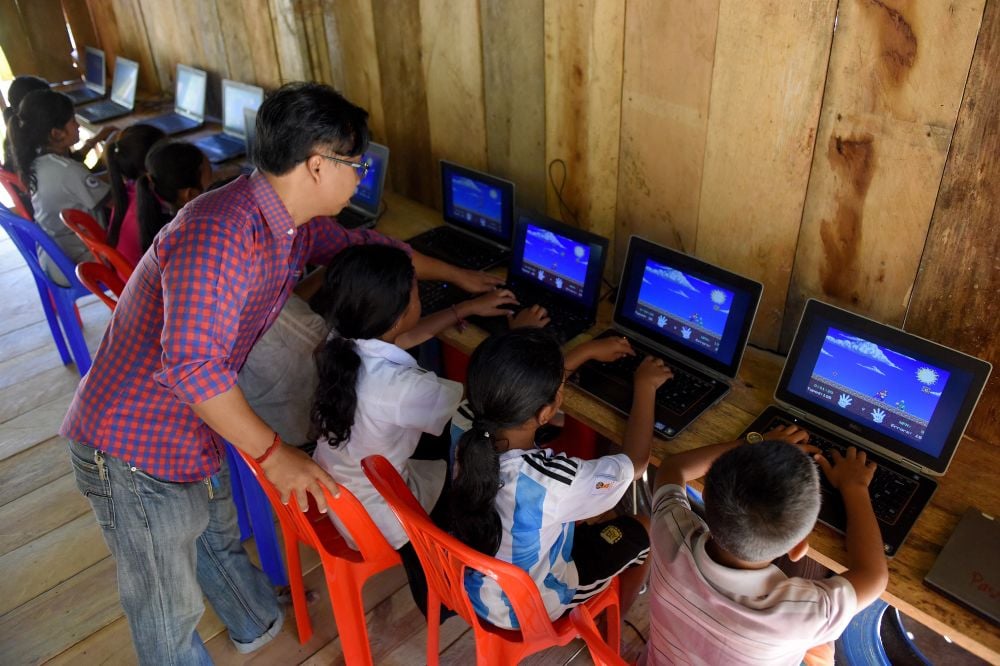
From years of teaching in local schools, one truth stands out: rural education suffers not just from a lack of teachers, but from a lack of the right conditions for teaching and learning. Classrooms are overcrowded. Digital tools are scarce or nonexistent. Professional support is limited. While MoEYS remains deeply involved, the scale of the problem often overwhelms the solutions on offer.
Community engagement is another missing piece. Despite repeated efforts to involve parents and local leaders, participation remains low. This is not only about money. Cultural attitudes, limited awareness, and fixed mindsets play a significant role. Education is still too often seen as the school’s responsibility alone, rather than a shared social project.
These challenges are not isolated. A high school teacher in rural Stung Treng province recently shared an almost identical experience. Despite two years of training in 21st-century teaching methods at the National Institute of Education, he struggles to apply those approaches in real classrooms. Classes are too large. Students are often unmotivated. The physical environment simply does not support student-centered learning.
This raises a critical question: is recruiting more contract teachers really the answer?
To its credit, MoEYS has worked hard to address teacher shortages, particularly in remote areas. Yet many trained teachers are understandably reluctant to leave their families, travel long distances on unsafe roads, or accept postings that strain their quality of life. Contract teachers have been introduced as a stopgap measure, but this approach has limits. Many of these teachers lack sufficient training and require ongoing guidance to teach effectively.
In some cases, schools are forced to borrow teachers across levels—primary teachers teaching secondary classes, or secondary teachers stepping into high school roles. Meanwhile, urban schools often have more teachers than they need. The result is a familiar pattern: teachers migrate toward cities in search of financial stability, leaving rural schools understaffed.
One promising approach has been the joint effort by MoEYS and the Ministry of Civil Service to recruit contract-based teachers locally. Candidates are assigned to provinces they applied for—often their home provinces—and receive weekend pedagogy training while teaching. Because these teachers have local roots, they are more likely to stay, grow professionally, and invest in their schools. While not perfect, this model shows potential.
Still, recruitment alone will not fix rural education. We must ask deeper questions. Are teachers being assigned to the schools they were trained for? Are they staying for the full contract period? Why do so many transfer repeatedly? What conditions push them to leave? These questions demand honest answers.
School leadership also matters. Strong principals can make schools feel like home—places where teachers feel supported, protected, and valued. Leadership training and professional development for school directors should be strengthened, not treated as an afterthought.
Inside the classroom, teachers must also adapt. Overcrowded classes and limited resources are real constraints, but they are not insurmountable. Promoting learner autonomy, using group work, assigning tasks instead of constant lecturing, and building rapport can transform even difficult classrooms. Learning students’ names, encouraging discussion, and showing care go a long way. Teaching, after all, is an art—one that demands flexibility.
Traditional teaching methods still have their place, but they are no longer enough. In an age shaped by digital media, social networks, and rapid change, students crave active, reflective, and collaborative learning. They want to see something new from their teachers—not just repetition from textbooks.
A Call for Action
Improving education in remote areas is not easy. It requires sustained attention from teachers, school leaders, policymakers, and communities alike. Teacher well-being, professional growth, working conditions, and incentives must be taken seriously—not treated as secondary to recruitment numbers.
Education policy makers must also leave their offices and visit remote schools regularly. Without seeing conditions firsthand, meaningful change is impossible. And as the teacher census concludes this year, we hope new policies will emerge—policies that move beyond short-term fixes and address the roots of inequality in Cambodia’s education system.
Rural schools should not be places where ambition quietly fades. With the right support, they can become spaces of resilience, dignity, and possibility—for teachers and students alike.
Kon Veasna earned a Master’s Degree of Education in Mentoring from the National Institute of Education’s New Generation Pedagogical Research Center, Phnom Penh. He is a state English teacher in Siem Reap province. Meak Loemheak holds a Master of Arts in Philosophy from the Royal University of Phnom Penh (RUPP). He is a Moral-Civic Education state high school teacher in Kampong Chhnang Province.