

Cambodia Investment Review
Cambodian health technology company QlinicOS is developing a digital platform to help clinics and hospitals manage patient records, consultations, laboratory results, pharmacy orders and billing in one system.
The platform is designed for facilities where patient information may still be recorded on paper or stored across separate systems. QlinicOS says its software supports Khmer-language registration and National Social Security Fund (NSSF) workflows, with the aim of reducing repeated paperwork and connecting departments during a patient’s visit.
Ansuman Das, founder and CEO of QlinicOS told Cambodia Investment Review that, “doctors and nurses re-entered the same details at every desk, chased lab results between departments, and filled in NSSF forms by hand at the end of the day.”
Das returned to Cambodia in 2022 after eight years in the United Kingdom, where he earned degrees in computer science and international business and worked as a software engineer. He joined his family’s pharmaceutical business, which has operated in Cambodia for more than two decades, and continues to oversee its operations and finance.
His work brought him into regular contact with clinics, hospitals and pharmacies. Das said he saw facilities using software that was often designed for other markets, lacked Khmer-language support or NSSF functions, and was priced for larger healthcare systems.
“As an engineer who knew the sector from the inside, I could see what needed building, so we built QlinicOS here, for how care is delivered here,” he said.

Connecting patient information across departments
QlinicOS is intended to create a shared patient record that can be used across registration, consultation, laboratory, pharmacy and billing. The company says information entered at registration can follow the patient through the facility, reducing the need for staff to copy details between departments.
Read More: Samnangvathana Sor on Driving Digital Health and Public-Private Dialogue
When a doctor orders a laboratory test, the request can be sent directly to the lab, with results returned to the patient’s record. Prescriptions can be sent electronically to the pharmacy, while dispensing and stock information can feed into billing.
The system also supports NSSF eligibility checks during registration and can generate claim forms and reports from the visit record, according to the company.
Many facilities still rely on paper or separate systems that do not exchange information, Das said. That can contribute to longer waits, duplicated administrative work and errors when details are copied by hand. It can also leave managers without reliable data to plan services and operations.
“With a connected platform, a patient’s information is entered once and follows them through the whole visit,” he said.
The company says facilities can adopt the software in stages. A smaller clinic could begin with registration, consultations and pharmacy functions, while a larger hospital could connect more departments over time.
AI designed to support clinicians
QlinicOS also uses artificial intelligence to draft clinical notes and provide decision-support alerts. Das said the system is designed to assist clinicians while leaving medical decisions with them.
“Our principle is ‘judgment-aware automation’: the AI drafts, and the clinician decides,” he said.
After a consultation, the software can prepare a draft note for a doctor to review, edit and approve. QlinicOS says AI-generated material is labelled, and does not enter the patient record without clinician sign-off. The platform can also flag information for a clinician to consider, but Das said it does not diagnose or prescribe independently.
The company says edits and approvals are recorded in an audit trail. Das added that QlinicOS does not promote or prioritise particular suppliers or products, leaving prescribing decisions to clinicians.
“The aim is to give doctors back time with their patients without moving responsibility away from them,” he said. “Clinicians adopt it once they’ve seen it be accurate and safe in their own daily work.”

Early accelerator recognition and pilot offer
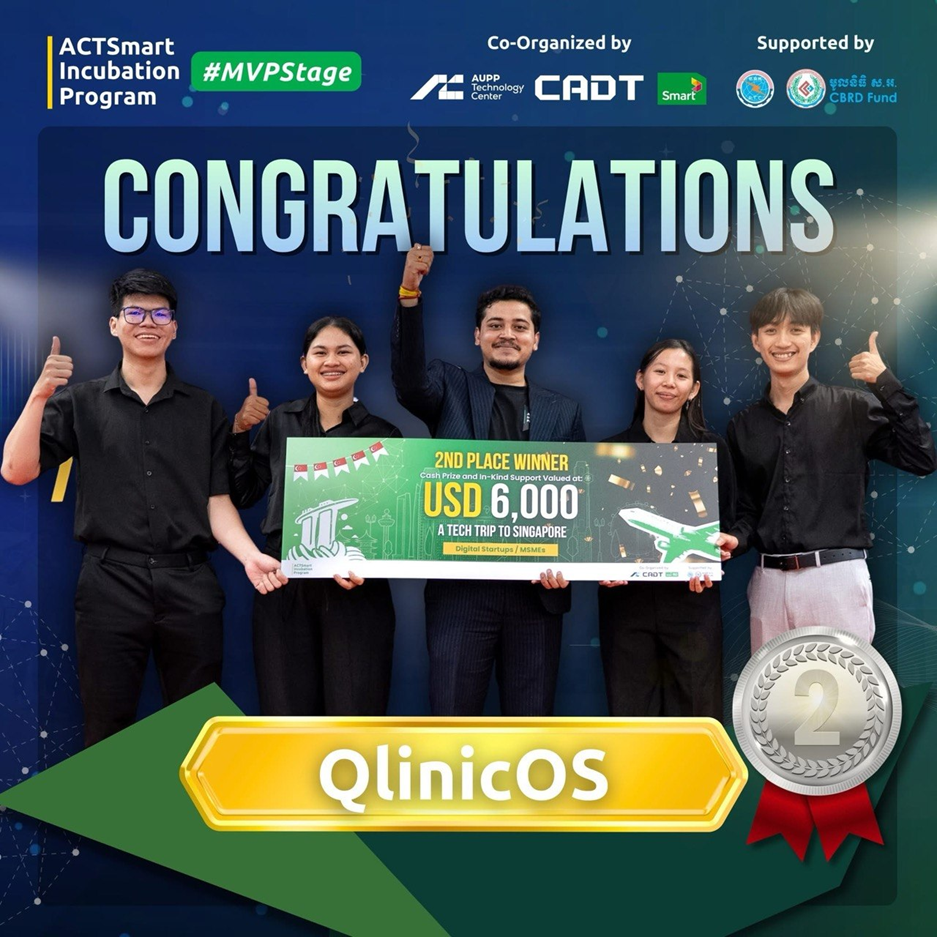
QlinicOS has placed second in the Smart Incubator Program, joined Plug and Play’s Batch 3 in Cambodia and become a member of NVIDIA’s Inception Program. The company says its platform is now used by more than seven healthcare facilities.
Das said the company’s experience has reinforced the importance of focusing on outcomes, training and support, and introducing the software in manageable stages. Clinics are often more interested in shorter waiting times and faster claims than in the number of software features, he said.
QlinicOS is seeking additional clinics, hospitals and partners to test and adopt the platform. It is offering 30 clinics a three-month pilot at their own facilities, including Khmer-language support and on-site training.
Clinics, hospitals and healthcare networks interested in the pilot can contact QlinicOS at info@qlinicos.com, call or Telegram 010 411 102 (+855 10 411 102), or visit qlinicos.com.


