
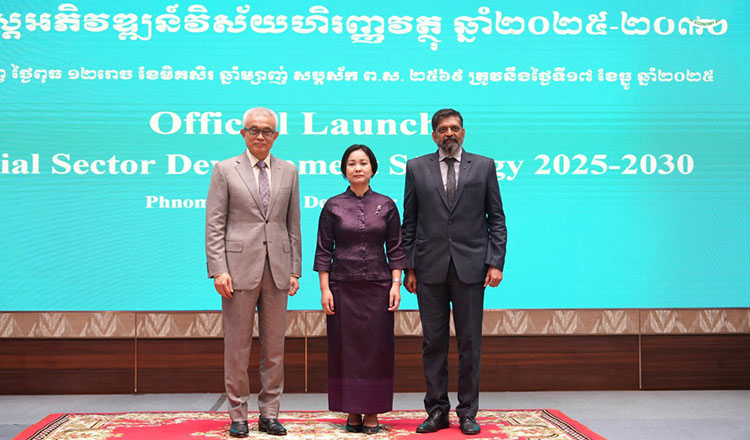
Cambodia has introduced its Financial Sector Development Strategy 2025–2030, laying out a roadmap to reinforce financial stability, deepen capital markets and expand financial access as the country targets around 5 percent economic growth over the next two years. The strategy, developed with technical support from the Asian Development Bank (ADB), was launched in Phnom Penh on Wednesday.
The event was presided over by Aun Pornmoniroth, Deputy Prime Minister and Minister of Economy and Finance, with participation from Chea Serey, Governor of the National Bank of Cambodia (NBC), and Vijay Kumar Akasam, ADB’s Country Operations Head for Cambodia.
Updated roadmap aims to strengthen resilience
Chea Serey said the 2025–2030 strategy marks the fourth update since Cambodia introduced its first financial sector reform plan in 2001. She noted that continuous updates demonstrate the Royal Government’s commitment to building a stable, diversified and modern financial system aligned with the country’s development goals.
Serey highlighted the increasingly unpredictable global environment, shaped by technological disruption, geopolitical tensions and the continued after-effects of the Covid-19 pandemic. While financial technology offers significant opportunities, it also introduces new risks that require a strong regulatory and supervisory foundation.
She added that the pandemic’s impact on supply chains and household incomes continues to influence economic performance globally, underscoring the need for a financial system that can adapt to evolving risks and support Cambodia’s ambition of reaching upper-middle-income status.

Growth outlook remains positive despite external pressures
Pornmoniroth said the new strategy builds on more than two decades of financial sector reform and incorporates contributions from ministries and institutions reflecting regional and global market shifts. The strategy was reviewed by the Economic and Financial Policy Committee before receiving approval from Prime Minister Hun Manet.
Despite the introduction of US tariffs and ongoing border tensions with Thailand, he said Cambodia’s economy remains on a stable recovery path. The government expects economic growth of around 5.2 percent in 2025 and 5.0 percent in 2026.
The Deputy Prime Minister said strengthening the financial sector remains essential for sustaining growth, improving efficiency and maintaining investor confidence across the economy.
ADB outlines six-pillar blueprint for development
ADB representative Vijay Kumar Akasam said the release of the strategy marks a significant milestone for Cambodia’s long-term financial development. He noted that the plan builds on past achievements while preparing the country for a more complex economic environment.
He outlined the strategy’s six interconnected pillars:
- Expanding access to finance for individuals and businesses, especially MSMEs and underserved communities.
- Maintaining financial sector stability through strengthened regulation and improved risk management.
- Enhancing financial market infrastructure and deepening capital markets, including developing local currency bonds and diversifying financial products.
- Harnessing technology to drive digital transformation and promote financial innovation across institutions.
- Promoting sustainable finance by integrating ESG standards and mobilising green investment capital.
- Advancing financial inclusion and strengthening consumer protection to ensure all citizens can participate safely in the financial system.
Akasam said the roadmap reflects a shared commitment between NBC, the government and ADB to build a financial system that is more inclusive, resilient and supportive of Cambodia’s long-term growth.